
In short: if you are a Spanish tax resident, a property abroad goes into your Spanish tax return even if the flat is in Ukraine. The IRPF law taxes your income «with no regard to the place where it was produced» (art. 2). Empty or for your own use, the flat can create imputed income, a calculated income you never receive (art. 85). Rented out, you report the rent (arts. 22 and 23). If you sell it, the gain goes to savings income (arts. 33 to 35 and 46). Tax you already paid abroad can be deducted up to a cap (art. 80). If your property abroad adds up to more than €50,000 of acquisition value, you must also file the Modelo 720.
In person or by representative? The flat has no procedure of its own: it is reported inside the Renta (Modelo 100) and, if it applies to you, in the Modelo 720. How each one is filed, and whether a representative can do it, is explained in the cards on the tax return for foreign residents and on the Modelo 720.
Does this apply to you? Only if you are a Spanish tax resident. A resident reports income from all over the world (art. 2); a non-resident, only what was obtained in Spain. When you become a resident, including if you have temporary protection, is explained in that card and not repeated here. One point from art. 9: migration status is not one of its criteria, what counts is the days in Spain and the center of your interests. Whether Ukraine shares data with Spain does not change this, and we claim nothing about it: the duty comes from being a resident (arts. 2 and 9), not from someone asking you for it.
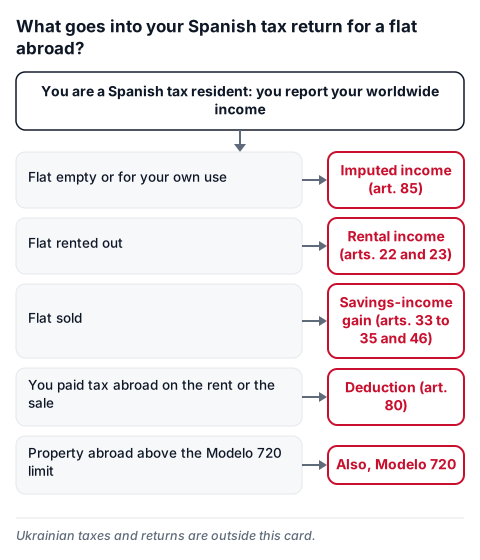
What goes into the tax return, by case
- Empty flat or flat for your own use: imputed income (art. 85), which goes into general income (art. 45).
- Flat rented out: rental income from real estate (arts. 22 and 23).
- Flat sold: capital gain or loss, in savings income (arts. 33 to 35 and 46).
- Tax paid abroad on a rent or a sale: deduction of art. 80, with a cap.
- Property abroad above the Modelo 720 limit: that form as well.
Empty flat or flat for your own use: imputed income (art. 85)
If you do not rent the flat out, you receive nothing, but the law can attribute income to you. It is a calculated income: it is added to your general income and you pay according to your bracket. It is not the tax itself.
Art. 85 leaves out your main home and land with no building. It also leaves out property used in a business activity or that gives you rent (that is taxed as rent), and property under construction or that cannot be used for planning reasons.
For a property with no cadastral value, or one whose value has not been notified to you, the rule of art. 85.1 is this. The percentage is 1.1% and it applies to 50% of the higher of two values. The two values are the one the tax office has verified for other taxes, and the price, consideration or acquisition value of the flat. If you owned the flat for only part of the year, the value is worked out in proportion to the days (art. 85.1). The income is attributed to the owners of the property (art. 85.2), and ownership is decided by the rules and evidence of art. 11.3.
Made-up example, only to show the mechanics: a flat bought for €40,000. 50% is €20,000, and 1.1% of €20,000 is €220 a year. Those €220 are added to your general income. You do not pay €220 in tax: you pay according to your bracket on that amount.
Does it apply to a flat in Ukraine? Yes, and the AEAT says so expressly. Art. 85 does not name property abroad, but the Renta WEB help for the 2025 Renta (section 7.3.5.4, «A disposición de sus titulares») covers the case where the property «estuviera situado en el extranjero» (is located abroad): for the program to calculate the imputation, you enter the result of applying your ownership or usufruct share to 50% of the higher of two values, the one the tax office verified for other taxes or the price, consideration or acquisition value. This is the help for the 2025 Renta: the one for the 2026 Renta, filed in 2027, may differ. The AEAT manual repeats the rule of 1.1% on 50%, and its example uses property in Spain.
Change planned for 2027, repealed. Real Decreto-ley 26/2026 provided for changing art. 85 with effect from 1 January 2027 and applying a scale to the sum of the values of your properties, but Congress repealed it on 2 October 2026 (BOE-A-2026-20526); it does not apply.
Rented flat: the rent in your return
The rent you collect is rental income from real estate. What counts is what the tenant pays for all items, without VAT (art. 22). You subtract the expenses needed to earn it (art. 23.1). They are interest and financing costs, repairs and upkeep, the taxes and fees that meet what that article asks, doubtful debts and third-party services. Depreciation of the property also counts, up to 3% of the higher of the acquisition cost and the cadastral value, not counting the land. Interest and repairs cannot exceed the income of that flat; the excess can be deducted in the next 4 years.
The reductions of art. 23.2 for home rentals are defined with the Spanish tenancy law (LAU) and Law 12/2023. We have not confirmed whether they apply to a rental abroad: it is a case for an adviser.
The tax you pay in Ukraine on that rent can be deducted under art. 80. The smaller of two amounts is deducted: what was paid abroad under a tax identical or analogous to the IRPF or the IRNR, or the result of applying your effective average rate to the part of the base taxed abroad. How it is worked out, which proof to keep and where it goes in Renta WEB: international double taxation deduction. For a flat in Spain: renting out a home and the IRPF.
The 1985 treaty with Ukraine
The Spain-USSR treaty of 1985 applies to Ukraine: the BOE notes that it «currently applies only to Tajikistan and Ukraine». The Hacienda list of treaties (version of 26-05-2026) reflects it. The row for Ukraine refers to note (2), «Ver convenio para evitar la doble imposición entre España y la URSS» (see the Spain-USSR treaty). It has a single date, in the column «Publicación BOCG» (19/02/21), and the column «Publicación BOE» is empty. The 2020 treaty with Ukraine is not in force: the check is in the tax residency card.
If the property is in another country. These Renta rules are the same for any Spanish tax resident, whatever their nationality and wherever the property is (arts. 2 and 8.1.a of the IRPF law). What changes with the country is the double taxation treaty, which says which state may tax the income and how you avoid paying twice, and that country's own taxes. Find yours in the Hacienda list of treaties.
What it means for a flat in Ukraine:
- Ukraine, where the flat is, may tax the rent (art. 10) and the gain on the sale (art. 11.1). The text says «may be taxed» in that State, not «only».
- The treaty does not say Spain leaves that income out. It says Spain, as the State of residence, eliminates double taxation under its own legislation (art. 16). In the IRPF law the mechanism is the deduction of art. 80.
- That is why you report it in Spain and subtract what you paid abroad, up to a cap.
- What the treaty says about the imputed income of an empty flat we have not confirmed: art. 10 speaks of income a resident «obtains» from property.
Flat sold: the gain (arts. 33 to 35 and 46)
If you sell the flat while a Spanish tax resident, the difference between the transfer value and the acquisition value is a capital gain if positive and a loss if negative (art. 34.1). It goes to savings income (art. 46.b).
- Acquisition value (art. 35.1): what you really paid, plus investments and improvements, plus the costs and taxes of the purchase that you paid, without interest. It is reduced by depreciation under the conditions of the regulation.
- Transfer value (art. 35.2): the real amount of the sale, minus the costs and taxes of the sale paid by the seller. What was actually received is used, unless it is below the normal market value: then the market value prevails.
- If you inherited it or it was donated to you: art. 36 says to take the values resulting from the inheritance and gift tax rules, not above market value. Which value applies if there was no official valuation is a question for an adviser.
- Savings income scale: in the state part (art. 66) it is 9.5% up to €6,000, 10.5% up to €50,000, 11.5% up to €200,000, 13.5% up to €300,000 and 15% above. The regional part (art. 76) has the same bands and percentages in the text of the law, so adding both gives 19%, 21%, 23%, 27% and 30%.
Exchange rate. If you bought and sell in hryvnias, both values must be expressed in euros. We have not found a rule in the IRPF law or its regulation that says which exchange rate to use for these cases. The exchange rates the law mentions are for other situations, such as international tax transparency (art. 91). We do not give an invented method: ask a tax adviser and keep the source of every rate you use.
Tax paid in Ukraine on the sale. The deduction of art. 80 covers capital gains obtained and taxed abroad (art. 80.1), with the same cap.
If it was your main home. The gain can be excluded from tax if you reinvest what you collected in a new main home (art. 38.1 of the law and arts. 41 and 41 bis of the IRPF regulation, RD 439/2007). Under the regulation, a main home is one that has been your residence for a continuous period of at least 3 years (art. 41 bis.1), with exceptions when circumstances that force a change of address, such as a job move, justify it. You are treated as selling your main home if it was one at that moment or up to any day in the 2 years before the sale (art. 41 bis.3). The reinvestment must be made within 2 years of the sale, or be a home bought in the 2 years before (art. 41.3). If you reinvest less than the total, only the proportional part is excluded (art. 38.1). We have not found a rule in those articles about the country of the new home: ask an adviser.
Modelo 720
If on 31 December your property abroad adds up to more than €50,000 of acquisition value, all together, you file the Modelo 720. It is filed from 1 January to 31 March of the following year (art. 54 bis of RD 1065/2007). If you sold the flat during the year, it also counts (art. 54 bis.5). It is not a tax: it is an information return. Who files it, the fines and how to do it: Modelo 720.
What this card does not cover
- Ukrainian taxes and returns in Ukraine: whether you must file there, what is paid, what being a resident of Ukraine means. Ask a Ukrainian tax adviser.
- A flat in Spain: owning a home and renting out a home.
- Other taxes that are not the Renta: the wealth tax (Impuesto sobre el Patrimonio), inheritance and gift tax and local taxes in Spain.
- The special regime for impatriates: if you are in it, the rules are different (Beckham law).
What we have not confirmed
- Which exchange rate to use to turn hryvnias into euros.
- Which acquisition value to take for an inherited or donated flat with no official valuation, and what a «value verified by the tax office» would be for a property abroad.
- Whether the reductions of art. 23.2 apply to a rental abroad.
- What the treaty says about imputed income.
Documents
- Purchase contract, or inheritance or gift documents, for the flat (date and acquisition value).
- Proof of investments, improvements and purchase costs.
- If you rent it out: the lease, proof of what you collected and of the deductible expenses (art. 23).
- If you sell: the sale contract, proof of the payment received and of the costs of the sale.
- Proof of the tax paid abroad (amount, year and type of tax), if you claim the deduction of art. 80.
- Details of the other owners and their share, if there are any.
Indicative list drawn from what arts. 23, 35 and 36 ask for: the law does not give a list of documents.
What you can do
- Check whether you are a Spanish tax resident.
- For each flat, note your case (empty, rented or sold), the date and acquisition value and the other owners.
- If there was a rent or a sale, gather the proof of the tax paid abroad.
- Add up the acquisition value of all your property abroad: if it goes over €50,000, the Modelo 720 is needed.
- If you doubt the exchange rate or an inheritance, ask a tax adviser before filing.
- If you have already let a year go by: what happens if you do not file the Renta.
Official source: Ley 35/2006 (IRPF), BOE, arts. 2, 9, 11, 22, 23, 33 to 36, 38, 45, 46, 66, 76, 80 and 85; RD 439/2007, arts. 41 and 41 bis, BOE; RD 1065/2007, art. 54 bis, BOE; Spain-USSR treaty of 1985, arts. 10, 11 and 16, BOE; Resolution of Congress of 2 October 2026 (repeal of Real Decreto-ley 26/2026), BOE.
Informational only; check the official source and a professional for your specific case. Rules checked against official sources on 3 October 2026.
