In short: Spain property tax for non residents has two parts: the IBI, which every owner pays to the town hall each year, and imputed income (renta imputada), which non-residents declare in the Modelo 210 even if the home is empty. If you live in Spain, the Renta, your annual tax return, adds that imputed income when the home is not your main home or rented out.
In person or by representative? You do not have to go in person. The IBI is assessed and collected by the town hall, directly or under an agreement with another administration (art. 77.1 and 77.8 of the Spanish local finance law, TRLRHL); its website explains how to pay. The Renta is filed online: Tax return for foreign residents. The Modelo 210 is filed online with Cl@ve or an electronic certificate. A representative with a power of attorney or a social collaborator (a person or entity authorised to file for others) can also file it for you, under art. 12 of Orden EHA/3316/2010. On the form you appear as the person making the self-assessment (art. 2.2). There is also a paper form generated on the AEAT website and paid at a partner bank in Spain (arts. 10 and 11). There is also a procedure without a certificate to pay by bank transfer from abroad (art. 14).
What you pay in your case
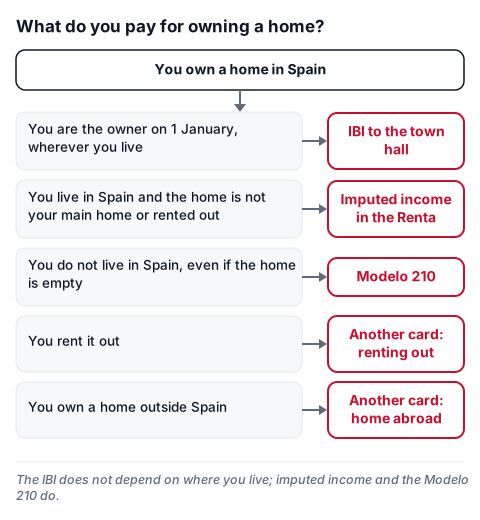
- Any owner: the IBI to the town hall, wherever you live.
- You live in Spain and the home is not your main home or rented out: imputed income in the Renta.
- You do not live in Spain: the Modelo 210 for imputed income, even if the home is empty.
- You rent it out: the rent is taxed separately, see renting out a home: IRPF and Modelo 210.
- You own a home outside Spain: see a home in Ukraine or abroad and the Spanish Renta.
Being a tax resident is not the same as living here with a permit: tax residence and the 183 days.
1. IBI: the municipal tax every owner pays
- What it taxes. The IBI (Impuesto sobre Bienes Inmuebles, the property tax) taxes the value of the property (art. 60 of the TRLRHL). The base is the cadastral value (valor catastral, art. 65), which the Catastro sets, not the price you paid. You see it on the IBI bill (art. 77.6) and on the Catastro online office.
- Who pays. The owner or, where they exist, the holder of the usufruct, the surface right or a concession. The taxable event goes by priority, from the concession down to ownership, so with a usufruct the usufructuary pays and with a concession the concession holder does (arts. 61 and 63). If the property has several owners, they are jointly liable for the bill, in proportion to their share if they are registered in the Catastro and in equal parts if not (art. 64.2).
- When. The IBI accrues on 1 January and the tax period is the calendar year (art. 75.1 and 75.2). Whoever is the owner on that day is the taxpayer for the whole year. A change of owner, for example a sale, counts at the next accrual after the date it takes effect in the Catastro (art. 75.3).
- Sales. Splitting the year's IBI between buyer and seller is a private agreement: the law lets the taxpayer pass the cost on under ordinary private law (art. 63.2) but does not order any split. The property stays liable for the payment on a subsidiary basis (art. 64.1), and the notary must warn about unpaid IBI debts.
- How much. Each town hall sets the rate within the legal range. For urban property the minimum is 0.4%, which applies if the town hall sets no other rate, and the maximum is 1.10%; some municipalities can add extra points (art. 72.1 and 72.3). The bill comes from applying that rate to the taxable base, then subtracting the discounts (arts. 66 to 71).
- Discounts. They depend on your town hall's tax ordinance (ordenanza fiscal). The law allows, for example, up to 90% for large families (art. 74.4) and up to 50% for solar panels or an electric-car charging point (art. 74.5 and 74.7). There is no national rate or discount you can take for granted, except for protected-housing (VPO) homes: 50% for three years, if you ask for it (art. 73.2).
- Empty home. If its tax ordinance provides for it, a town hall can charge a surcharge of up to 50% of the IBI bill. It is for homes left unoccupied, continuously and without justified cause, for more than two years, owned by people with four or more residential properties. It can reach 100% if the vacancy exceeds three years. The town hall can add up to 50 more percentage points if the owner has two or more empty homes in the same municipality. The law counts as a justified cause, among others, a second home with at most four consecutive years of vacancy (art. 72.4, wording of Law 12/2023). Real Decreto-ley 26/2026 provided for reforming that surcharge from the 2027 IBI, but Congress repealed it on 2 October 2026 (BOE-A-2026-20526); it does not apply. Check your town hall's ordinance and final provision 3 of Law 12/2023 in the BOE, which holds that wording of art. 72.4.
- When and how it is paid. Arts. 60 to 77 set no payment dates: each town hall, or the body that collects for it, sets them. Check its tax calendar. The law does not require a new assessment notice every year once the cadastral value has been notified in a general revaluation (art. 77.4). If no bill arrives, ask the town hall before the deadline.
2. If you live in Spain: imputed income from property
Many owners hear that a second home costs 2% of the cadastral value. That is not how it works. The law presumes income from owning urban property that you do not use as your main home or rent out, and that income is a percentage of the cadastral value (art. 85 of the IRPF law, the personal income tax). It is added to your other income in the general base (arts. 45 and 48) and taxed with the IRPF scale, like your salary. What you pay is the IRPF on that income, not 2% of the cadastral value.
How much income is imputed
- General rule (art. 85.1): 2% of the cadastral value, or 1.1% if the cadastral values of your municipality were revised through a general collective valuation, a revaluation of the whole municipality, that came into force in the period or in the ten before.
- Additional provision 55: the 1.1% also for municipalities whose collective valuation came into force from 1 January 2012, but only for the 2023 tax year. Real Decreto-ley 26/2026 provided for extending it up to the 2026 tax year, but Congress repealed it on 2 October 2026 (BOE-A-2026-20526); that extension does not apply. For 2026 the general rule of art. 85.1 holds.
How it is counted
- Days. The cadastral value is prorated by the days of the year you are the owner (art. 85.1).
- Owners. The income goes to the owners according to legal title: if the property is common to a married couple, half each unless you prove another share; with a usufruct, to the usufructuary (art. 85.2 and art. 11.3).
- No cadastral value. If the property has no cadastral value or it was not notified to you, the starting point is 50% of the higher of the value the tax office has verified for other taxes and the purchase price, and the 1.1% applies (art. 85.1).
- What is not imputed. The main home and undeveloped land; properties used in an economic activity or that produce capital income, such as rented ones; those under construction or that cannot be used for planning reasons; and timeshare rights of up to two weeks a year (art. 85.1 and 85.3).
Example. A home with a cadastral value of €80,000 for a full year: at 2%, the imputed income is €1,600; at 1.1%, €880. That figure is added to your other income: it is not what you pay.
Do you have to file the Renta? If your only income is a salary within the limit and imputed income of up to €1,000 a year, you may not be obliged (art. 96.2). The limits and exceptions are in Tax return for foreign residents. In the Basque Country and Navarre the IRPF follows regional rules: the above is the national law.
3. If you do not live in Spain: the Modelo 210 for imputed income
- Who. Non-resident individuals who own urban property in Spain not used in an economic activity (art. 13.1.h of the Spanish non-resident income tax law, TRLIRNR). You file the Modelo 210 for imputed income whether the home is empty or you use it yourself (art. 4.3 of Orden EHA/3316/2010).
- How it is calculated. Art. 24.5 refers to the imputation rules of the IRPF. It does so through the old art. 87 of the 2004 consolidated text, which today corresponds to art. 85 (additional provision 17 of the IRPF law). The base is the full imputed income, with no reductions (art. 24.1). The rate is 24%, or 19% if you live in another EU or European Economic Area (EEA) state with which there is effective exchange of tax information (art. 25.1.a).
- Example. Cadastral value of €80,000, full year, 2%: imputed income of €1,600. At 24% that is €384 and at 19% it is €304. With 1.1%, the income is €880 and the tax €211.20 or €167.20. An example, not a calculation for your case.
- Accrual and deadline. The income accrues on 31 December each year (art. 27.1.c of the TRLIRNR). The filing and payment period runs from 1 April to 31 December of the following year (art. 5.b of the Orden, amended by Orden HAC/623/2026). Imputed income for 2025 is filed from 1 January to 31 December 2026, so on 2 October 2026 the period is still open. For 2026, from 1 April to 31 December 2027. If you direct-debit the payment, the last day is 23 December (art. 13.6).
- Draft. You can ask the AEAT for a draft of the imputed-income return (art. 28 bis of the TRLIRNR). If it is not provided, the duty to file stays the same.
- Treaties. If your country has a tax treaty with Spain and you apply it, the return takes its limits into account and you attach a tax residence certificate valid for one year (arts. 4.6 and 7.1 of the Orden).
- Several owners. Each owner files for their own share (art. 8 of the TRLIRNR, which refers to the IRPF rules on who the income belongs to).
- Representative. If you live outside the EU, the AEAT can require you to name a representative in Spain because of the amount of income or because you own property (art. 10 of the TRLIRNR).
- Years not filed. If you let a year's deadline pass, see what happens if you do not file the Renta. It covers the Renta, but its surcharge rule (art. 27 of the LGT, the general tax law) is general.
- Property in the Basque Country or Navarre. The IBI there follows regional (foral) rules (art. 39 of the Basque Economic Agreement; arts. 48 and 49 of the Navarre Agreement). If you do not live in Spain, the imputed income of that property is declared to the foral tax office, under its own rules on place, form and deadline (arts. 21 and 22.2.h of the Basque agreement; arts. 28 and 29.1.l of the Navarre agreement). Do not assume that the AEAT Modelo 210 or its deadlines apply, nor what is explained above about the IBI.
Real Decreto-ley 26/2026: repealed
Real Decreto-ley 26/2026 provided for a scale by bands for imputed income from 1 January 2027, extending the 1.1% of additional provision 55 up to the 2026 tax year and changes to the IBI surcharge on empty homes. Congress repealed it on 2 October 2026 (BOE-A-2026-20526); it does not apply. If you signed or applied for something relying on the decree between 1 and 2 October, talk to a professional.
Documents
- NIF or NIE. Without a NIE, the NIF with the letter M is requested with the Modelo 030: Modelo 030. To pay without a certificate from abroad, a NIF or the identifying code that the form itself gives is enough (art. 14).
- Property details: cadastral value and cadastral reference, which appear on the IBI bill or in the Catastro online office.
- Purchase date or other change of ownership and your ownership percentage, to prorate the days and split between owners.
- Cl@ve or an electronic certificate, or a power of attorney for a representative: Cl@ve and electronic certificate.
- If you apply a treaty: a tax residence certificate from the country where you live, valid for one year.
- If you direct-debit the payment: an account of the taxpayer or of the person filing (art. 13.7).
Indicative list: the consolidated text of the Orden does not list the content of the form. Check it on the AEAT form itself.
Steps:
- Look at the diagram and decide your case: whether you live in Spain, whether the home is your main home and whether you rent it out.
- Find the cadastral value and cadastral reference on the IBI bill or in the Catastro online office.
- IBI: pay according to your town hall's calendar. If you bought or sold this year, check who receives the bill and what was agreed.
- If you live in Spain: include the property in the Renta with its use and the days of each use: Tax return for foreign residents.
- If you do not live in Spain: calculate the imputed income and the tax from the cadastral value, the days and your rate, 24% or 19%.
- Go to the Modelo 210 and choose imputed income from urban property (income type 02). With Cl@ve or a certificate, you pay at a partner bank, which gives you an NRC (complete reference number), and you enter it when you submit; or you direct-debit the payment. Without a certificate and paying from abroad, you use the procedure of art. 14.
- Keep the accepted self-assessment with its secure verification code (art. 13.1.e).
Official source: TRLRHL, arts. 60 to 77, BOE, IRPF law, arts. 11, 45, 48, 85 and 96, BOE, TRLIRNR, arts. 13, 24, 25, 27 and 28, BOE, Orden EHA/3316/2010, BOE, Orden HAC/623/2026, BOE, Resolution of Congress of 2 October 2026 (repeal of Real Decreto-ley 26/2026), BOE and AEAT, Modelo 210.
Informational only; check the official source and a professional for your specific case. Rules checked against official sources on 3 October 2026.