
In short: do you need to file a tax return in Spain as a foreign resident? Yes, if you pass an income limit. The general limit is €22,000 a year of salary or pension from a single payer. It drops to €15,876 if you are paid by more than one payer (the second and later ones above €1,500). It also drops if you are paid by someone who does not withhold IRPF (the income tax) in Spain, such as a foreign employer or a pension from abroad. Below the limit you can still file, and sometimes you get money back. Today (October 2026) no filing campaign is open: the Renta 2025 closed on 30 June 2026; the next one, on 2026 income, is filed in 2027 (dates to be announced).
In person or by representative? You do it online, without going to an office: Renta WEB with Cl@ve, an electronic certificate or a reference number. A voluntary representative with powers (an apoderado) or a duly authorised social collaborator can also file it for you online, using their own electronic certificate. You can file by phone or at an office with an appointment too, but those two routes are not allowed if the result is to pay and you do not direct-debit the payment. More: filing deadline and methods and the AEAT website (the Tax Agency).
Who files the Renta? Tax residents of Spain. In general, you are one if you spend more than 183 days of the calendar year in the country, or if your main activities or economic interests are here (art. 9 LIRPF, the personal income tax law). How days are counted: tax residence and the 183 days. A resident is taxed on all income, whether it comes from Spain or from another country. If you are not a tax resident you pay IRNR (non-resident income tax) on other forms, for example Modelo 210 for a property: buying property as a foreigner.
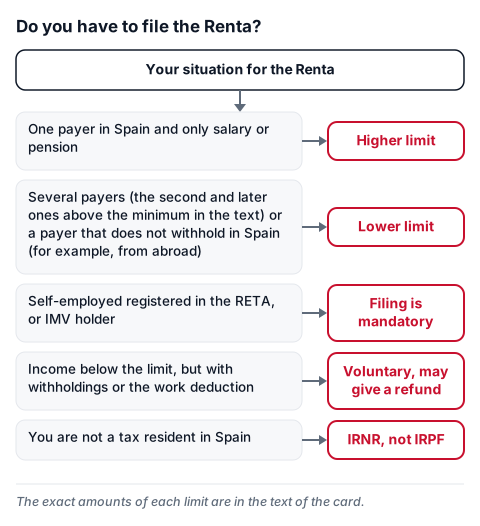
Income limits (art. 96 LIRPF): you do not have to file if all your income for the year comes from these sources and stays within these limits. They are the same for Renta 2025 and, according to the current BOE text on 1 October 2026, for Renta 2026 (the one filed in 2027).
- €22,000 a year of gross work income (salary or pension) from a single payer. Also if there are several payers, but what you receive from the second and the following ones adds up to €1,500 a year or less.
- €15,876 a year, instead of €22,000, in any of these cases:
- more than one payer, and the second and following ones add up to more than €1,500;
- a compensatory pension from a spouse or non-exempt maintenance payments;
- a payer with no obligation to withhold IRPF in Spain (for example, a foreign employer or a pension from abroad);
- withholding at a fixed rate.
- €1,600 a year combined from investment income (interest, dividends) and capital gains with withholding.
- €1,000 a year combined from imputed property income (a property you own and do not rent out), Treasury bills, subsidies for protected housing and other gains from public aid.
- €1,000 a year in total if you mix income from work, capital or a business activity with capital gains, and capital losses stay below €500.
These people always file, among others, whatever the amount:
- anyone registered as self-employed (RETA) at any time of the year;
- holders of the minimum living income (IMV) and the people in their household unit;
- anyone claiming the international double taxation deduction;
- anyone claiming reductions for contributions to pension plans and other social-security savings schemes.
If you are paid from abroad. A salary or pension from outside Spain falls under the rule of the payer who does not withhold IRPF when that payer does not operate in Spain. The AEAT itself explains it for pensions: a non-resident payer is not obliged to withhold as long as it does not operate in Spain. In that case your limit becomes €15,876 even with a single payer. If the payer abroad does operate in Spain, the rule may be different: check your case. With income from a business activity and no RETA registration, check your case too: the margin for not filing is €1,000 a year in total.
Below the limit you can still file. If you are not obliged, the AEAT lets you file to claim the refund you are entitled to, if any. It lets you recover tax withheld in excess. The deductions you are entitled to lower the tax and can increase the refund. The work-income deduction (additional provision 61 of the LIRPF) lowers your quota, meaning the tax you pay, by up to €340 for Renta 2025 and up to €590.89 for Renta 2026. For income of 2026 (Renta 2026, filed in 2027) the full amount is for gross work income of up to €17,094 a year; it falls gradually and reaches 0 at €20,048.45. It requires an employment or statutory relationship and other income, exempt income aside, of no more than €6,500.
Documents
- NIE or TIE and a way to identify yourself: Cl@ve Móvil, an electronic certificate or a reference number.
- IBAN of your account, for the refund or to direct-debit the payment.
- Proof of income from outside Spain: payslips, a pension certificate or statements, with amounts and country.
- Proof of tax paid outside Spain, if you claim the international double taxation deduction.
- Invoices and payments for the deductions you apply, for example rent, health costs or childcare.
Indicative list: it depends on your income and deductions; check it on the AEAT website.
Doubtful cases
- First year. There is no part-year rule: the tax period is the calendar year (art. 12 LIRPF). If you spend more than 183 days in Spain that year, you are a resident for the whole year and you also declare what you earned before moving. Tax paid abroad may give you the international double taxation deduction (art. 80 LIRPF).
- Temporary protection. On its own it does not exempt you from the Renta. Binding ruling V0442-23 of the DGT (27.02.2023) deals with a self-employed Ukrainian who came to Spain in March 2022 with his family (the ruling does not mention temporary protection): it applies the general 183-day rule and cites no exception for the war.
- Resident in two countries. If another country also treats you as a resident, the treaty to avoid double taxation between the two decides. This is a case for an adviser.
- The €400 a month aid of RD 673/2022 (Ukrainians under temporary protection). It is not confirmed that it is exempt from IRPF and we have not found a DGT ruling on it. If you received it, ask an adviser before assuming it is not taxed.
- A business in Ukraine (FOP, single tax). We have not found a DGT ruling saying whether that tax counts as tax paid abroad for the double taxation deduction. It is a grey area and the AEAT might not accept it. It is another case for an adviser.
- Past years not filed. The limit was not the same every year: the reduced limit was €14,000 in 2022 and €15,000 in 2023, and since 2024 it is €15,876. If you file on your own before the AEAT contacts you and the result is to pay, there is a surcharge (art. 27 LGT, the General Tax Law): 1% plus 1% for each full month of delay. After 12 months it is 15% plus late-payment interest. If the result is not to pay, there is no surcharge, but there may be a fixed fine (art. 198 LGT): €100 if you file on your own with no prior notice, €200 otherwise. The Administration's right to assess the tax expires after 4 years (art. 66 LGT). How to file past years step by step: Renta not filed: surcharges and how to regularise.
If you live in the Comunitat Valenciana. There are regional deductions of its own, for example for rent on your main home, health costs, sport and childcare. You apply them yourself in the return and they do not always show up in the borrador (the draft return the AEAT prepares): check they are there and add any that are missing. Official AEAT list. Detail: Valencian regional deductions.
State rent deduction: repealed. Royal Decree-law 26/2026 provided for a state deduction for rent on your main home of 10% of what you pay, but Congress repealed it on 2 October 2026 (BOE-A-2026-20526) and that deduction does not apply. More: news on the repealed deduction.
Steps:
- Check that you are a tax resident that year and whether you pass a limit. You need a NIE: if you do not have one yet, see how to apply for the NIE.
- Get a way to identify yourself: Cl@ve Móvil, an electronic certificate or a reference number. How: Cl@ve and electronic certificate. For the reference number the AEAT will ask for your NIF or NIE, details of your ID document and, if you did not file the Renta last year, an IBAN (or box 0505 of last year's Renta, if you filed it) (AEAT requirements).
- Open Renta WEB and the borrador. The AEAT prepares it with data that third parties report to it; you can change it and add data.
- Add what is missing: income from outside Spain, the tax you paid abroad if you claim the international double taxation deduction and, if you live in the Comunitat Valenciana, your regional deductions.
- Check the result. If you get a refund, give your IBAN. If you owe tax, you can direct-debit the payment or pay another way; without direct debit you can only file online.
- File within the deadline. In 2026 it ran from 8 April to 30 June, with direct debit until 25 June. The AEAT will announce the Renta 2026 dates: roughly April to June 2027.
- If you need help, the AEAT offers a virtual assistant, an information phone line (Monday to Friday, 9 to 19) and appointments. In 2026 phone assistance by appointment («Le llamamos»: the AEAT calls you) started on 6 May and in-person help on 1 June. More: help services for the campaign.
Official source: art. 96 LIRPF, BOE and AEAT, Do I have to file?.
Informational only; check the official source and a professional for your specific case. Campaign figures checked on 1 October 2026.
