
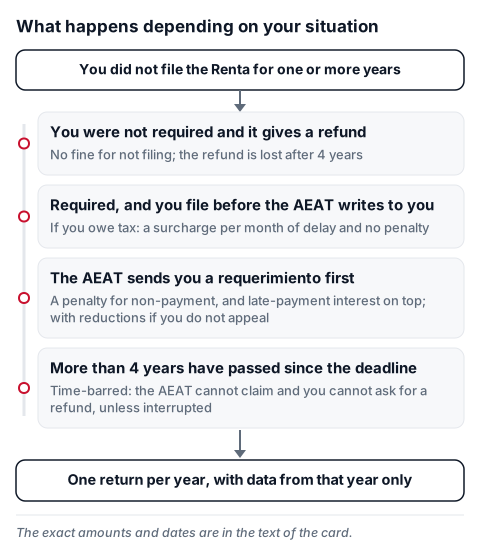
In short: what happens if you don't file a tax return in Spain? If you were not required to file, there is no fine, but the refund you may have been owed is lost after 4 years. Filing on your own before the AEAT (the Spanish Tax Agency) writes to you costs a surcharge of 1% plus 1% for each full month of delay, with no penalty. If the AEAT claims first, the penalty can be 50% or more of what you did not pay. By our calculation, the AEAT can claim the Renta 2022 until 30.06.2027.
In person or by representative? You do it online on the AEAT website, with Renta WEB for the missing year, without going to an office. In the Renta campaign, an apoderado (a representative with powers) or an authorised social collaborator can file for you with their own certificate: how the Renta card explains it. For past years, confirm it with the AEAT or an adviser. If you received a requerimiento (a formal request from the AEAT), you also answer it online: how to answer a requerimiento.
First, check whether you were required to file. Each year has its own limit (art. 96 LIRPF). With a single payer in Spain, the limit was €22,000 a year. If you were paid by someone who does not withhold IRPF in Spain, such as a foreign employer or a pension from Ukraine, it was lower: €14,000 for Renta 2022, €15,000 for 2023 and €15,876 since Renta 2024 (AEAT 2022, 2023, 2024). Cases with several payers and who always files are in the card on the Renta for foreign residents. If you were not required to file and the result is a refund, there is no fine for not filing. You can file to claim that refund as long as 4 years have not passed.
If you file before the AEAT writes to you. If the result is to pay, the surcharge for late filing applies (art. 27 of the LGT, the General Tax Law). It requires that there was no prior requerimiento: no AEAT action, with your formal knowledge, aimed at recognising, regularising, checking, inspecting, securing or assessing that debt (art. 27.1). There is no penalty.
- Less than one month late: 1% of what comes out to pay.
- Each full month of delay adds another 1%: 6 full months make 7%, 11 full months make 12%.
- After 12 months: 15% plus late-payment interest, from the day after those 12 months until you file.
- A 25% reduction of the surcharge if you pay the debt when you file and the surcharge within the period the AEAT gives you when it notifies its assessment (art. 27.5).
- If you file and do not pay, the AEAT assesses the surcharge and the interest, and enforcement-period surcharges may be added on the unpaid amount: 5%, 10% or 20% depending on when you pay (arts. 27.3 and 28).
Each late return must state the year it refers to and carry only data from that year (art. 27.4). If not, this regime does not apply and non-payment can be penalised as a minor infraction (art. 191.6).
If the result is a refund or zero, there is no surcharge, because it is calculated on what comes out to pay. If you were required to file, there may be a fixed fine (art. 198 LGT): €100 if you file on your own before the AEAT writes to you and €200 otherwise.
If the AEAT gets there first with a requerimiento. The art. 27 surcharge no longer applies. The AEAT assesses the debt with late-payment interest from the day after the filing period ended (art. 26) and can penalise non-payment (art. 191). The penalty is 50% of the unpaid amount if it does not exceed €3,000. Above €3,000, not filing counts as concealment of data (art. 184.2) and the penalty runs from 50% to 100%, with a minimum that rises with the harm caused (art. 187). In a limited check (comprobación limitada) it is reduced by 30% if you do not appeal and by another 40% of what remains if you pay within the voluntary period (art. 188). If there is nothing to pay, the fixed fine is €200 (art. 198).
An example with numbers (our calculation, indicative). Renta 2023 of a single person with no children, resident in the Comunitat Valenciana, with a gross salary of €16,000 from a Ukrainian company (€1,000 above that year's €15,000 limit). Assumptions: no Spanish Social Security contributions, €2,000 of other expenses and no deductions, including none for international double taxation. The tax to pay comes to about €311. It is paid about two years after the end of the filing period, with late-payment interest of 4.0625% a year (the rate set by Ley 31/2022 for 2023; each year's budget law sets the rate).
- Filing on your own first: €311 plus the 15% surcharge with the 25% reduction (about €35) plus the interest for the second year (about €13). In total, about €359, with no penalty.
- After a requerimiento: €311 plus the 50% penalty (about €156, or about €65 with both reductions) plus two years of interest (about €25). In total, between about €402 and about €492 (rounded figures).
Your amount depends on your income, your deductions and the payment date. Renta WEB calculates the tax for your case.
How far back the AEAT can go. The AEAT's right to assess the debt expires after 4 years (art. 66 LGT). They are counted from the day after the last day of the filing period of each Renta (art. 67). The right to claim a refund also expires after 4 years. By our calculation:
- Renta 2022 (filing period 11.04.2023 to 30.06.2023): until 30.06.2027.
- Renta 2023 (03.04.2024 to 01.07.2024; 30.06.2024 was a Sunday): until 01.07.2028.
- Renta 2024 (02.04.2025 to 30.06.2025): until 30.06.2029.
- Renta 2025 (08.04.2026 to 30.06.2026): until 30.06.2030.
- Rentas before 2022: in principle, already time-barred.
The limitation period is interrupted, and the 4 years start again, by any AEAT action notified to you to regularise or check that year and by your own filing (art. 68). Relying on the limitation period is risky: the date is easy to miscalculate and a single notified action restarts the clock.
Documents
- NIE or TIE and a way to identify yourself that the service for that year accepts, for example Cl@ve or an electronic certificate: Cl@ve and electronic certificate.
- Your tax data for that year: the AEAT website shows them in the «Datos fiscales» service of each year (year 2022, year 2023).
- Withholding certificates or payslips from each payer in Spain for that year.
- Proof of income from outside Spain (payslips, a pension certificate, statements), with amounts, dates and country, converted into euros. We have not confirmed which exchange-rate rule to use: ask an adviser.
- Proof of tax paid outside Spain, if you claim the international double taxation deduction.
- Invoices and payments for that year's deductions, for example rent, health costs or childcare.
- IBAN of your account, for the refund or to pay.
- The AEAT requerimiento, if you received one.
Indicative list: it depends on your income and deductions each year; check it on the AEAT website.
Doubtful cases
- Temporary protection. On its own it does not exempt you from filing the Renta: tax residence in Spain and the 183 days.
- «Nobody wrote to me». The obligation comes from the law (art. 96 LIRPF), not from a letter from the AEAT. Not having received a letter does not mean you were not required to file, and it does not change the 4-year period.
- Income from Ukraine. With no withholding agent in Spain, the limit is the lower one (€14,000, €15,000 or €15,876 depending on the year), not €22,000. If the payer abroad does operate in Spain, the rule may be different: check your case.
- You already filed that year and an income is missing. Correct it with the «Modificación de una declaración ya presentada» service of Renta WEB for that year, instead of filing a new return. For Renta 2024 and 2025 the AEAT describes it as a corrective self-assessment (autoliquidación rectificativa) (Renta 2024 manual); for 2023 its manual speaks of a supplementary return (declaración complementaria) or a request for rectification (solicitud de rectificación), and for 2022 we have not confirmed it. If what you pay goes up, the art. 27 surcharge may apply (AEAT, applicable surcharges).
- Surcharge on screen. We have not confirmed whether Renta WEB calculates the surcharge when you file late. Check the result before confirming and wait for the AEAT assessment.
- Modelo 720. It is a different return (assets and accounts abroad), with other penalties: it is not covered in this card.
Steps:
- List the years you have not filed, from 2022 to 2025. Rentas before 2022 are in principle already time-barred. For the Renta 2025 we have not confirmed where it is filed late.
- For each year, check whether you were required to file and whether you were a tax resident: Renta for foreign residents and tax residence and the 183 days.
- Gather the documents and check your tax data for that year on the AEAT website, past years.
- Open Renta WEB for the missing year with your identification method. File one return per year and only with data from that year.
- If the result is to pay, pay when you file. The AEAT will then notify the surcharge (and the interest, if 12 months have passed): pay it within the period it states to get the 25% reduction.
- If it is a refund, give your IBAN. If you had already filed that year, correct that return instead of filing another.
- If the AEAT has already written to you, answer the requerimiento on time from the AEAT website and review your case with an adviser before paying.
Official source: LGT, arts. 27, 66, 188, 191 and 198, BOE and AEAT, Renta of past years.
Informational only; check the official source and a professional for your specific case. Figures and dates checked on 1 October 2026.