
In short: Spain tax residency follows the 183-day rule plus two other circumstances. You are a tax resident if you spend more than 183 days in Spain in a calendar year or if the center of your activities or economic interests is here. It is also presumed if your spouse and dependent minor children live here (you can prove otherwise). A resident reports income from all over the world; a non-resident, only the income obtained in Spain.
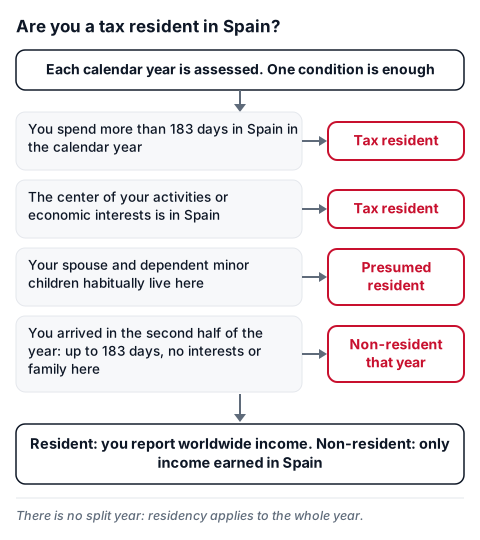
How to tell if you are resident:
Art. 8 of the IRPF Law 35/2006 calls anyone with habitual residence in Spain a taxpayer, and art. 9 says you have it if any of these circumstances applies:
- More than 183 days in the calendar year. Days in Spain are counted between 1 January and 31 December. Sporadic absences count as days in Spain, unless you prove your tax residency in another country. If that country is a tax haven, the tax authority can ask you to prove you were there for 183 days.
- Center of economic interests in Spain. The main base of your activities or economic interests is here, directly or indirectly: your job, your business, your investments.
- Family in Spain. It is presumed, unless proven otherwise, that you are resident if, under the criteria above (more than 183 days or center of interests), your spouse (not legally separated) and your dependent minor children habitually reside in Spain. The presumption does not apply if they themselves do not meet those criteria.
According to the AEAT manual, which follows the criterion of the Central Economic-Administrative Tribunal (TEAC), days are counted in three parts. First, certified presence: a day counts in full even if you spend only a few hours in Spain. Then, presumed days between two certified presences, unless you prove you were abroad. Last, sporadic absences. To prove you were abroad you need certified evidence. The same manual notes that, according to the Supreme Court, the intention to return to Spain is not enough to treat time abroad as a sporadic absence.
How the tax office (Hacienda) knows
The law does not list the evidence, and whoever claims a right must prove the facts it rests on (art. 105 of the General Tax Law). In practice, the padrón, your TIE card, your bank accounts and cards, a work or rental contract and your children's school enrolment can serve as indications. This is a description of practice, not a rule: what the law decides is where you spend your days and where the center of your interests is.
What changes if you are resident
- You report all your income, from any country, in the IRPF (art. 2 of the law), wherever you obtained it.
- A non-resident pays tax only on income obtained in Spanish territory, under the Non-Resident Income Tax (IRNR).
- The thresholds for having to file a return and how the first one works: tax return for foreign residents.
- If you are resident and hold accounts, securities or property outside Spain worth more than 50,000 € in one category, there is also an information obligation, the Modelo 720, filed until 31 March.
Temporary protection and the DGT ruling
The binding ruling V0442-23 of the Dirección General de Tributos (DGT), of 27.02.2023, dealt with a similar case. A self-employed professional from Ukraine settled in Spain in March 2022 with his family and works remotely for clients in Ukraine. He considered himself a tax resident of Ukraine. The DGT answered that the days in Spain count: if he spent more than 183 days in 2022, he is an IRPF taxpayer on his worldwide income. The ruling mentions neither temporary protection nor the war as grounds for an exception, and art. 9 does not include migration status among its criteria either: the days and the center of interests are what count. If Ukraine also considers him resident, the conflict is settled by the tie-breaker order of the treaty with Ukraine (below).
Your first year in Spain
There is no «split year» in Spain: a person is resident or non-resident for the whole calendar year (art. 12 of the law), because a change of residence does not interrupt the tax period, according to the AEAT. If you arrive in April and pass 183 days, you are resident for the whole year and also report what you earned before moving, for example a salary or a pension from your country.
To avoid paying twice on the same income there are two routes: the international double taxation deduction in art. 80 of the law and the treaty between the two countries. The deduction subtracts the smaller of two amounts: the tax you paid abroad, or what comes out of applying your average tax rate to that income. If you claim that deduction, you must file the return even if you are under the thresholds (art. 96).
Treaties with other countries
- Ukraine. The Spain-USSR treaty of 1985 applies: according to the BOE note, it now applies only to Tajikistan and Ukraine. The new treaty with Ukraine, signed in 2020, is not in force: according to our check, Ukraine's ratification is missing and on 01.10.2026 the BOE has not published its entry into force. Art. 16 of the 1985 treaty regulates how double taxation is eliminated.
- Tie-breaker. If both countries consider you resident, art. 1, paragraph 3 of the 1985 treaty applies this order. First, your permanent home; if you have one in both, the country with which your personal and economic ties are closer. Then the country where you habitually live. Then your nationality. If you are a national of both countries or of neither, the authorities of both decide under the procedure in art. 20 of the treaty.
- Other countries. The AEAT list of treaties shows the treaties signed by Spain. Each treaty divides differently which country taxes each kind of income, and the Spanish law leaves intact what the treaties say (art. 5).
Tax residency certificate
It is the document with which the AEAT certifies that you are a tax resident in Spain. What you need it for in your case (for example, for a bank, a payer or an authority in another country) is for whoever asks you for it to say.
- Where: in the AEAT online office, procedure G305, «Certificados tributarios. Expedición de certificados tributarios. Residencia fiscal».
- How: online with an electronic ID card, an electronic certificate or Cl@ve PIN (how to get Cl@ve), or at AEAT offices. The procedure sheet gives 10 working days as the resolution period.
- When you get it: it is issued if the data held by the AEAT show that you are tax resident in Spain. If you have just arrived, there may not yet be data to show it; the same page has a step to submit documents and allegations. The page does not say which data are enough: ask the AEAT.
- Language: the official sheet does not state the language of the certificate or mention an English version; we could not confirm that a bilingual one exists. If you are asked for another language, ask the AEAT and whoever requests it first.
- Residency in another country: to prove you are resident there (for example, for sporadic absences), you use the certificate of that country's tax authority, which according to the AEAT is valid for one year.
If you stop being resident
You stop being resident when in a calendar year none of the three circumstances applies: you are in Spain 183 days or fewer, the center of your interests is abroad and the family presumption does not apply. Because residency is measured for the full year, you are a non-resident for that whole year. The tax residency certificate of your new country helps to prove it.
To tell the AEAT your new address there is the Modelo 030, which covers registration, change of address and changes to personal data. The official page does not expressly explain the case of leaving Spain, so confirm it with the AEAT. If you held assets abroad, check how your Modelo 720 for the last year works out.
There is a special case for large shareholdings in companies (art. 95 bis). If they are worth more than 4,000,000 € in total, or more than 1,000,000 € with more than 25% of the capital, and you were resident for at least 10 of the last 15 years, leaving can trigger a tax. Ask an adviser.
Cases that often cause confusion
- You arrive in the second half of the year (for example, a student or a minor who arrives after the summer). If you spend 183 days or fewer that year, the center of your interests is not here and the family presumption does not apply, you are a non-resident that year. What you earn from Spanish sources is reported as a non-resident (IRNR). If you pass 183 days the next year, you will be a resident.
- A Ukrainian pension. The 1985 treaty has an express rule only for pensions for service to the State (art. 13): in general they are taxed by the State that pays them, unless the person is a resident and national of the other State. An ordinary retirement pension is not named in the treaty; if it fits under «other income» (art. 14), it is taxed only in the State of residence, but how yours fits depends on its type. Ask an adviser before deciding where to report it. If you are resident and have no other income, the limit for not filing drops to 15,876 € when the payer is not obliged to withhold in Spain, as happens with a foreign pension.
- Remote work for a Ukrainian employer. If you are resident, that salary is reported in Spain like the rest of your worldwide income. Because the foreign company is not obliged to withhold in Spain, the limit for not filing drops from 22,000 € to 15,876 € gross per year (art. 96). If you moved to Spain to work remotely for a foreign company (for example, with a teleworking visa) and were not resident in Spain in the previous 5 years, there is an optional special regime, the one in art. 93 of the law. For 6 years (the year of arrival and the next 5) you are taxed under rules similar to those of a non-resident. It is requested with the Modelo 149 within 6 months of the start date of the activity (the date shown in the Social Security registration or, if there is none, in the document proving the start), and it removes almost all IRPF deductions. Ask an adviser before deciding. This card covers only taxes: the work permit and Social Security are other topics.
Valencia and other regions
None of this changes by region, except the regional part of the IRPF: it depends on the community where you spend the most days of the year (art. 72). If that cannot be determined, it is where you earn most of your income and, as a last resort, your last declared residence. Details are in tax return for foreign residents.
Official source: IRPF Law 35/2006, arts. 8 and 9, BOE.
Informational only; check the official source and a professional for your specific case.
