
In short: the TIE (Foreigner Identity Card), often called the Spanish residency card, is the physical card that proves your residence authorisation in Spain and contains your NIE. You obtain it after your residence has been granted, and you must apply in person within one month (art. 209, RD 1155/2024).
In person or by representative? In person, mandatory. Art. 209.1 requires you to apply "in person". The EX-17 form itself says it can only be filed in person at the National Police, not online or at public registries. The TIE contains your facial image and two fingerprints, which are taken from the age of 6 (Regulation (EC) 1030/2002, arts. 4a and 4b). The card is handed to the person concerned, who shows that they are its intended recipient and have paid the fee (art. 209.11). We have found no rule that expressly covers collection by someone else; art. 209.3 puts the steps to obtain and receive the card on the holder, so plan to go yourself. Someone else can help you book the appointment or pay the fee.
Important: the TIE is not the NIE. The NIE is only a number; the TIE is the card that documents your legal status and carries that number (see glossary). Everyone with a visa or authorisation to stay in Spain for more than six months has the right and the duty to obtain the TIE (art. 209.1). The TIE has the same validity period as the authorisation that justifies it and loses validity when that authorisation expires (art. 209.7). It is not issued together with your residence decision: first the authorisation is granted, and then you process the card. To do so you book a prior appointment, attend the fingerprinting and, when the card is ready, collect it.
✈️ With the TIE you can travel in Europe. With your valid TIE and valid passport you can move around the rest of the Schengen area up to 90 days in any 180 (short stays, not for working or residing outside Spain). Always carry both documents; the resguardo or a TIE "in process" does not count. Rules, limits and pitfalls: Travelling in Schengen with your residence.
Documents (check the exact list at your appointment/office; it may vary by authorisation type):
- Grant decision (resolución) of your residence authorisation (or the document proving the right).
- Form EX-17 — "Application for the Foreigner Identity Card (TIE)" (official form, inclusion.gob.es); what each EX form is for and where to download it: Spanish immigration EX forms.
- Fee modelo 790, code 012 paid (the amount varies by card type).
- Valid passport or travel document (original and copy).
- One recent passport-size photo, white background.
- Where applicable, proof of padrón registration and the documents specific to your authorisation type.
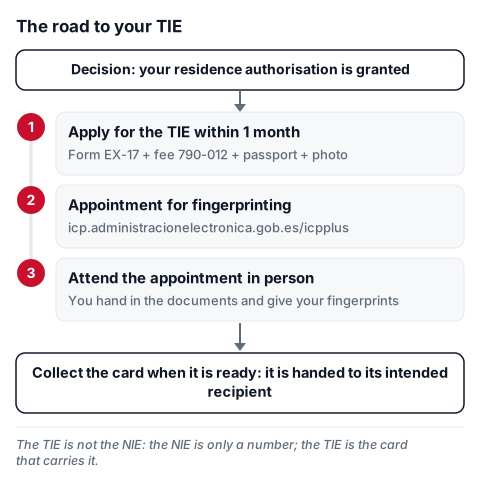
Steps:
- Gather the documents (grant decision, EX-17, fee 790-012 paid, passport, photo).
- Book a prior appointment for "fingerprinting / TIE issuance" at the Public Administration e-office (icpplus).
- Attend the appointment in person: you submit the EX-17 and the documents, and your fingerprints are taken (Regulation (EC) 1030/2002, art. 4b).
- Collect the card when it is ready: it is handed to the person concerned, who shows they are its intended recipient (art. 209.11).
Official source: art. 209, RD 1155/2024 (BOE-A-2024-24099) and application forms — Ministry of Inclusion (inclusion.gob.es). (The Policía Nacional e-office, owner of the TIE appointment and fingerprinting, is temporarily unavailable; the appointment is handled at the Public Administration e-office.) Informational only; check the official source and a professional for your specific case.
