In short: Temporary Protection for people displaced from Ukraine is applied for in person at a CREADE centre or an enabled National Police station (by prior phone appointment). It grants residence, work, healthcare and study rights and is valid until 4 March 2028 (Council Implementing Decision (EU) 2026/1912).
In person or by representative? Personal appearance is mandatory: the application is made in person before the police, who take your photo and fingerprints (art. 2, Order PCM/169/2022). No representative or online option is accepted.
Who can apply: Ukrainians living in Ukraine before 24 Feb 2022 (regular or irregular in Spain); other nationalities with protection/legal residence in Ukraine who cannot safely return; certain family members.
From 5 August 2026, anyone submitting a new application for temporary protection must also have fulfilled their military obligations in Ukraine, with evidence where applicable, and the burden of proof is on the applicant. According to recital 18 of the Decision, the Ukrainian exit stamp in your passport proves that the exit was authorised; if the legal exit cannot be confirmed, you need an official document confirming exemption or fulfilment (for example, from the Reserv+ app). The rule is the same across Spain. This condition does not apply to anyone who already had protection before 4 August 2026 (inclusive) and keeps it uninterrupted in that same Member State. More detail in EU Decision 2026/1912. If it is refused: what to do.
If you already have temporary protection in another EU country: the rights of temporary protection are enjoyed in one Member State at a time. According to recitals 5 and 6 of Decision (EU) 2026/1912, Member States should reject an application when it is clear that the person has already obtained that permit in another Member State, and no State is obliged to issue a permit to someone who already holds one elsewhere. The Commission's operational guidelines add two points: with the permit from the first country you may travel to other Member States for 90 days within a period of 180, and if you move and receive another temporary protection permit, the first one expires and is withdrawn. The Ministry of Inclusion's official list of documents includes a passport, ID or travel document and, for relatives, documents proving the family link. If you want to know whether you will also be asked for proof that you gave up the earlier protection, ask before you go, on the Temporary Protection information line (+34 91 399 00 09) or at the CREADE you choose. The same goes for the military condition: the exception in art. 2 of the Decision refers to people who keep their protection without interruption in the same Member State, so if you come from another country, ask what proof you will need. The rule speaks of EU Member States; Moldova is not one, and if your protection is Moldovan, the same question goes to the CREADE.
If you were not in Ukraine on 24 February 2022: according to the Commission's operational guidelines, Ukrainians who lived in Ukraine and left before 24 February 2022, or were outside the country before that date (for work, studies, holidays, a family or medical visit or other reasons), do not in principle have the right to the temporary protection of the Decision. The official CREADE page serves people from Ukraine displaced after 24 February 2022, or who were in Spain, legally or not, when the conflict broke out. If you were in a third country (for example, the USA), ask about your case at a CREADE or on +34 91 399 00 09.
If you hold an EU long-term residence permit from another EU country (not temporary protection): you can apply to live in Spain without a visa (art. 179 of the Immigration Regulation, RD 1155/2024). The application is filed before you enter or, at the latest, within 3 months after entry. You provide proof of your EU long-term resident status, your passport, the fee and, if you will not work, proof of means and health insurance (if you will work, the work documents). The decision takes 2 months, and without an answer the application is deemed refused. Spain's own EU long-term residence requires 5 years of legal, continuous residence in Spain (art. 176), and once it is granted you lose the status in the previous country (art. 181.2). If your permit is national rather than EU long-term (for example, a German permit), ask first at the Spanish consulate in your country of residence.
Where you apply: in person at the CREADE centres in Pozuelo (Madrid), Barcelona and Málaga or at an enabled National Police station (e.g. Valencia, no CREADE). The Torrevieja CREADE does not take applications for protection: it only books information and access to reception; you apply at a National Police station. Addresses of the 4 centres: CREADE centres.
Housing and reception (also for retired and elderly people): according to the official CREADE page, these centres have three functions. One is initial reception and assistance, with accommodation places in the centre itself or nearby. Another is processing temporary protection. The third is referral to the reception network. The stay at the centre is temporary: it is for completing the procedures, identifying your particular needs and referring you to the most suitable accommodation and services. The services they give access to include accommodation and maintenance, financial aid, psychosocial care, healthcare and legal assistance. For a retired or elderly person the first step is the same: book an appointment at a CREADE by phone. In Torrevieja the appointment is for information and access to the Reception System. In addition, while the application is being processed, Order PCM/169/2022 (art. 3) authorises you to receive the social aid managed by the Ministry of Inclusion. Whether there is a place for you and on what conditions, ask at the CREADE when you book. The same page links to the Reception Plan for people displaced from Ukraine (Plan de Acogida) and to the State Reception Network (Red Estatal de Acogida).
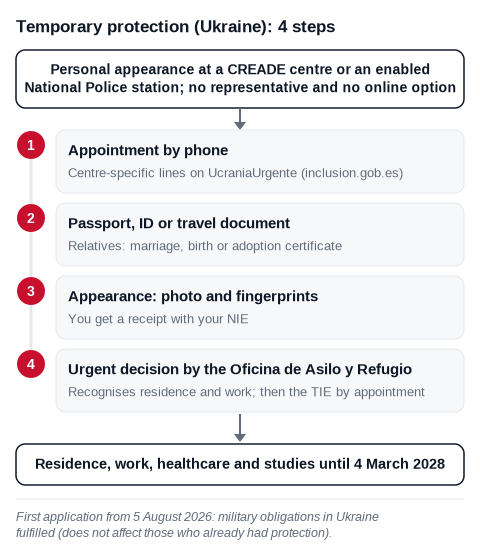
Appointment: by phone only, on centre-specific lines published on the official Ministry of Inclusion site — UcraniaUrgente; no single email or online portal.
Required documents (per official source):
- Passport, ID document or travel document (for people without a passport: a travel document e.g. UN/Convention).
- For relatives: marriage, birth or adoption certificate.
- Other nationalities legally residing in Ukraine: prove you cannot safely return.
What you receive: during the appearance, police take photo + fingerprints and issue a receipt with your NIE; the Oficina de Asilo y Refugio decides within max 24 h (Order PCM/169/2022), recognising residence and work. Then request the TIE by appointment. Temporary protection itself is extended until 4 March 2028. However, the validity of already-issued TIE cards was extended only until 2027 by Order INT/96/2026. As of 29.10.2026 there is no Spanish order extending them to 2028: check the official source. Common follow-up: padrón, health card.
Steps
- Request a cita previa by phone at a CREADE centre or, if there is none in your city, at an enabled National Police station.
- Gather passport, ID or travel document and, for relatives, marriage/birth/adoption certificates.
- Attend in person (comparecencia): submit the application; they take your photo and fingerprints; you get a receipt with the NIE.
- The resolution (urgent, max 24 h) recognises residence and work; then request the TIE by appointment.
Official sources: Ministry of Inclusion — Temporary Protection procedures, Ministry of Inclusion — CREADE centres and Order PCM/169/2022 (BOE-A-2022-3715). Informational only; check the official source and a professional for your specific case.