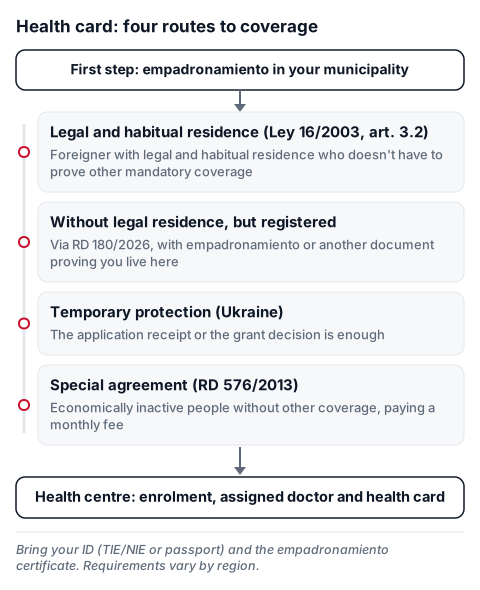
In short: as a foreigner in Spain, to have a doctor in the public system you need the health card; the route depends on your situation but almost always starts with registering on the town roll (empadronamiento). There are four routes: with legal and habitual residence (Ley 16/2003, art. 3.2), via RD 180/2026 (without legal residence), with temporary protection (Ukraine), or by paying the special agreement.
In person or by representative? Enrolment is usually done in person at your health centre (with your ID and the town-registration certificate). The exact procedure varies by region: some allow part of it online, so check yours.
Routes to SNS coverage:
- Legal and habitual residence (Ley 16/2003, art. 3.2, letter c): if you are a foreigner with legal and habitual residence in Spain and don't have to prove other mandatory coverage, you have the right to publicly funded healthcare. This used to be regulated by RD 1192/2012; its arts. 2 to 8 were repealed in 2018 by Real Decreto-ley 7/2018.
- Without legal residence: you access it through RD 180/2026 (Ley 16/2003, art. 3 ter, leaves the details to it). You prove you live in Spain with a current certificate or volante of empadronamiento (town registration) or, if you don't have one, with another document the rule accepts (for example school enrolment, a consular travel letter, a social-services visit record or utility bills in your name). There is no minimum registration period.
- Temporary protection (Ukraine): see the next section.
- Special agreement (Royal Decree 576/2013; Ley 16/2003, art. 3.3): for people who have no right through the routes above, mainly economically inactive foreigners without other coverage, paying a monthly fee of €60 (under 65) or €157 (65+). Requires town registration.
If you have temporary protection (Ukraine): under the Ministry of Health instruction of 10 March 2022, what gives you the right is the receipt of your application for temporary protection (with your NIE) or the grant decision. You show it at the administrative desk of your health centre or at the point your region has set up. Passport, address and phone are recorded "whenever possible"; this instruction does not ask for empadronamiento. The document or card lasts as long as your temporary protection and its renewals (Order PCM/169/2022, art. 7). At the pharmacy you pay 40% of the price of prescription medicines (code F003). Details in the card healthcare with temporary protection.
Children: foreign minors have their own card: public healthcare for foreign minors.
How to do it in practice: go to your health centre or regional health service with your ID (TIE/NIE or passport) and proof that you live in the municipality: the town-registration certificate or, under RD 180/2026, another accepted document. There they enrol you, assign a doctor and issue the card.
Important: the exact requirements, timing and documents vary by region (comunidad autónoma). Check yours: directory of regional health services.
Steps:
- Register (empadrónate) in your municipality (under RD 180/2026, if you can't yet, other documents that prove you live here are accepted).
- Identify your route: legal and habitual residence (Ley 16/2003), RD 180/2026 (without legal residence), temporary protection (Ukraine) or the special agreement.
- Go to your health centre or regional health service with your ID (TIE/NIE or passport) and the town-registration certificate (with temporary protection: the application receipt or the grant decision).
- They enrol you, assign a doctor and issue the health card.
Official source: Healthcare — Ministry of Health.
Informational only; check the official source and your regional health service for your specific case.