
In short: healthcare under temporary protection in Spain is public. If your protection is granted or you have lodged the application, you have the right to National Health System care, and you ask for the card at your health centre. Under the Ministry of Health Instruction of 2022, empadronamiento (town-roll registration) is not a mandatory item. Keep the grant resolution or the application receipt (with your NIE) at hand: those are the documents the instruction names. In practice the temporary-protection TIE is usually enough (that is what people tell us, not what the rule says). The list “Your status and what the norms say” also covers asylum, refugee status and other situations.
In person or by representative? The application is filed at the administrative unit of your health centre or at the unit your region sets up (Ministry of Health Instruction of 2022, point 3.1). In Ceuta and Melilla it is filed with INGESA (Instituto Nacional de Gestión Sanitaria, the national health management institute). In Andalusia it starts at the primary care centre nearest your home, with a form that has a section for a legal representative (parent or guardian). In Madrid it is done at the Processing Unit (Unidad de Tramitación) at calle Sagasta 6, where you get the document on the spot. Whether someone else can do it with your authorisation, or whether it can be done online, the sources do not specify: by default plan to go in person and ask your health service (health card).
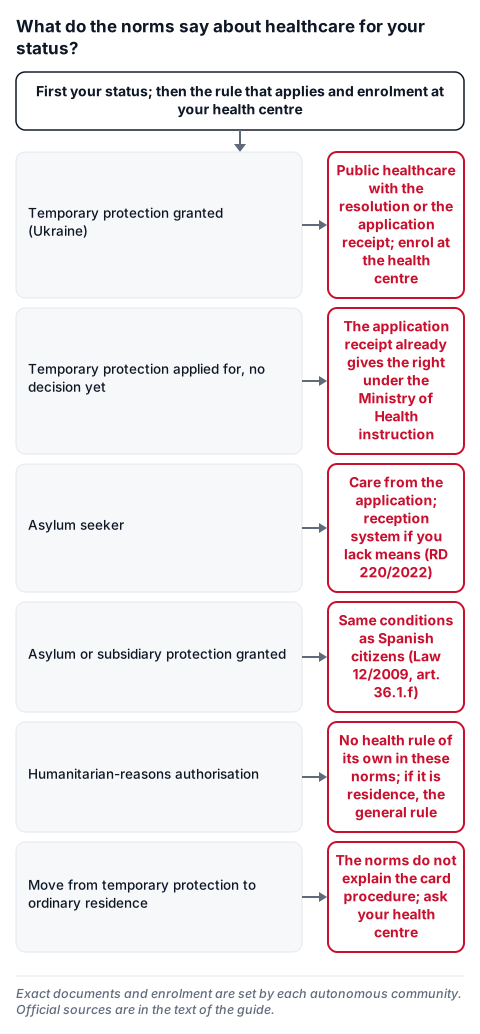
Your status and what the norms say:
- Temporary protection granted (Ukraine). The Ministry of Health Instruction of 10 March 2022 (copy published by MUGEJU) gives the right to National Health System care on the strength of the grant resolution from the Ministry of the Interior. In addition, the resolution includes a residence and work authorisation (Order PCM/169/2022, art. 5.1), which means legal residence. Law 16/2003 (art. 3.2.c) recognises publicly funded care for people with legal and habitual residence who do not have to prove cover by another route, for example through a job registered with Social Security. Directive 2001/55/EC (art. 13.2) requires at least emergency care and essential treatment of illness, and more care for special needs (art. 13.4: unaccompanied minors, victims of torture, rape or other serious violence). Implementing Decision (EU) 2022/382 (recital 17) lets Spain keep a system more favourable than that minimum. RD 1325/2003 (art. 20) adds that people without sufficient means can use social and health services. Order PCM/169/2022 itself does not regulate healthcare. How to apply: temporary protection guide and extension to 2028.
- Temporary protection applied for, no decision yet. The same instruction gives the right on the strength of the application receipt (National Police, with NIE). RD 180/2026 (art. 4.d) also lists people who have applied for temporary protection among the "groups of special protection", but refers to their specific rules for making the right effective. Details in the RD 180/2026 guide.
- Asylum seeker (international protection). Law 12/2009 recognises healthcare for the applicant (arts. 16.2 and 18.1.f). RD 180/2026 (art. 4.c) sets it from the moment the application is lodged, with the basic common service portfolio of the National Health System and extra care for special needs. If you lack sufficient means you can enter the reception system (RD 220/2022, art. 3), whose initial phase includes health care and epidemiological control (art. 16). Reception also covers temporary-protection beneficiaries without means. How to apply for asylum: asylum guide.
- Asylum (refugee) or subsidiary protection granted. Law 12/2009, art. 36.1.f: access to healthcare, education, housing and social services in the same conditions as Spanish citizens. Letter c) of the same article includes a permanent residence and work authorisation.
- Humanitarian-reasons authorisation. If asylum is refused, the law allows stay or residence to be authorised on humanitarian grounds (Law 12/2009, art. 37.b). The norms reviewed set no health rule of their own for this permit. If it is a residence permit, the general rule in point 1 applies (Law 16/2003, art. 3.2.c); confirm with your health service.
Documents (temporary protection granted or applied for; each region may ask for more):
- Grant resolution from the Ministry of the Interior or receipt of your application for temporary protection (National Police, with your NIE). These are the documents the Ministry of Health instruction names: keep one of the two at hand.
- Temporary-protection TIE. It carries your NIE and your status. In practice it is usually enough; that is what people tell us, not what the rule sets.
- Mandatory details: name, sex, date and country of birth, nationality, NIE and regional CIP (assigned by the community).
- Passport, address, phone and email, whenever possible.
- Empadronamiento: the instruction does not require it. Bring it if you have it: Madrid asks for the certificate if possible.
Pharmacy and validity. The instruction records this enrolment as an uninsured person protected by the National Health System: at the pharmacy you pay 40% of the price of the prescription medicines you buy (co-payment). Your region issues a document or card whose validity follows the term of your temporary protection and its renewals (Order PCM/169/2022, art. 7).
Examples (official pages checked on 1 October 2026). In Andalucía you ask for enrolment at your primary care centre (centro de atención primaria) with the form "Solicitud de tarjeta/alta/modificación de datos en BDU". Your identity is taken from the temporary-protection application receipt, which also shows the NIE. The documents it asks for are the National Police receipt or the grant resolution from the Ministry of the Interior; empadronamiento is not on the list. In Madrid you go to the Processing Unit (calle Sagasta 6) with the receipt and, if possible, passport and empadronamiento certificate; they hand you the document on the spot.
From temporary protection to ordinary residence. The SEM Instructions 2/2026 allow you to apply for another authorisation. It is not automatic, and you renounce temporary protection only after obtaining the new one. On healthcare, the norms reviewed do not say whether the card continues without a break or what procedure applies when you change authorisation. With the new authorisation you remain a legal resident, so the general rule in point 1 is still the reference. After the change, ask your health centre whether your details need updating.
If care is refused although you fall in one of these groups, you can file a complaint with the Ombudsman (Defensor del Pueblo), which receives complaints against public administrations.
Steps:
- Identify your situation in the list above and keep the document that proves it (temporary-protection resolution or receipt, TIE, asylum applicant document, asylum resolution).
- With temporary protection granted or applied for, go to the administrative processing unit of your health centre (or the point your region has set) with the resolution or receipt; the TIE is usually enough in practice, but the rule does not say so. The Ministry of Health Instruction does not require empadronamiento; bring it if you have it.
- In other cases, go to your health centre or regional health service with your ID and the document of your status. Exact documents vary by region (some ask for empadronamiento): general steps in the health card guide.
- If you live in a reception-system place, ask your managing organisation or social worker first.
- When your situation changes (new authorisation, asylum decision), tell your health centre.
Official sources: Ministry of Health Instruction, 10 March 2022, Law 16/2003, RD 180/2026, Law 12/2009, RD 220/2022, Order PCM/169/2022.
Informational only; check the official source and a professional for your specific case.