
In short: to apply for international protection (asylum) in Spain you state in person that you want protection before the competent authority (a designated National Police station or a border post, among others), your application is registered and then formalised in an interview; you are documented as an applicant, you cannot be returned or expelled while your application is decided (with limited exceptions in the law), and you receive healthcare from the moment you formulate the application (Law 12/2009 and Regulation EU 2024/1348).
Since 12 June 2026 applications are processed under the procedures of Regulation (EU) 2024/1348 of the EU Pact (border, accelerated and examination procedures), and Law 12/2009 applies only where it is compatible with it (Instruction BOE-A-2026-12855). Timelines and rights under the new system: asylum procedures under the EU Pact.
In person or by representative? The rule is personal appearance (art. 17.1): you submit the application yourself and it is formalised in a personal interview (the official website also mentions a representative for someone who lacks legal capacity to act alone). Only in case of physical or legal impossibility may a person who represents you submit it, and you must ratify the request once the impediment ends.
Where to apply: the law refers to "the places established by regulation"; at the border art. 21 also applies. According to the official website of the Asylum and Refuge Office (Pact system), the competent authority is: the National Police stations designated to receive applications; the security forces that control entry at the border; and, for people already inside, the designated public reception centres, immigration detention centres (CIE) and prisons. If you are already in Spain, the appointment for this first step is requested at the places set up by the National Police (the website lists the means for each province). Telephone information on the procedure: 910 006 910 (Spanish, Arabic, English and French).
When? Law 12/2009 (art. 17.2) says you must appear "without delay" and in any case within one month at most of entering Spain or of the events that justify the well-founded fear of persecution or serious harm. Irregular entry is not penalised if the person meets the requirements to be a beneficiary of protection. Instruction BOE-A-2026-12855 does not address this deadline: confirm with the OAR whether it still applies after the Pact.
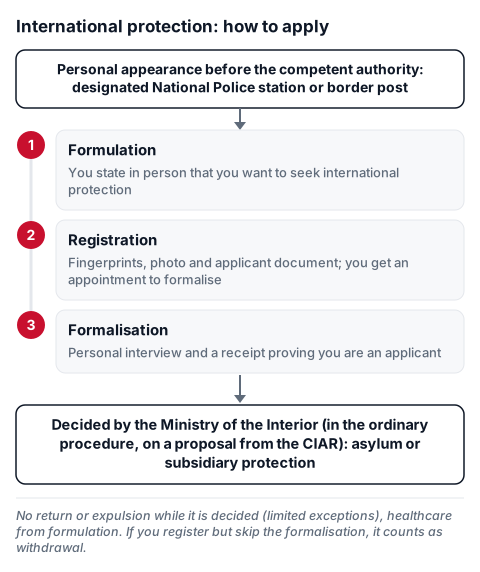
How the procedure works:
- Formulation: you state in person, before the competent authority, that you want international protection. From then on you are protected by the principle of non-refoulement (no return).
- Registration: the National Police registers the application, takes your fingerprints and a facial image, and gives you a document identifying you as an applicant and guaranteeing non-return. You then receive an appointment to formalise.
- Formalisation: on the appointment day, at the assigned police station, you have a personal interview about the grounds of your application (audio-recorded and transcribed; you review and sign it and get a copy) and you receive a formalisation receipt proving you are an applicant. You may attend with a lawyer (on request, according to the official website; in the border procedure legal assistance is mandatory, see Pact procedures) and an interpreter. The phases can also be carried out together. Important: if you have registered and do not attend the formalisation, you are considered to have withdrawn the application and you lose the right to remain.
- At the border, a decision of inadmissibility or refusal must be notified within a maximum of four days of the application (art. 21 of the Law; up to ten days in certain cases if UNHCR asks with reasons). Under the Pact, the authorities aim to finish the initial examination within four calendar days, and the passing of that period in no case means authorisation to enter Spain.
While it is decided, you are entitled to: be documented as an applicant (at registration, a document identifying you as an applicant and guaranteeing non-return; after the interview, the formalisation receipt); not being returned or expelled while your application is decided (art. 19 of the Law, with limited exceptions, for example precautionary measures for public health or security); and access to your case file. The official texts consulted give no renewal periods for these documents: confirm with the OAR (910 006 910).
Healthcare: applicants for international protection "will receive healthcare from the moment the application is formulated", to the extent of the common basic service portfolio of the National Health System (Royal Decree 180/2026, art. 4.c). Details in the card healthcare with temporary protection and asylum.
Types of protection: asylum (refugee status) and subsidiary protection. Decided by the Ministry of the Interior (in the ordinary procedure, on a proposal from the CIAR).
Official source: Law 12/2009 on the right of asylum. See also the MIR-UNHCR agreement on the asylum system.
Informational only; the procedure and timeframes may vary — check the official source, the Asylum Office and a professional for your case.
