
In short: free healthcare for children in Spain applies even when the child has no legal residence: the law recognises that minors under 18 who are in Spain are entitled to healthcare on the same terms as Spanish minors. "Free" means publicly funded; the co-payment (copago, the part the user pays) is the same as for other covered people. Enrolment is handled by your region and the exact papers vary.
In person or by representative? RD 180/2026 allows the application to be filed by the person concerned or by an expressly authorised third party (art. 3.1). The decree does not spell out how parents or guardians act for a minor, and each region decides whether the procedure is in person or online: check at your health centre.
What the law says:
- Foreign minors in Spain: entitled to healthcare on the same terms as Spanish minors (Organic Law 1/1996, art. 10.3).
- Foreign nationals without legal residence: entitled to healthcare on the same terms as Spaniards. The public sector pays if there is no other mandatory coverage (EU law, bilateral agreements), the cover of their home country cannot be exported and no third party is obliged to pay (Law 16/2003, art. 3 ter, as worded by RDL 7/2018). Art. 12 of Organic Law 4/2000 only refers to health legislation.
- Children under 18 without legal residence: public care from the National Health System to the same extent as other covered people and with the same type of co-payment (RD 180/2026, art. 4). More on the decree in our RD 180/2026 card.
What the law does not say: art. 4 does not clarify whether minors follow the general procedure of arts. 2 and 3. Each region sets its procedure and may ask for or accept other papers, so check yours before you go: directory of health services.
Two more points in RD 180/2026 worth knowing: if the person is in a temporary stay situation, the second additional provision requires a prior favourable report from the region's social services; and in the responsibility declaration in the annex the person states that they have no valid stay visa, no entry in the EU Citizens Register and no valid TIE.
Documents (list from RD 180/2026, art. 2; it may be incomplete for your case, verify in your region):
- The child's identity: passport or another official ID from their country with a photo. Without a passport or official ID: birth certificate, family book or guardianship papers (public child-protection body or a legal guardian appointed by a judge).
- Habitual residence in Spain: an up-to-date padrón certificate (how to register).
- If the padrón is not possible, one of these is enough: enrolment certificate from a public or publicly funded school; schooling certificate of a dependent minor; travel letter from the consulate; visit-register certificate from social services (or from social workers of a public-interest NGO); electricity, gas, water, phone or internet bills in the applicant's name; registration card from the National Police or a Prosecutor's decision on age determination; consular registration document; certificate from a public migration centre.
- A responsibility declaration on the requirements of art. 3 ter of Law 16/2003.
- If someone else files the application: express authorisation.
If the centre says no:
- The decree says health and social services must inform and help start the procedure from the first contact (art. 3.3), and that a provisional document is handed over when the application is filed (art. 3.2).
- Your municipality's social services can help with the paperwork; a certificate from them also counts as proof of residence (list above).
- Complaint: the Defensor del Pueblo (Spain's ombudsman) accepts complaints online and free of charge from foreign nationals regardless of age or legal status; Organic Law 1/1996 (art. 10.2) states that a minor can complain to it or to the equivalent regional institution.
- Ask at the centre or on your regional health service's website for its complaints channel. For appeals against an unfavourable decision (notified under Law 39/2015), ask a lawyer or an NGO.
Pregnant women: RD 180/2026 (art. 4) gives foreign pregnant women without legal residence care during pregnancy, birth and the postpartum period, to the same extent and with the same co-payment. For termination of pregnancy, see this card.
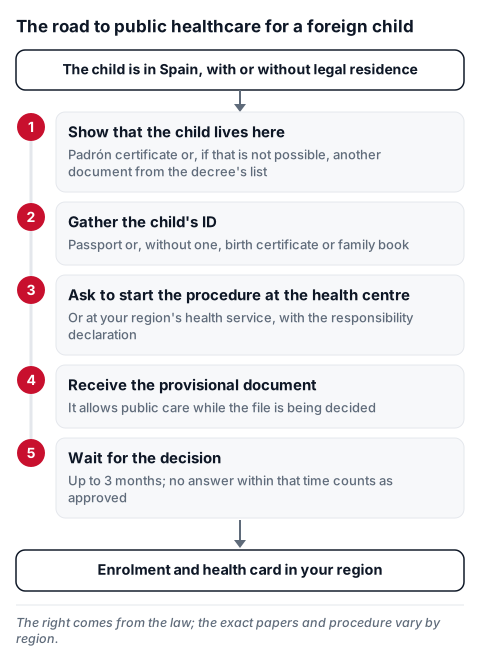
Steps:
- Register the child on the padrón or gather another proof of residence from the list (empadronamiento).
- Gather their ID (passport or, without one, birth certificate or family book) and the responsibility declaration.
- Go to their health centre or your region's health service and ask to start the procedure there.
- When you file, you get a provisional document that allows public care while the file is decided. Keep it.
- The decision must arrive within 3 months; with no answer in that time, the application is deemed approved (art. 3.5).
- Enrolment and the health card are handled as in the health card guide.
Official sources: RD 180/2026 (BOE), Organic Law 1/1996, art. 10, Law 16/2003, art. 3 ter.
Informational only; check the official source and a professional for your specific case.