In short: rental income tax in Spain depends on where you are a tax resident. If you are a Spanish tax resident, you declare the rent in the Renta (the annual income tax return): income minus expenses and, for a home, a reduction that depends on the date and the terms of the contract. If you are not a resident, you file the Modelo 210: 24% on gross income, or 19% on income minus expenses if you live in the EU or the EEA. Ukraine is not in the EU or the EEA.
In person or by representative? You do not have to go to an office. The Renta is filed online (see the Renta guide). The Modelo 210 is filed online with an electronic certificate or Cl@ve, or filed for you by a representative with powers or a social collaborator (art. 12 of Orden EHA/3316/2010). There is also the paper form the AEAT generates. If you have no certificate and the result is a payment, you can file and pay by bank transfer from abroad (art. 14). Even if someone else files it, for rental income the form must be in the taxpayer's own name (art. 2.2). To file online, whoever files needs a NIF and must be in the census (art. 12.1); if you have no NIE, see the Modelo 030.
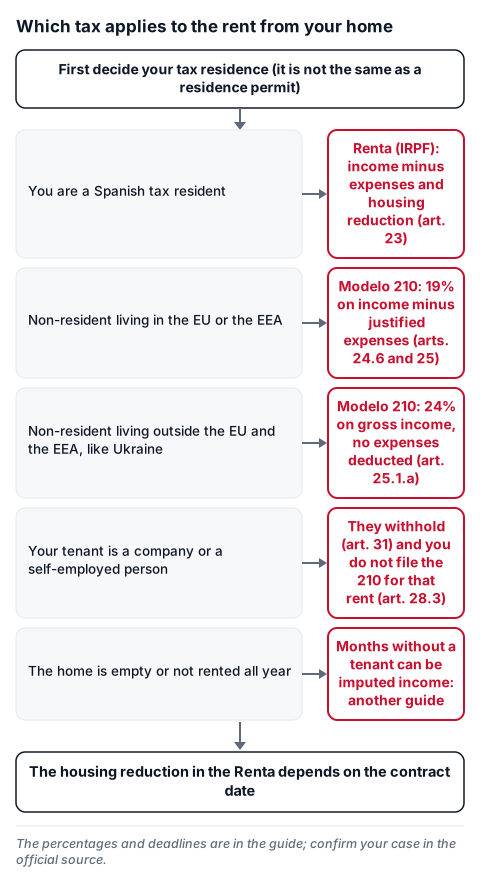
Which tax applies to you? It depends on your tax residence, which is not the same as a residence permit: the law decides it (see tax residence and the 183 days).
- Spanish tax resident: Renta (IRPF), with expenses and a reduction (arts. 22 and 23 of the IRPF law).
- Non-resident: Non-Resident Income Tax (IRNR) and the Modelo 210, on the income you earn in Spain (art. 28.1 of the IRNR consolidated text).
- Empty home, or rented only part of the year: the months without a tenant can be taxed as imputed income. See owner taxes: IBI, imputed income and Modelo 210.
- You are the tenant: the contract, the deposit and rent rises are in the guide for foreign tenants.
If you are a tax resident: rent in the Renta
Rent is "capital income from real estate" (rendimiento del capital inmobiliario). The calculation is: income, minus expenses, minus the housing reduction.
- Income: everything the tenant pays under any heading, including the goods let with the home, without VAT (art. 22.2).
- Expenses (art. 23.1 of the law and arts. 13 and 14 of the IRPF Regulation):
- Interest on the loan to buy or improve the home and other financing costs. The loan capital you repay is not among the expenses.
- Repairs and upkeep: painting, plastering, fixing installations, replacing heating, a lift or doors. An extension or an improvement does not count. These expenses and the interest cannot exceed, together and for each home, what you earn from it in the year. The excess is deducted over the following 4 years.
- Non-state taxes and surcharges, such as the IBI, and state fees and surcharges, if they affect the home or its rental and are not penalties.
- Third-party services (management, security, concierge), the cost of formalising the contract and legal defence.
- Insurance premiums for the home, services and supplies, and doubtful debts if justified.
- Depreciation: up to 3% a year of the higher of two values, the purchase cost or the cadastral value, without counting the land (art. 23.1.b of the law and art. 14.2 of the Regulation). Furniture let with the home follows a simplified table.
- If you doubt whether an expense counts, for example a special levy from the homeowners' community, ask the AEAT or an adviser: the law does not name it.
- Housing reduction (art. 23.2): it applies to the positive net income of a housing rental. The one that applies to you depends on the date you signed the contract.
- Contract signed before 26 May 2023. Art. 23.2 as it stood on 31 December 2021 applies (transitional provision 38). The preamble of Law 12/2023 speaks of "the current 60 percent reduction" of the net income.
- Contract signed from 26 May 2023. The art. 23.2 introduced by final provision 2 of Law 12/2023 applies:
- 90%: the same landlord signs a new contract on a home in a tensioned zone and the starting rent falls by more than 5% from the last rent of the previous contract, already updated.
- 70%: if that does not apply and it is the first time you let the home, it is in a tensioned zone and the tenant is aged 18 to 35. Also if the tenant is a public administration or a non-profit body that uses the home for social rent or for vulnerable people, or if the home is in a public programme that limits the rent.
- 60%: if none of the above applies and the home was refurbished, with works finished in the 2 years before the contract date.
- 50%: in any other case.
Common conditions
- The requirements are checked when the contract is signed and the reduction lasts while they are met. The cases go in order: if the first does not apply, you move to the next. With several tenants, the 70% reduction by age counts only for the share of those aged 18 to 35.
- It applies only to the positive net income that you calculate in a return filed before the AEAT starts a data check, a limited check or an inspection covering that income.
- It does not apply to the part that comes from undeclared income or wrongly deducted expenses that are regularised in those procedures, even if you accept them.
- Nor to contracts that break the limit on the starting rent in a tensioned zone (art. 17.6 of the LAU). Tensioned zones are those in the resolution of the ministry in charge of housing.
- If the tenant is your spouse or a relative up to the third degree, the net income has a floor that comes from the imputed-income rules (arts. 24 and 85).
- You declare it in the Renta of the year: the 2026 one is filed in 2027, with dates published by the AEAT (see the Renta guide).
Deductions of your region. On top of the reductions in the national law, nine regions have a regional deduction for landlords for renting out a home or for the costs of renting it: Galicia, Asturias, Cantabria, Aragón, Canarias, Extremadura, Illes Balears, Comunitat Valenciana and Comunidad de Madrid (Ministry of Finance, «Tributación autonómica. Medidas 2026», updated to 23 September 2026). Each has its own requirements: check them in your region's rules or at its tax office. In the Basque Country and Navarre their own foral rules apply.
If you are not a tax resident: the Modelo 210
- Who files: you declare the income you earn in Spain without a permanent establishment (art. 28.1 of the IRNR consolidated text). If your tenant is a private individual, they do not withhold: the duty to withhold falls, among others, on entities resident in Spain and on resident individuals with an economic activity (art. 31.1). Then you file the Modelo 210 yourself (art. 4.3 of the Order). If the tenant is a company or a self-employed person renting for their activity, they withhold and you do not file the 210 for that rent (art. 28.3).
- Base: the gross amount, without the reductions of the IRPF law (art. 24.1). By the text, the housing reduction above does not apply to a non-resident.
- Rate (art. 25.1.a): 24%. If you live in another EU or EEA state with effective exchange of tax information, 19%.
- Expenses, only if you live in the EU or the EEA (art. 24.6): the expenses of the IRPF law (the ones above) count if you prove they are directly related to the income earned in Spain and have a "direct and inseparable economic link with the activity carried out in Spain". You attach the tax residence certificate of your country, valid for one year from issue (art. 7.1 of the Order). There is also an option to be taxed as a resident for some EU residents, with its own conditions that we do not detail here (art. 46).
- Outside the EU and the EEA (Ukraine, the United Kingdom and others): 24% on gross income, without deducting expenses, under the text of the law. Ukraine is not in the EU or the EEA. The 1985 Spain-USSR treaty, which the BOE says applies to Ukraine, lets Spain tax income from property located in Spain, including rent (art. 10). How your country of residence treats the same income, ask there. There is an open debate about the limit on expenses and it is not settled in the official sources we reviewed: see "Jurisprudencia" below.
- Accrual: each rent accrues when it falls due or, if earlier, when you collect it (art. 27.1.a).
- Deadlines (art. 5 of Orden EHA/3316/2010, as worded by Orden HAC/623/2026, in force from 24 June 2026):
- With a result to pay: the first 20 days of April of the year after the accrual, filed separately or grouped. This is new. It applies to 2026 rent if you group it into one year, and to rent of the 4th quarter of 2026 if you file separately.
- Rent filed separately up to the 3rd quarter of 2026: the earlier rule continues, the first 20 days of April, July, October and January for the previous calendar quarter. The 3rd quarter of 2026 (July to September) is filed by 20 October 2026.
- With a zero result: 1 to 20 January of the next year. For a refund: from 1 February of the next year.
- If you set up direct debit for the payment, for those same 2026 rents you file from 1 to 15 April of the next year (AEAT note).
- Group or not: for rentals, the grouping period is annual (art. 2.1.b). The period on the form is 0A, or 1T to 4T if you file by quarter. If you group rent from several tenants, use income type code 35.
- New form from 2027: returns you file from 1 January 2027 use a form with more data. For rentals it asks for the days the home was let, your ownership share and the cadastral reference, and adds an annex itemising deductible expenses. Have that data ready.
- Where: online (art. 12). On paper, if you have to pay, at a bank that collaborates with the AEAT in Spain (art. 11); with a zero result or a refund, at the AEAT office for the place where the home is (arts. 6 and 11).
- Home in the Basque Country or Navarre: if you are not a resident and the home is there, the rent and the imputed income are declared to the regional (foral) tax office, under its own rules on place, form and deadline (arts. 21 and 22.2.g and h of the Basque Economic Agreement; arts. 28 and 29.1.h and l of the Navarre Agreement). Do not assume that the AEAT Modelo 210 or the deadlines above apply. If you live there, your IRPF also follows regional rules: the reductions above are those of the national law.
Worked example (not your return): rent of 12,000 € a year.
- Resident with a 2024 contract and no other conditions: expenses of 3,000 € (IBI, insurance and interest) and depreciation of 3,000 € (3% of a building value of 100,000 €, without land). Net income: 12,000 − 3,000 − 3,000 = 6,000 €. With the 50% reduction, 3,000 € is added to your taxable base and you pay under the IRPF scale.
- Non-resident outside the EU and the EEA: 24% of 12,000 € = 2,880 €, with no expenses deducted.
- Non-resident in the EU or the EEA with 3,000 € of justified expenses: (12,000 − 3,000) × 19% = 1,710 €.
Tourist or seasonal rentals: other rules
- The art. 23.2 reduction is for the lease of property used as housing. A seasonal or tourist let may fall outside it, and how it is classed depends on the contract and the LAU. On the rental decree that Congress repealed, read the news item.
- VAT: renting buildings or parts of them used exclusively as housing is exempt, including the garages, annexes and furniture let with it (art. 20.Uno.23.b of the VAT law). The exemption does not cover furnished flats with hotel-type services such as cleaning or a restaurant.
- The rules of each region on tourist lets are not in this guide.
Validity. Royal Decree-law 26/2026 provided for other reduction bands for contracts from 1 December 2026, but Congress repealed it on 2 October 2026 (BOE-A-2026-20526); it does not apply. If you signed or applied for something relying on the decree between 1 and 2 October, talk to a professional.
Documents
- Rental contract: signing date, starting rent, the tenant's details and, if it counts, their age (18 to 35). For a new contract, also the previous one, to compare the rent.
- Proof of the rent received during the year.
- Invoices and receipts for expenses: IBI, insurance, repairs and the loan interest certificate.
- Purchase deed and IBI receipt, for the acquisition cost, the cadastral value and the cadastral reference.
- Proof that the home is in a tensioned zone or that the refurbishment finished in the previous 2 years, if you claim that reduction.
- Non-resident: NIF and electronic certificate or Cl@ve, or a power of attorney for a representative. If you live in the EU or the EEA and want to deduct expenses, the tax residence certificate of your country, valid for one year.
Steps:
- Decide your tax residence with the diagram and the 183-day guide. Resident: continue with the Renta. Non-resident: continue with the Modelo 210.
- Gather the year's data: contract (date, starting rent, tensioned zone, tenant's age), rent received and proof of expenses.
- Calculate: income minus expenses and depreciation. If you are a resident, apply the reduction for your contract date. If not, use gross income, or income minus expenses if you live in the EU or the EEA and have the certificate.
- Resident: declare the rent in the real-estate capital income section of the Renta (Renta guide).
- Non-resident: choose between filing by quarter or grouping the year, check the deadline and open the Modelo 210 (filing: service that asks for identification, or the form to print). If you have no Cl@ve or certificate yet, see Cl@ve and electronic certificate.
- Keep the filing receipt, the payment receipt and the invoices: the AEAT may ask for them later.
Official source: IRPF law, arts. 22 to 24 and transitional provision 38, BOE, IRPF Regulation, arts. 13 and 14, BOE, IRNR consolidated text, arts. 24, 25 and 28, BOE, Orden EHA/3316/2010, BOE, Orden HAC/623/2026, BOE, Law 12/2023, final provision 2, BOE and Resolution of Congress of 2 October 2026 (repeal of Royal Decree-law 26/2026), BOE.
Informational only; check the official source and a professional for your specific case. Rules checked against official sources on 3 October 2026.