In short: Modelo 720 Spain is an information return, not a tax, for tax residents of Spain who hold more than €50,000 abroad on 31 December in accounts, in securities and insurance, or in real estate. The limit is counted separately in each of those three blocks. You file it online only, from 1 January to 31 March of the following year. The Modelo 720 has not been abolished: since 2022 the penalty rules are different.
In person or by representative? You file online, without going to an office. You can do it yourself with an electronic certificate, an electronic DNI or Cl@ve (Cl@ve works only for individuals). If you have no certificate, a social collaborator (a person or firm authorised by the AEAT) or an apoderado (a representative with powers) registered for this procedure can file for you. More: Modelo 720 on the AEAT website (the Tax Agency) and its technical help on filing.
Who files the Modelo 720? Tax residents of Spain, meaning people taxed here on all their worldwide income (art. 9 LIRPF, the personal income tax law). How days are counted: tax residence and the 183 days. Your first year is not split (arts. 9 and 12 LIRPF): if you spend more than 183 days in Spain, you are a resident for the whole year and what you hold abroad on 31 December counts. According to the AEAT's frequently asked questions, people under the special regime for posted workers (art. 93 LIRPF) are not obliged, but that regime does not extend to their spouse or children: if they are tax residents, the general rules apply to them. If you are under that regime, check your case with an adviser. If you are not a tax resident, you do not file this form.
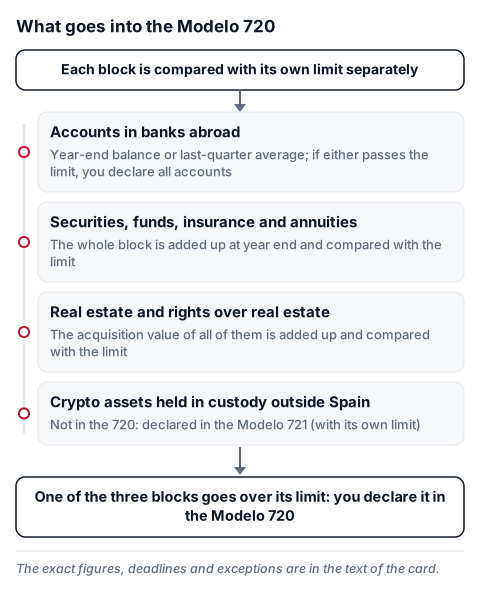
The three blocks and the €50,000 limit (arts. 42 bis, 42 ter and 54 bis of RD 1065/2007). The limit is measured separately in each block. If one block goes over it, you declare that whole block. The other blocks are not declared.
- Accounts at banks and credit institutions abroad: current, savings, term deposits, credit accounts and any other money account, with or without interest. They count if you are the holder, a representative, an authorised person or a beneficiary, or have power of disposal, and so do those of foreign companies or structures of which you are the beneficial owner (art. 4.2 of Law 10/2010, on money laundering prevention). You file if the sum of the balances on 31 December is above €50,000, or if the sum of the average balances of the last quarter of the year is above €50,000. It is enough for one of the two to be exceeded: then you declare all the accounts. Negative balances are subtracted from positive ones.
- Securities, funds, insurance and annuities: shares and holdings, ETFs and investment funds, securities deposited with a foreign broker or bank, life or disability insurance (by its surrender value, except temporary insurance that only covers death or disability) and life or temporary annuities taken out abroad. The whole block is added up on 31 December and compared with €50,000.
- Real estate and rights over real estate abroad: the acquisition value of all of them is added up and compared with €50,000. For timeshare, part-time ownership, usufruct and bare ownership you declare their value on 31 December under the Wealth Tax rules (Law 19/1991), not the acquisition value (art. 54 bis, paragraphs 3 and 4).
Example: €30,000 in one account and €25,000 in another add up to €55,000, so you declare both accounts. With €40,000 in accounts, €45,000 in shares and €30,000 in a flat you file nothing, because no block goes above €50,000, even if the total is higher. Crypto assets held in custody outside Spain do not go in the 720: they are declared in the Modelo 721, which has its own limit of €50,000.
When, and how many times. The deadline is 1 January to 31 March of the following year: the 2026 return is filed from January to March 2027. The first time you file the blocks that pass the limit. In later years you file again in only two cases. First: the total of a block rises by more than €20,000 compared with the one you declared last time (not compared with the previous year); for accounts, either total counts, the one for 31 December balances or the one for average balances. Second: you stop being the holder during the year, because you close the account or sell the property or the securities. If you never had a duty to file, you do not have to report the closing or the sale either.
In euros and at what value. Everything is declared in euros. An account in another currency is converted at the exchange rate of 31 December (if you close it during the year, the rate of the closing date), according to the AEAT's frequently asked questions. That answer does not say where to take the rate from: use an official rate of that date and keep your calculation. A property is declared at its acquisition value, with the purchase costs and taxes. If you paid in another currency, according to the AEAT's frequently asked questions that value is converted to euros at the exchange rate of 31 December of the year you declare; exchange-rate changes in later years do not count for the €20,000 rule. If you inherited it or received it as a gift, at its real value on the day you acquired it. For listed securities, the AEAT accepts using the quoted price on 31 December.
An account or a flat in Ukraine. An account at a bank in Ukraine is an account abroad and goes in the accounts block. It does not matter whether it is a current account, a savings account or the one linked to a card. A flat in Ukraine goes in the real estate block. In the rules and in the AEAT frequently asked questions we found no war exception and none for blocked or inaccessible accounts or assets. If your situation is special, check your case with an adviser. Interest, rent or gains from those assets are taxed separately, in the Renta: tax return for foreign residents.
Has the Modelo 720 been abolished? No. The Court of Justice of the EU (judgment C-788/19 of 27 January 2022) held that some aspects of the regime breached EU law. Spain responded with Law 5/2022 of 9 March (BOE of 10 March 2022): it rewrote additional provision 18 of the LGT and repealed two provisions of Law 7/2012. The duty to report remains in force and the AEAT keeps the form.
What happens if you do not file. Since Law 5/2022 the general penalties of the General Tax Law (LGT) apply, and each of the three blocks is penalised separately, according to the AEAT.
- Not filing on time (art. 198 LGT): €20 for each data item, with a minimum of €300 and a maximum of €20,000. If you file late on your own, before the AEAT asks you to, everything is halved: €10 per item, minimum €150 and maximum €10,000.
- Filing incomplete, inaccurate or false data (art. 199 LGT): it has another scale of fines, which depends on the type of data. Check your case.
- Ignoring a request from the AEAT: the penalty for not answering it can be added (art. 203 LGT).
A «data item» (dato) is each piece of information: for each account, among others, its identification, each date and each balance count (art. 42 bis of RD 1065/2007). The power to penalise expires after 4 years from the moment the infringement is committed, and actions by the AEAT aimed at penalising interrupt that period (art. 189.2 and 189.3 LGT). If you had a duty to file and did not in past years, filing now on your own costs less than waiting for the AEAT to ask you.
How does the tax office know about my accounts abroad? Besides what you declare yourself, there is an automatic exchange of financial account information between tax administrations. The LGT covers it in its additional provision 22, with Directive 2011/16/EU, a multilateral agreement and the FATCA agreement with the US. What data reaches Spain depends on the country of the account: we could not confirm whether, for example, Ukraine does it. The duty to file does not depend on the tax office already knowing.
Documents
- NIE or NIF and a way to identify yourself: an electronic certificate, an electronic DNI or Cl@ve.
- Accounts: name and address of the institution, identification of the account (IBAN or number), opening or closing date, your status (holder, representative, authorised person, beneficiary) and your percentage. From the bank: balance on 31 December and average balance of the last quarter (statements).
- Securities, funds and insurance: institution, number and class of shares or holdings, value on 31 December (annual report from the broker or bank) and, for insurance, the surrender value.
- Real estate: country, town, street and number, date and value of acquisition with costs and taxes (deed, contract or inheritance or gift document) and your percentage.
- The exchange rate of 31 December for each currency and your calculation, to keep.
Indicative list: it comes from the data required by arts. 42 bis, 42 ter and 54 bis of RD 1065/2007; check it in the AEAT form.
When you do not file, and doubtful cases
- Below the limit in each block. You do not file, even if the sum of the three blocks is higher.
- Shared account or property. The limit is measured with the full balance or value, without dividing it among the holders. If you pass it, each obliged holder declares the total and notes their percentage. For community property both spouses declare: the formal holder with 100% and the other with 50%.
- Someone else's accounts. If you are a representative or an authorised person, or have power of disposal, they count for you (art. 42 bis RD 1065/2007).
- Highest balance during the year. It does not count: only the balance on 31 December and the average balance of the last quarter matter.
- Pension plans abroad. You do not report them until they are paid as a temporary or life annuity, unless the plan lets you withdraw the money.
- Cash, jewellery, works of art or physical gold. They are not declared as such. A unit-linked insurance is declared.
- Inheritances. The heir reports from the moment of accepting the inheritance, at the real value of the asset on the day it was acquired.
- Neobanks, brokers and electronic money institutions. The institution and the product matter: a money account at a bank or credit institution goes with the accounts, and deposited securities go with the securities. We have not confirmed in the AEAT frequently asked questions whether accounts at electronic money or payment institutions count as accounts of the first block: check your case. We do not assess specific companies.
- Blocked or inaccessible accounts. We found no exception. Check your case.
Steps:
- Check that you are a tax resident in the year you declare: tax residence and the 183 days. You need a NIE: if you do not have one yet, see how to apply for the NIE.
- Group what you hold abroad into the three blocks and convert it to euros: balance on 31 December and, for accounts, also the average balance of the last quarter. Subtract negative balances.
- Compare each block with €50,000: for accounts it is enough that one of the two balances is above it; for securities and insurance the value on 31 December counts; for real estate, the acquisition value. If a block goes over, that whole block is declared.
- Gather the data from the list of documents and the exchange rate of 31 December.
- Get a way to identify yourself: an electronic certificate, an electronic DNI or Cl@ve. How: Cl@ve and electronic certificate.
- Open the Modelo 720 page on the AEAT website, open the form and fill it in. File from 1 January to 31 March of the following year, online only. Keep the receipt and your calculations.
- In later years, file again only if a block rises by more than €20,000 (for accounts, either total counts) or if you stop being the holder. Crypto assets are declared separately, in the Modelo 721, with its own limit of €50,000.
Official source: additional provision 18 of the LGT, BOE, RD 1065/2007, BOE, Order HAP/72/2013, BOE and AEAT, Modelo 720.
Informational only; check the official source and a professional for your specific case. Figures and rules checked on 1 October 2026.