
In short: the Beckham law is the popular name for Spain's special impatriate regime (art. 93 of the IRPF law, the personal income tax law). The main requirements of the Beckham law in Spain: you were not a Spanish tax resident in the previous 5 years, and you move for work, as a company director, to start a business or as a highly qualified professional. If you qualify, you can be taxed as a non-resident for 6 years: 24% up to €600,000 of work income and 47% above that. You opt in with the Modelo 149, at most 6 months after the activity starts.
In person or by representative? Everything is online. The Modelo 149 is filed only on the internet (Order HFP/1338/2023, art. 8), with a recognised electronic certificate (including the electronic DNI one) or Cl@ve PIN, according to the AEAT instructions, and before that you need a NIF and a place in the census of the AEAT (the Tax Agency). The form has a section for a representative; how the representation is proved we have not checked. How to get the certificate or Cl@ve: Cl@ve and electronic certificate. If you do not have a NIE yet: how to apply for the NIE.
What it is. It is not a deduction or an exemption from the ordinary Renta: it is another way of calculating the tax. You remain an IRPF taxpayer, but the tax is worked out with the IRNR rules (non-resident income tax), that is, on what you earn in Spain. The exception is work: during the regime, everything you earn from work or from an entrepreneurial activity counts as earned in Spain, even if you do it from another country (art. 93.2 of the law). Work done before the move or after the end of the displacement is left out (art. 114.2.a of the regulation).
Who can use it (art. 93.1 of the IRPF law). All three conditions must be met at once:
- You were not a Spanish tax resident in any of the 5 years before the year you arrive. How residence is measured: tax residence and the 183 days.
- You move to Spain, in the first year of the regime or the year before, for one of these reasons:
- An employment contract (the special employment relationship of professional athletes does not count). It is met if you start working for an employer in Spain, if your employer sends you and there is a displacement letter, or if you work remotely using only IT and telecommunication means. The law names in particular employees with the international teleworking visa: visa requirements.
- Becoming a director of an entity. If it is an asset-holding entity (entidad patrimonial), your stake cannot make it «related» to you under the Corporate Tax law.
- Carrying out an entrepreneurial activity in Spain: innovative or of special economic interest, with a favourable report from ENISA (the National Innovation Company). Whoever needs a residence permit must hold the business-activity authorisation before moving; EU citizens ask ENISA for the report themselves (art. 113.2 of the regulation).
- Being a highly qualified professional who provides services to an emerging company (startup), or doing training, research, development and innovation, with that work making up more than 40% of your business, professional and work income.
- Not earning income through a permanent establishment located in Spain (a fixed presence of a company, such as an office). Entrepreneurs and the professionals in the last two cases are exempted.
Family. Your spouse and your children under 25 (any age if disabled) or, with no marriage, the parent of your children, can also join (art. 93.3). They must move with you or later, before your first year in the regime ends. They must also become Spanish tax residents and meet the 5-year condition and the no-permanent-establishment condition. And the sum of their taxable bases must be lower than yours. If you renounce or are excluded, they leave with you.
Is it worth it? The law does not ask for a minimum salary to opt in, and we do not set a salary above which it pays off: it depends on your case. The mechanics are these. The 24% applies from the first euro of work income, while the ordinary IRPF scale is progressive: it has low brackets with rates below 24% and high brackets above it. In exchange, income from foreign sources that is not work (interest or dividends from abroad) does not enter the base, because the regime taxes what is earned in Spain. The renunciations in the table weigh against that. The teleworking visa has its own financial-means requirement, but that is another rule. Running the numbers with your figures and your region is a job for a tax adviser.
What you pay and what you give up
| Ordinary Renta (IRPF) | Beckham regime | |
|---|---|---|
| What is taxed | All your income, wherever it comes from | What is earned in Spain and all the work and entrepreneurial income of the period |
| Work and entrepreneurial income | Progressive scale (state plus regional) | 24% up to €600,000; 47% from €600,000.01 |
| Savings (in general, dividends, interest and capital gains from Spanish sources) | IRPF savings scale | 19% up to €6,000; 21% from €6,000 to €50,000; 23% from €50,000 to €200,000; 27% from €200,000 to €300,000; 30% from €300,000 |
| Personal and family minimum and reductions | Yes | No: the base is the sum of all income, with no offsetting between them |
| Tax credits | State and regional | Only those of art. 26 of the IRNR law and the international double taxation credit, with a limit (art. 114.2.b of the regulation) |
| Withholding on pay | According to the IRPF scale | 24%; 47% on what a single payer pays you above €600,000 in the year |
| Wealth tax (Patrimonio) | On all your assets | On a real-obligation basis: in general, only assets and rights in Spain |
| Annual return | Modelo 100 (the Renta) | Modelo 151 |
| Duration | No limit | The year of the move and the next 5 (6 years) |
The rows on minimums, reductions and credits come from reading art. 93.2 of the law, art. 114 of the regulation and arts. 24.1 and 26 of the IRNR law together: confirm them with an adviser before opting in. How the ordinary return works: tax return for foreign residents.
The year of the move is the first calendar year in which, after the displacement, you spend more than 183 days in Spain (art. 115 of the regulation): if you arrive late in the year, it may be the next one.
Other points to check
- Modelo 720 (assets abroad): what it is and who files it. We have not found an official rule or instruction saying whether someone under this regime files it. The tax management regulation requires it from «residents in Spanish territory» and its exceptions do not mention this regime, while art. 93 says you remain an IRPF taxpayer. It is not confirmed: ask an adviser before assuming the 720 does not apply.
- Double taxation: the regulation allows the international double taxation credit for work and entrepreneurial income earned abroad, capped at 30% of the part of the tax that corresponds (art. 114.2.b).
Renouncing or leaving the regime
- Renunciation: only in November and December before the year it must take effect, with the Modelo 149. If you are an employee, you first give your payer the data communication (art. 88 of the regulation) and attach a stamped copy.
- Exclusion: if you stop meeting a condition, you are excluded from that year and you report it within 1 month with the Modelo 149. From then on withholding goes back to the IRPF rules (on work income, from when you tell your payer).
- End of the displacement without losing tax residence: reported within 1 month with the Modelo 149.
- Whoever renounces or is excluded cannot opt in again. If the principal taxpayer renounces or is excluded, their spouse and children leave with them.
Deadlines and mistakes
- The 6 months count from the activity start date shown in the Social Security registration (or in the documents that allow you to keep the home-country Social Security legislation; if there is no compulsory registration, in the document proving the start). For the spouse and children: 6 months from their entry into Spain or the principal's deadline, if longer (art. 116 of the regulation).
- The regulation speaks of a maximum deadline and does not provide for a later option. We have not seen a route to opt in late in arts. 113 to 120: whoever lets the 6 months pass is left without the regime.
- The documents are uploaded before the Modelo 149 and the registration number is part of the form: do not leave it for the last day.
- You cannot opt in if you earlier used the special withholding procedure of art. 89.B of the regulation (art. 116.3).
- If you already apply the regime and start another entrepreneurial activity, you also need the ENISA report for it. For the whole regime, the only economic activities the regulation admits are the entrepreneurial one, services to emerging companies and training, research, development and innovation (art. 113.2).
When it does not work
- You were a Spanish tax resident in any of the 5 years before you arrived, for example if you have lived here for years.
- You move for another reason and there is no contract, no director role, no entrepreneurial activity, no job in a startup or in R&D. Example: Ukrainians with temporary protection who have none of those routes: art. 93.1.b has no other.
- You are self-employed (freelance) and your activity is not entrepreneurial with an ENISA report, nor services to an emerging company, nor training, research, development and innovation: art. 93 has no route for that case.
- You let the 6 months pass.
- You earn income through a permanent establishment in Spain, except in the entrepreneur and qualified professional cases.
- Your employment relationship is the special one of a professional athlete (excluded from the employment-contract route).
- Living in the Basque Country or Navarre. There, the IRPF of people with habitual residence is levied by the regional (foral) tax office under its own rules (Economic Agreement with the Basque Country, art. 6; Economic Agreement with Navarre, arts. 1 and 9). This page describes the regime of the state law: ask your foral tax office whether it has a similar regime and on what conditions.
Documents
- For everyone: proof of the Social Security registration (or of the documents that allow you to keep the home-country Social Security legislation; if there is no compulsory registration, a document proving the activity start date) and the residence authorisation, if you have one.
- Employment contract: a document from the employer recognising the employment relationship, with the start date, workplace and contract duration.
- Displacement ordered by your employer: a copy of the displacement letter and an employer document with the start date, workplace and duration of the order.
- Remote work not ordered by the employer: an employer document recognising the employment relationship, with the start date and estimated duration of the work in Spain.
- Director: a document from the entity with the date you became a director and, for an entidad patrimonial, that your stake does not make it a related entity.
- Entrepreneur: a favourable ENISA report, unless you provide the residence authorisation for entrepreneurs.
- Highly qualified professional: proof of your qualification (unless you provide the highly qualified professional residence authorisation), registration of the emerging company in the commercial register or the cooperatives register, and a document showing you provide services to it.
- Training, research, development and innovation: a document on those activities (art. 113.2 of the regulation), unless you provide the researcher residence authorisation.
- Spouse and children: documents proving the link with the principal taxpayer.
Indicative list, by route and taken from the AEAT instructions for the Modelo 149: check it on the official site.
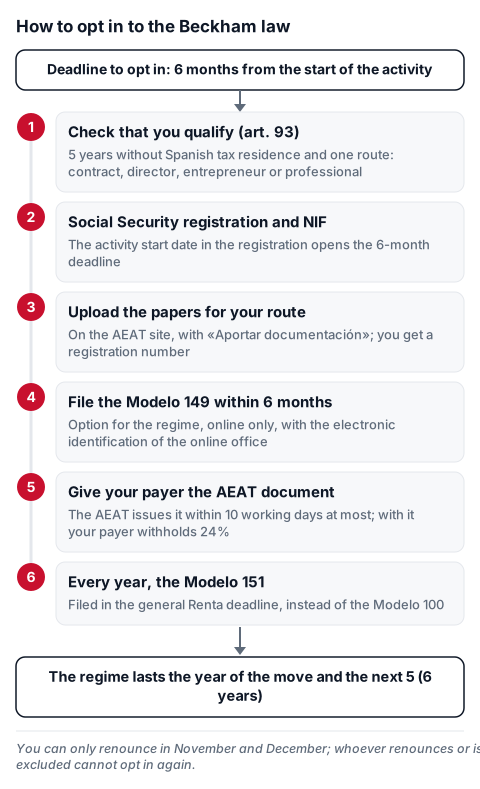
Steps:
- Check that you qualify: 5 years without Spanish tax residence, one of the routes in art. 93.1 and no permanent establishment. Note the start date of your activity: it opens the 6-month deadline.
- Have a NIF or NIE, the Social Security registration and an electronic certificate or Cl@ve PIN (both are valid to file the Modelo 149, according to the AEAT instructions). Being in the census of tax obligations is a prior requirement to file the Modelo 149.
- Gather the documents for your route (list above).
- Upload the documents in «Modelo 149. Aportar documentación necesaria para optar por el régimen especial», linked from the Modelo 149 page, and note the registration number you receive.
- File the Modelo 149 on the internet (instructions to fill it in). Tick «Opción por el régimen» (31), enter the registration number of the documents (32), the date of entry into Spanish territory (51), the activity start date (52), the last country of residence (53) and your country of nationality (67), and fill in the section for your cause of displacement. Spouse and children file their own Modelo 149 as associated taxpayers, after the principal and with the principal's Modelo 149 receipt.
- Wait for the document that proves your option: the AEAT issues it, where applicable, within 10 working days at most from filing (art. 119.4 of the regulation). Give it to your payer so they withhold 24%.
- Every year file the Modelo 151 in the general Renta deadline, instead of the Modelo 100: Modelo 151 page.
Official source: art. 93 of the IRPF law, BOE, arts. 113 to 120 of the IRPF regulation, BOE, AEAT, Modelo 149 and Order HFP/1338/2023, BOE.
Informational only; check the official source and a professional for your specific case.