
In short: the joint Instruction of 29-30 March 2023 sets the practical requirements for the international teleworker visa and residence permit (the "digital nomad" route), added to Ley 14/2013 by Ley 28/2022 (chapter V bis).
In person or by representative? It depends on the step. The residence permit is processed by the UGE-CE online, with no visit to an office (art. 76.1 of Ley 14/2013). You can act through a representative if the representation is proven, for example with an apud acta power of attorney or one entered in the electronic register of powers of attorney (art. 5 of Ley 39/2015). The visa is issued by Spanish consulates (art. 75.1 of Ley 14/2013). Under the general visa rules of the Immigration Regulation, you file and collect the application in person at the consular office (or at its external service provider, or electronically where an application exists). A representative is allowed only where the rules provide for it or, as an exception, if you live far from the consulate or have transport or health problems, prove it and the consulate agrees (art. 26.1 of RD 1155/2024). The TIE is requested in person (art. 209.1 of RD 1155/2024). Whether your consulate accepts a representative for this visa: ask the consulate itself; for the permit, ask the UGE-CE ([email protected]).
Who: foreign nationals who telework for one or more foreign companies, as employees or self-employed. It does not apply to those who fall under intra-company transfer (arts. 73 and 74 of the law).
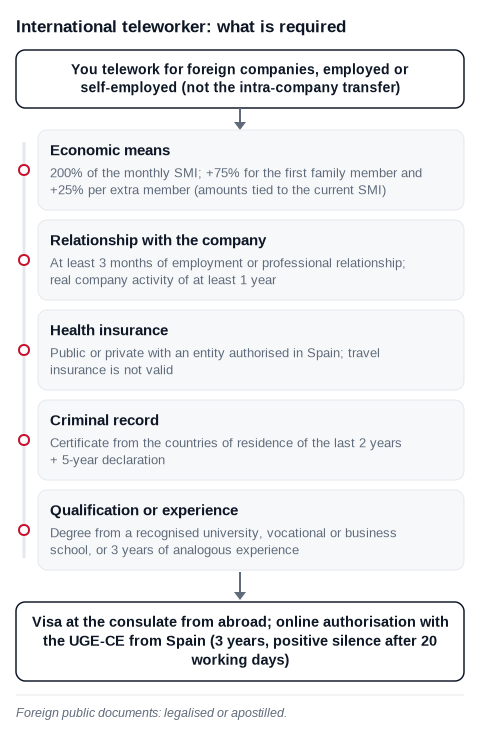
Main requirements (per the Instruction)
- Economic means (art. 62.3 f): holder, 200% of the SMI monthly; for the first dependent family member, an additional 75% of the SMI; an additional 25% of the SMI per extra member. With the 2026 SMI (€1,221/month × 14 payments = €17,094/year), the approximate monthly amounts are: holder ≈ €2,850; +≈ €1,070 for the first family member (a couple ≈ €3,920); +≈ €360 per additional member. Figures are indicative, tied to the current SMI: they change every year.
- Relationship with the company: employment or professional relationship of at least 3 months as of the application date; and real, continuous activity of at least 1 year of the foreign company or group.
- Health insurance (public or private, with an entity authorised in Spain), active for the whole validity period; travel insurance is not valid.
- Criminal record certificate from the countries of residence over the last 2 years + a declaration of no record over the last 5 years (not required if you already hold a Spanish permit or stay longer than 6 months).
- Qualification or experience (art. 74 bis): a degree from a recognised university/vocational/business school, or professional experience of at least 3 years in analogous functions.
Documents (Instruction Eighth): full valid passport; proof of the fee; signed form; proof of the work relationship (3 months) and of the company's activity (1 year); company letter authorising remote work (employees) or terms of the activity (self-employed); economic means; criminal record; insurance; Social Security responsibility declaration; qualification or experience. Foreign public documents must be legalised or apostilled.
Where to apply? The visa is requested at the Spanish consulate abroad. The residence permit is processed online with the Large Companies and Strategic Collectives Unit (UGE-CE). If applied for while legally in Spain, the initial authorisation is valid for 3 years and positive administrative silence applies: if there is no decision within 20 working days, it is deemed granted (Ley 14/2013).
Applying from inside Spain. The permit can be requested by those who are in Spain lawfully or entered with the teleworker visa (art. 74 quinquies.1); one of the general requirements is not being in Spain irregularly (art. 62.3 a). A stay (estancia) is remaining in Spain for up to 90 days (art. 30.1 of LO 4/2000). Filing the application extends your current residence or stay status until the decision (art. 76.1). If you entered as a tourist, confirm your case with the UGE-CE ([email protected]) before filing.
Fees. You must pay the fee for the permit or the visa (art. 62.3 g). With the initial permit application you attach proof of payment of form 790 code 038 (UGE-CE). According to the UGE-CE FAQ, the fee for initial applications is €73.26, for the holder and for family members alike, and it is paid online before filing (card, direct debit or Bizum); check the amount on the payment gateway. For the renewal fee, ask the UGE-CE. The visa fee is charged by the consulate: amounts are set by ministerial order and may be adjusted on the basis of reciprocity, so they can depend on your nationality (art. 48 of LO 4/2000). For example, the consulate in Bogotá says Colombian citizens are exempt from the fee for this visa and publishes the amount for everyone else. Check the amount on your consulate's visa page.
Age. The law requires you to be over 18 (art. 62.3 b) and to have a degree or at least 3 years of experience (art. 74 bis.2). Among the requirements in the law there is no other age limit.
Clients in Spain (20% limit). If your relationship is employment (as an employee), you can only work for companies located outside Spain. If you carry out a professional activity (self-employed, with a commercial relationship), you can also work for a company in Spain, as long as that work is no more than 20% of your total professional activity (art. 74 bis.1; PRIE). If your contract is for services and the company pays your contributions, ask the UGE-CE whether it counts as an employment or a professional relationship.
Duration and renewal. The visa lasts up to 1 year; within the 60 calendar days before it expires you can apply for the residence permit, if the conditions are kept (art. 74 quater). The permit lasts up to 3 years (art. 74 quinquies.2) and is renewed for periods of 2 years while the conditions that gave the right are kept; renewal is filed electronically and the Directorate-General for Migration may request reports to check this (art. 76.3). If the permit lasts more than 6 months, you must apply for the TIE (art. 76.2). A renewal application extends validity until the decision, also if you file it within 90 days after the previous permit ends, without prejudice to a possible penalty procedure (art. 76.3). At renewal, the authorities check that the conditions of the grant still hold, and foreign public documents must be legalised or apostilled (joint Instruction, Eighth.4 and 5).
Family members. Your spouse or partner, minor children or adult dependent children who have not formed their own family, and dependent ascendants can apply for the permit and, where relevant, the visa, together with you or later; the general requirements of art. 62.3 must be proven (art. 62.4). Which documents family members need at renewal: ask the UGE-CE ([email protected]).
Social Security. There are no special rules for this permit: you comply with the Social Security obligations of current law. The application includes a declaration from the company (employees) or from you (self-employed) committing to comply with them before starting work. If you stay in your home country's Social Security under a convention, the certificate of applicable legislation is added. If you are an employee and no Social Security convention signed by Spain covers you, proof is added that the company is registered with Spanish Social Security (if you apply for the visa from outside Spain, proof that it has applied to register) (joint Instruction, Sixth).
RETA registration (self-employed). If you are self-employed, the UGE-CE asks for a commitment to register in the RETA once the permit is granted and before starting the activity in Spain (UGE-CE). According to its FAQ, if you do not register immediately after getting the permit and this is detected in a later review, the permit is extinguished, also for dependent family members.
Changing company, a Spanish employer or days in Spain. In an employment relationship, this permit does not allow you to work for an employer in Spain (art. 74 bis.1): a different permit is needed. How to move from this permit to a Spanish employer: ask the UGE-CE ([email protected]) or the Oficina de Extranjería. If the foreign company changed, renewal checks that the conditions of the grant still hold, and foreign public documents must be legalised or apostilled (joint Instruction, Eighth.4 and 5). Which exact documents the UGE-CE asks for after the change, and whether they include a QR code, is confirmed with the UGE-CE.
Absences from Spain. The permit allows you to remain in Spain to telework (art. 74 bis.1) and is renewed while the conditions that gave the right are kept. The Directorate-General for Migration may request reports to check this (art. 76.3). The law applies without prejudice to your tax and Social Security obligations (art. 62.5). The Regulation provides that temporary residence permits are extinguished, by a resolution, when the requirements or conditions of each type of permit stop being met, unless the permit's own rules say otherwise (art. 200.2.d of RD 1155/2024). Whether that rule reaches your Ley 14/2013 permit, confirm with the UGE-CE. How many days you can spend outside Spain, for example more than 6 months in a row, without affecting the permit or its renewal, and how your taxes are checked at renewal: ask the UGE-CE. To apply later for long-term residence (5 years of legal and continuous residence), continuity is not broken by absences of up to 6 months in a row if they add up to no more than 10 months over those 5 years; for work-related absences the total can reach 18 months (art. 183.2 of RD 1155/2024).
Official source: International teleworkers (PRIE — Comercio) · Initial applications: documents (UGE-CE) · Joint Instruction — international teleworkers (Inclusión) · Ley 14/2013 consolidated (BOE).
See also: the former residence-by-investment route (Golden Visa) no longer exists, see Golden Visa abolished and alternatives.
Informational only; check the official source and a professional for your specific case.
