
In short: the student visa extension in Spain (officially the "prórroga" of your student stay authorisation) is filed electronically in the 2 months before the authorisation expires (it is also accepted up to 3 months after, but a penalty procedure may then be opened), with the immigration office (Oficina de Extranjería) of the province where it was granted. You must show that you are still studying, with enrolment paid, and pay form 790-052 (17.49 €). Higher studies and post-compulsory secondary studies allow up to 2 extensions; training activities, such as a language course, only 1.
This is for people who already hold the initial student stay authorisation in Spain and want to keep studying. If you want to work after your studies, see the switch to residence and work or the permit to look for a job or start a business. This page does not cover volunteering or pupil mobility programmes.
In person or by representative? The extension is filed electronically, by you or through a representative, on the official form (art. 55.4 of RD 1155/2024; Sheets 1 and 2 of Migraciones). Who can act as a representative: Sheet 60, persons entitled to apply. The only in-person step is the TIE card: if the extension is granted, you apply for it in person at the police station within 1 month of the notification. How: TIE, how to get it.
Deadlines
- When to file: during the 2 months before the date your authorisation expires; also up to 3 months after, with a possible penalty procedure (art. 55.4; Sheets 1 and 2).
- Which date to choose: once your enrolment is paid and inside the window, which opens 2 months before expiry (our calculation: if it expires on 30 September, from late July). If your university lets you pay enrolment in July or August, do not wait for the end of the September enrolment period: the 3 months after expiry are a safety net with a penalty risk, not the normal deadline. If your centre's payment and enrolment deadline does not fit the application deadlines, the paid-enrolment requirement (art. 53.1) is met if you prove that situation and commit to paying; the office may later check that you did (Instrucción SEM 3/2025, second instruction). Enrolment paid in instalments or with an exemption is also fine if you prove it.
- While you wait: filing on time extends the validity of your previous authorisation until the decision. The same applies if you file within the 3 months after expiry, "without prejudice" to a penalty procedure being opened (art. 55.4). What that would mean in your case, ask the immigration office.
- Reply: if 1 month passes without notification, the application is treated as refused by administrative silence (art. 55.4). What to do after a refusal: appeals.
- Length: that of the course you are enrolled in, up to 1 year (art. 55.5).
- How many: up to 2 extensions per authorisation for higher studies and post-compulsory secondary studies; only 1 for training activities (art. 55.5). The limit counts the extensions of that same authorisation: if you have not had any yet, the one you request is the 1st, also if you are already in the 3 months after expiry, because Sheet 1 also calls the one filed in those 3 months «an extension» (our deduction; for example, with an authorisation that expired on 31 August, those 3 months run to about 30 November, our calculation).
- If you work with your stay: the work authorisation lasts as long as the stay. If the extension is refused, it ends; if it is granted, it is extended automatically while the circumstances remain (art. 57.4). The extension's document list (Sheet 1) does not include timetables or proof that work is compatible with the studies: that document is asked for when you apply for the work authorisation in intermediate-level FP or language courses (Sheet 4 bis), and with higher studies you work without an extra procedure if it is compatible with the studies.
Changing studies, pausing or using up the extensions. You can request the extension even if you change to different specific studies, as long as you stay in the same category ("supuesto") of art. 52 (SEM interpretative criteria, 7 Aug 2025, section 18). The categories are: higher studies (52.1.a); post-compulsory secondary (52.1.b), which includes, for example, the Bachillerato and intermediate-level FP cycles; volunteering (52.1.d); language assistant (52.1.e.1); Spanish or co-official language course (52.1.e.2); preparation for specialised health training (52.1.e.3); technical aptitude certification or professional qualification (52.1.e.4); and professional certificate of level 2 or 3 (52.1.e.5). Moving from one intermediate-level FP cycle to another, or from one professional certificate to another, keeps you in the same category. If you switch to another category, for example from a professional certificate to a language course, the extension does not cover the change: ask the immigration office which application applies.
- A break in your studies: the SEM treats having stopped studying or attending the centre as a ground for ending the authorisation, especially if you have been working, and it can refuse the extension if the stay has been used for other purposes, for example when your activity has been limited to working (Criteria, sections 18 and 21; art. 200.2.c). How a specific break affects your case, ask the immigration office.
- If you use up the extensions: the only option is a new initial authorisation with all the requirements. You can apply again for the same studies, but the office assesses case by case whether it is an abuse of right and, if so, refuses it; that is why you must submit a reasoned justification with the application, and if you do not, they ask for it (Criteria, section 18). Extensions obtained under the earlier regulation (RD 557/2011) do not count towards the limit.
- A 1-year authorisation in higher studies: since 20 May 2025 you have the right to a stay for the whole length of the degree. With a 1-year authorisation you can request an extension or an initial authorisation for the time you have left; in the second case you provide the official total length of the studies and the years remaining (Criteria, section 18).
Authorisation longer than one year. For higher studies the authorisation can last as long as the official length of the degree (art. 55.1). When it is granted for more than 1 year, to keep it valid you (or your centre) must provide every year, at the start of each course, the enrolment or an equivalent document showing you are still on those studies (art. 55.2; Sheet 1). This yearly proof is a separate obligation from the extension. How and where to provide it, ask the immigration office.
Requirements
- Still studying: admission to the centre and enrolment or registration fees paid (art. 53.1). For higher studies the authorisation is for a full-time programme, that is, enrolment in at least 90 % of the credits or, if it is not measured in credits, of the programme (art. 52.2).
- A valid passport or travel document with at least 1 year of validity (art. 35.b).
- Funds: each month 100 % of the IPREM (the public income indicator set by the State; check the current figure). Accommodation prepaid for the whole stay counts within that figure: including its value, the total must reach 100 % of the IPREM per month (SEM interpretative criteria, section 5). If family members depend on you, add 75 % of the IPREM for the first and 50 % for each of the others. Scholarships, grants, subsidies and, if your authorisation allows work, a valid work contract or a firm job offer count. Money you will use to pay for your studies does not count (art. 35.h).
- Figure for 2026: 100 % of the IPREM is 600 € a month (IPREM 2026), that is 7,200 € for 12 months (our calculation: 12 × 600 €). How much to show for the return to your country, ask the immigration office.
- Family money (parents, siblings): any means of proof works, own or from family, grants or scholarships (Sheet 1), and it has to cover the period you request and the return trip, not the earlier visa period. Which proof of kinship your office accepts, confirm with it; university guides ask, for example, for a letter from the parents with a copy of their passport and statements (see «Community experience»).
- Work contract and rental: a contract counts if your authorisation allows work. With higher studies you can work without an extra procedure if it is compatible with the studies, in general up to 30 hours a week (arts. 57.1 and 57.2). A contract of 14,000 € a year is about 1,167 € a month (our calculation), above 600 €. On housing, the rule takes into account accommodation prepaid for the whole stay (art. 35.h), and the SEM also treats as secured the home of a relative up to the second degree if you prove, all together, the family link, the title under which they occupy it and their signed declaration that you will have it throughout the authorisation (SEM interpretative criteria, section 5). A rental contract is not one of those cases: if you want to submit it, first ask the immigration office whether and how they count it.
- Health insurance with an insurer authorised to operate in Spain, with benefits similar to the basic common service package of the National Health System, valid for the planned length of the stay (art. 35.i). A 6-month policy does not cover an extension for a whole course; UNAV asks for cover for the whole course, from 1 September to 31 August, with start and end dates (2026-04; Navarra). If you work with your authorisation, registration with Social Security meets this requirement (art. 57.5).
- Not being a threat to public order, public security or public health, checked through criminal records in Spain and the police report (art. 53.2).
- Fee paid (art. 53.3; Sheet 1 and Sheet 2: fee receipt).
Documents
- A valid passport or travel document, recognised as valid in Spain, with at least 1 year of validity.
- Proof of funds for the period you request and for the return to your country. Any means of proof is accepted: own or family funds, subsidies, grants and scholarships, among others.
- Proof of health insurance.
- Proof that you are admitted to the institution or centre and have paid the registration or enrolment fees. For higher studies Sheet 1 asks for admission and paid enrolment, not grades or achievement certificates; passing the course is required only for language courses (art. 55.5). In practice, UNAV uses the enrolment report and the academic record report issued by the university itself (2026-04; Navarra), and UAB the academic record of the previous year; for a PhD, a letter from the programme coordinator (Barcelona).
- Receipt of the fee payment.
- If you submit documents from another country: translation into Spanish by a sworn translator and, in general, an apostille or legalisation (Sheet 1; Sheet 61). More in sworn translator and sworn translation.
- The extension list does not include registration at the town hall (empadronamiento) or a medical certificate: art. 55.3 only refers to the passport, funds and insurance (art. 35.b, h, i), plus art. 53. Criminal records from other countries are asked for in one case only: if your initial authorisation was for less than 6 months and the extension takes you over 6 months, and you are an adult under criminal law, you must show a clean record in the countries where you lived in the last 5 years (art. 35.j; Instrucción SEM 3/2025, fourth instruction). If a clean certificate is already in your file and you show you have not left Spain, it is not asked for again; and if the initial authorisation and the extension do not add up to 6 months, it is not required either (SEM interpretative criteria, section 18). Some universities ask for the empadronamiento depending on the case (see «Community experience»). Curricular internships that are part of the study plan need no other authorisation: they are covered by the stay authorisation (art. 57.1).
Cost
- Form 790 code 052, item 1.1.2: 17.49 € (Order PJC/617/2025, BOE-A-2025-12056), for the main holder and family members. Amounts can change: check the current one on the form.
- The payment receipt is among the documents of the application (Sheet 1). How it is generated and paid: form 790 code 052.
- When to pay: Sheet 1 puts the receipt among the documents of the application, and the UNAV and UAB guides say to pay first and attach it (Navarra and Barcelona). The Order sets payment at the moment of electronic filing for residence or work applications (art. 2.3) and, in general, gives 10 working days from filing (art. 2.5); the extension is a stay, not a residence, so if the site shows you another moment, confirm with the immigration office.
- TIE after the extension: 19.30 € (form 790-012, item 4.3 of Order PJC/617/2025), different from the 052. Check the amount on the form.
Where
- Electronic filing: Mercurio, the electronic office of the Ministry of Territorial Policy and Democratic Memory, which Sheet 1 names as the online channel for the initial application; for the extension, Sheet 1 and art. 55.4 say «electronic means» without naming the site. Step by step: Mercurio, how to file.
- Addressee: the immigration office of the province where you got the initial authorisation, not necessarily the one where you live today.
- Access to Mercurio: the site says you need a recognised digital certificate or the electronic ID card (DNIe), and the Autofirma program to sign the form and the documents when registering the application. The Spanish mint (FNMT) issues the certificate to a foreigner who proves their identity at an office with the foreigner identity card showing the NIE, or with the official document granting the NIE, together with the passport. If you have no certificate, art. 55.4 allows the extension to be filed through a representative (Sheet 60, linked above), and the site provides its own access for graduados sociales, gestores administrativos and lawyers. If your visa gave you neither an NIE nor a document granting one, confirm with the immigration office how to get in.
- All of Spain: the Regulation and the electronic office are national and apply the same in all of Andalusia and in every other province. What changes is each office's practice and what universities ask for: how long they take, what insurance amount they ask for, whether they ask for empadronamiento. Examples from Jaén, Navarra and Barcelona in «Community experience».
Training activities (Sheet 2). These are the ones in art. 52.1.e: language assistant in a Spanish school; an in-person Spanish or co-official language course at an official language school or a centre accredited by the Instituto Cervantes or a similar body; a course preparing for the specialised health training exams; training leading to a technical aptitude certificate or professional qualification; and a full vocational training professional certificate. The extension has the same deadline, the same electronic channel and the same addressee. It lasts as long as the activity, up to 1 year, and can be requested only 1 time. Sheet 2 lists the same five documents (valid passport, funds, insurance, admission with paid enrolment, and fee receipt). Art. 55.3 also applies art. 35.b here, which requires a passport with at least 1 year of validity. The fee: item 1.1.2 names studies, mobility, non-work placements and volunteering; for training activities, confirm the item and the amount on the form and with the immigration office.
- Language course (art. 52.1.e 2.º): to grant it, they require that you passed the course you were enrolled in if it is an Official School of Languages. In other centres, you need a DELE diploma (Diplomas of Spanish as a Foreign Language), to have registered for that exam, or a diploma from the International Spanish Language Evaluation Service (art. 55.5).
- Specialised health training preparation (art. 52.1.e 3.º): you must show that you sat the selective exams (art. 55.5).
What is not confirmed
- Electronic filing. Art. 55.4 and both Sheets say "electronic means". The Supreme Court ruling of 8 July 2026 annulled art. 197.2, the general list of procedures with mandatory electronic relation; art. 55.4 is not among the annulled provisions. If you need to file another way, first confirm with the immigration office whether they accept it.
- Form EX-00 in Mercurio. The official text says "on the official form" (art. 55.4) and the form is the EX-00 (Sheet 1; how to fill it in: EX-00 form). The Mercurio site lists "Application for stay authorisation and extensions (EX00)" and explains that, after choosing the option, you fill in the form data and attach the necessary documents; Sheet 1 does not include the EX-00 in the extension's document list. The UNAV 2026-27 guide fills it in inside Mercurio and its list of 7 documents has no separate EX-00 (2026-04; Navarra); the UAB and UIC guides still list it as a document (2025-05; Barcelona). If the screen offers a slot for the EX-00 as a document, upload it filled in; if it is unclear, ask your centre or the immigration office.
- Centre code and programme name. The EX-00 asks for the name, tax ID (NIF) and code of the centre, with the official register where it appears (RUCT for universities, RCD for non-university centres), and the programme details. Ask the centre itself for those codes.
- Real response time. The rule sets 1 month for silence. How long each office takes varies, and what happens to your status if that month ends without notification, confirm with the immigration office.
- Stay of 6 months or less, no TIE. The TIE is required when the stay exceeds 6 months (Sheet 1). The extension is electronic in any case (art. 55.4). If your initial authorisation was for less than 6 months and the extension takes it above that, and you are an adult under criminal law, you need the criminal record certificate (Instrucción SEM 3/2025, fourth instruction; see «Documents»). The SEM interpretative criteria (section 18) speak of an initial authorisation «of 6 months or less»: if yours was for exactly 6 months, ask your office. How to get into Mercurio without a TIE: see «Where», access to Mercurio.
- Unfinished master's or a PhD. To request the extension you must keep studying: admission and paid enrolment for the course you request (art. 53.1). The rule requires having passed the course only for the Official Schools of Languages (art. 55.5), not for higher studies. Since the authorisation is for a full-time programme (at least 90 % of the credits, art. 52.2), if few credits remain, ask the immigration office whether your enrolment is enough. A PhD can also go through another route: residence authorisation for research.
Steps
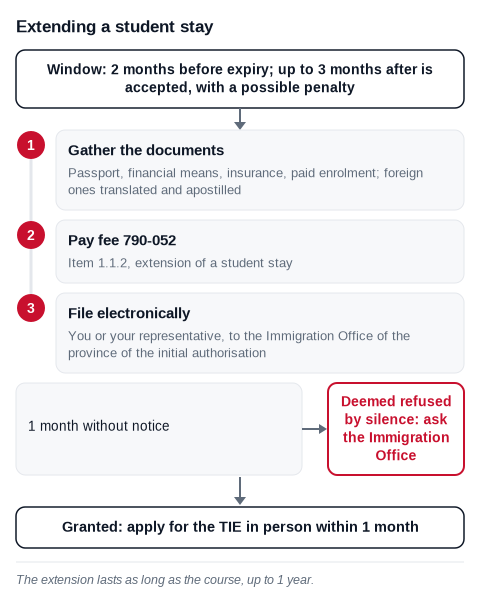
- Check the date your authorisation expires and work out the window: the 2 months before; also up to 3 months after, with a possible penalty procedure (art. 55.4).
- Make sure you have paid enrolment, insurance, funds and a passport valid for at least 1 year.
- Have documents from other countries translated by a sworn translator and apostilled or legalised.
- Generate and pay form 790 code 052, item 1.1.2, with the form from the site.
- File electronically (for example, through Mercurio), yourself or your representative, addressed to the immigration office of the province of your initial authorisation.
- Filed on time, your previous authorisation stays valid until the decision.
- If there is no notification within 1 month, it is treated as refused: ask the immigration office.
- With a favourable decision, apply for the TIE in person within 1 month of the notification.
Official source: Immigration Regulation (RD 1155/2024), arts. 53, 54, 55 and 57; student stay and training activities sheets at inclusion.gob.es.
Informational only; check the official source and a professional for your specific case.
