
In short: to switch from student visa to work permit in Spain, you apply from within Spain and with no new visa for a residence and work authorisation (employed or self-employed) or a residence authorisation with an exemption from the work authorisation, as long as you already hold the degree or certificate for your studies (art. 190 of RD 1155/2024). You file from 2 months before to 3 months after your stay ends or you obtain the degree.
In person or by representative? It depends on the type (Migraciones Information sheet 58, updated April 2026). For employment the application can be filed by your employer or by you. Sheet 58 mentions only the electronic route, through Mercurio, but it predates the Supreme Court rulings that annulled art. 197.2 (the list of applications with mandatory electronic filing, which included the initial employment authorisation). Art. 197.1 now applies: if you are in Spain, you can file in person or electronically; confirm the channel with the office. If the employer is a legal entity (a company), it always files electronically (art. 14.2 of Law 39/2015). For self-employment and the work-authorisation exemption the sheet says the person concerned files it, at the immigration office or through Mercurio; for family members the student files it, in person or through a representative, at the office or through Mercurio. To see who can act as a representative, check Information sheet 60 (legitimated persons). The foreigner's card (TIE) is always requested in person.
This route is for people holding a long-stay student authorisation for higher studies or post-compulsory secondary education, for those doing training that leads to a professional qualification or a full vocational (FP) professional certificate, and for those in specialised health training (art. 190.1, art. 52 and art. 58). If your stay is of another kind (language course, preparatory course for specialised health training, student mobility, volunteering or language assistant), this route is not provided for: ask the immigration office what options you have. A doctorate has its own regime: residence authorisation for research.
Requirements
For every type:
- You already hold the degree or certificate for the studies or training completed (art. 190.1).
- You have not been funded by public or private bodies under Spanish or home-country sustainable-development cooperation or humanitarian-action programmes (art. 190.1).
- You are not within a no-return commitment period taken on when you voluntarily returned to your country.
- You are not a threat to public order, public security or public health.
- You pay the fee.
Depending on the type you choose:
- Employment (art. 190.2): the requirements of art. 74 of the Regulation, except the national employment situation (art. 74.1.a). That means your employer does not have to show that the post cannot be filled by workers already in the labour market. Still required: a contract signed by both, with continuous activity for the validity of the authorisation and a start date tied to when it takes effect; conditions in line with the law and the collective agreement; an employer up to date with the tax office and Social Security and with means for the business and to pay you; and the training or qualification the profession requires. For a part-time contract, your annual pay must reach the full-time minimum wage (SMI). If the employer is an individual, they must also show means for their own family, after deducting your salary: 50 % of the SMI per month (about 610 €) with no dependants, 100 % (1,221 €) with two members in the household and a further 25 % (about 305 €) for each additional member (art. 76; 2026 SMI, check the current one).
- Self-employment (art. 190.3, referring to art. 84): meet what the law requires of Spaniards to open and run the activity; have the professional qualification or sufficient experience and, where needed, be registered with the professional body; and show that the planned investment is sufficient and what it does for job creation, self-employment included. How the project is set up: residence and work as self-employed.
- Exemption from the work authorisation (art. 190.4, referring to art. 89.2): show that you fall under one of the exemption cases. Sheet 58 lists them, for example researchers and teachers invited or hired by a Spanish university or administration, foreign media correspondents, ministers of religion, or workers posted from another EU country.
- Family members (art. 190.5 and art. 56): you can apply for residence by family reunification for family members already in Spain on a stay who live with you (spouse or partner and children, under the conditions of art. 56), if you show sufficient means, adequate housing and health insurance.
Does the job have to match what you studied? For employment, the requirements of art. 74 apply except the national employment situation (art. 190.2). That list covers the contract, the conditions, the employer's means and your qualification; a post in the same field as your studies is not among them. What art. 74.1.f does require is that you have the training and, where relevant, the professional qualification legally required to practise the profession in the contract (Sheet 58 adds: "where applicable, duly recognised"). If you doubt that your profile fits the post, ask the immigration office.
Part-time contract (for example, 30 hours). If the contract is not full time, your total pay for the year must be equal to or higher than the full-time minimum wage (SMI) over a year (art. 74.1.c; Sheet 58). With the 2026 SMI that is 1,221 € a month and no less than 17,094 € a year (RD 126/2026, arts. 1 and 3). The pay of a 30-hour contract is not scaled down: the annual total has to reach that figure. Check the current SMI. If the office sends you a request for documents, art. 77.4 (the employment procedure, to which art. 190.1 refers) gives 10 days to fix it; if you do not, the file is closed.
Individual employer (for example, domestic work). Yes, the employer's details are submitted. Sheet 58 asks for a copy of their NIF or NIE (or their consent for the administration to check their identity), the signed contract and proof that they can pay you: a copy of their income-tax or VAT return for the last 3 years, plus a descriptive statement of the job. As an individual, they must also show means for their own family after deducting your salary (art. 76.2, SMI percentages given above).
Documents
According to Sheet 58, copies are generally submitted and originals shown when filing. Foreign documents come with a sworn translation and legalisation or apostille. The list can be updated: compare it with the current sheet.
For every type:
- Form EX-26, signed by you (for employment, by you or by the employer).
- Full valid passport or travel document (or registration certificate).
- Certificate that you have passed the studies or training.
Employment and self-employment, in addition:
- Certificate from the authority of your home country that you were not funded under those cooperation or humanitarian programmes; if you cannot obtain it, a sworn statement.
- Criminal-record certificate from the countries where you lived during the 5 years before entering Spain.
Employment only:
- Signed employment contract.
- Documents showing your training and, where relevant, the qualification or recognition the profession requires.
- From the employer: NIF or NIE if a sole trader; if a company, NIF, registered deed of incorporation, a document showing the signatory is the legal representative and their NIF or NIE.
- Employer solvency: a copy of the income-tax, VAT or corporate-tax return, or the company's employment record report (VILE) for the last 3 years, plus a descriptive statement of the job.
Self-employment only:
- Sworn statement or prior notice (retail trade and services in premises up to 750 m²) or, for other activities, the list of licences and authorisations needed and the stage of each procedure.
- Documents on training, qualification, recognition and professional registration, if the profession requires it.
- Documents on the adequacy of the investment and job creation. As an example, the assessment report of ATA, UPTA, CIAE, OPA or UATAE is accepted.
Work-authorisation exemption only:
- Documents showing the exemption case.
Family members, in addition: documents proving the family link, health insurance, financial means and adequate housing; the student signs the EX-26.
Deadlines
- Filing: in the 2 months before or the 3 months after the student stay ends or the degree is obtained (art. 190.6, wording in force since 16 April 2026 under RD 316/2026). Because art. 190.1 requires you to already hold the degree, confirm with the office which date counts in your case.
- Effect of filing on time: your stay authorisation stays valid until the decision is notified (art. 190.6).
- Decision: 3 months for employment, self-employment and family members; 2 months for the work-authorisation exemption, counted from the day after the application reaches the register. If nothing has been notified, it is treated as refused by administrative silence (Sheet 58).
- Working in the meantime: once the application is admitted for processing, your stay becomes a provisional residence and work authorisation, with permission to work full time (art. 190.7). ⚠️ If the application is refused, that provisional authorisation is lost automatically, with no separate decision.
- Duration: 1 year; when renewed, its effects are those of each type of authorisation (art. 190.9).
- Taking effect and TIE: the residence and work authorisation only takes effect when you are registered with Social Security (art. 190.8). You request the TIE in person within 1 month from when the authorisation takes effect (for employment, from the registration). How: TIE, how to get it.
Cost
- Change of status: form 790 code 052, heading 2.5.1, about 10.94 € (Order PJC/617/2025).
- Work fee, employment: heading 3.2.1 (code 062), about 203.84 € if pay is below 2 times the SMI and about 407.71 € if equal or higher. The employer pays it (art. 190.2) and cannot charge you for it (art. 3.2 of the Order).
- Work fee, self-employment: heading 3.3.1, about 203.84 €. If you are self-employed, there are two fees: the change of status (about 10.94 €) and the work fee (about 203.84 €).
- Work-authorisation exemption and family members: only the change-of-status fee (code 052).
- Exemptions: art. 3.3 of the Order exempts Ibero-American nationals, Filipinos, Andorrans, Equatorial Guineans and Sephardic Jews, children and grandchildren of Spaniards by origin, and people born in Spain from the fees for work authorisations, but only when they intend to carry out an initial self-employed activity. It does not reach the work fee for employment (heading 3.2.1), which the employer still pays. Check on the form whether it applies to you.
- When to pay: the Order says that for electronic filing the fee is paid when you file (art. 2.3); Sheet 58 speaks of 10 working days from admission for processing. Follow what the form generated by the portal says. How to fill it in: fee 790 code 052.
- Amounts may rise every year with the budget (art. 1.2 of the Order): check the current one.
Where
- Online: Mercurio, electronic office (step by step: Mercurio, how to file).
- In person (self-employment, exemption and family members; for employment, confirm the channel): the immigration office of the province where you live or will live; addresses and hours are on the portal itself.
- Official sheet: Sheet 58, Migraciones.
Other options after your studies. If you have finished a bachelor's degree or higher (level 6 of the European Qualifications Framework), art. 190.10 refers to a separate authorisation of up to 24 months to look for a job or start a business, during which you cannot work: job search or starting a business after your studies. From a student stay, art. 190 does not provide for moving to non-lucrative residence.
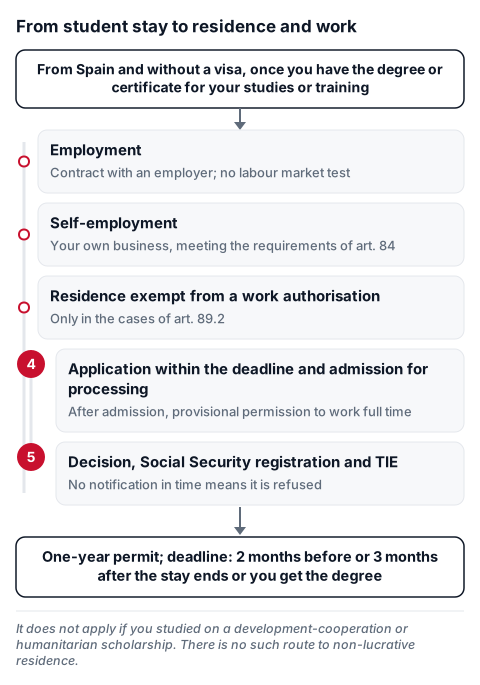
Steps
- Check that your stay is one that art. 190 covers and that you already hold the degree or certificate.
- Choose the type (employment, self-employment or work-authorisation exemption) and gather the documents; translate and legalise or apostille foreign ones.
- File the EX-26 within the deadline, through Mercurio or at the immigration office (art. 197.1). For employment your employer can file it; a company always files electronically.
- Pay the fee with the form 790 that the portal generates.
- Once the application is admitted for processing, read the admission decision: it records the permission to work full time while the decision is pending.
- Wait for the decision: 3 months (2 for the work-authorisation exemption). With no notification, it is treated as refused.
- If it is granted, the employer registers you with Social Security for employment, and you do it yourself for self-employment. Request the TIE in person within 1 month from when the authorisation takes effect (for employment, from the registration).
Official source: RD 1155/2024, art. 190 (consolidated text); Sheet 58, Migraciones; Order PJC/617/2025 (fees).
Informational only; check the official source and a professional for your specific case.
