In short: the student stay (from abroad you apply for it as a student visa at the consulate) lets you pursue higher or post-compulsory studies in Spain. It requires admission to an official centre, financial means and health insurance, and allows working up to 30 h/week in higher studies (RD 1155/2024).
It is for master's degrees, undergraduate degrees and other regulated studies; if you are coming to do a PhD, do not apply for this stay: you need the national research residence authorisation instead (Criterio de Gestión DGGM 2/2026).
In person or by representative? It depends on where you apply (RD 1155/2024). From abroad, the visa is requested at the Spanish consulate, in person or through a representative, and that application includes the authorisation request (art. 36.1). The consulate may summon you in person to check your identity and documents or interview you; if you do not attend within the time it sets (15 days at most), the application is treated as withdrawn (art. 27.3). From Spain, in person, through a representative or electronically, at the immigration office (oficina de extranjería) of the province where you will start your studies (art. 54.3). This route is for people who already hold a residence authorisation or, for higher studies and specialised health training (art. 58), who are lawfully in Spain and of legal age (art. 54.1). For higher studies, if you are lawfully in Spain, your centre can also file it electronically (art. 54.6). The extension is requested electronically, by you or a representative (art. 55.4). If the stay exceeds 6 months, you apply for the TIE card in person within one month of entering Spain or of the authorisation being granted (art. 209.1).
Deadlines: the visa, at least 2 months before your studies start, unless there is a justified reason, such as specific enrolment dates at the centre (art. 36.1; Hoja 1). From Spain, at least 2 months before your current legal status ends (art. 54.3); on the higher-studies or specialised-health-training route while lawfully in Spain, also at least 2 months before you start (art. 54.1). The consulate has one month to notify from the day after filing, and with no reply the application may be treated as refused (Hoja 1). Once you are notified that the visa is granted, collect it within 1 month (art. 28.4); Hoja 1 says 2 months, but it is only guidance and the regulation applies, so count on 1 month. If you do not collect it in time, you are deemed to have given it up and the procedure is closed. The extension is requested in the 2 months before the authorisation expires (art. 55.3). If you apply within 3 months after it expires, the previous authorisation stays valid until a decision is made, but a penalty procedure may be opened (art. 55.4). Conditions and documents for the extension: extending a student stay.
If you cannot file 2 months ahead: you can file within the 2 months before your studies start if the centre's enrolment or registration process requires a shorter time. You justify it with a certificate, document or official publication from the study centre (or the competent body) showing the enrolment or registration deadlines; the criterion speaks of a document from the centre, not a letter written by you. It applies the same from Spain or from abroad, and when the centre files the application. According to the SEM criteria, other accepted reasons include: admission by the centre within the previous 2 months (it can be shown with the admission certificate), being on a waiting list, receiving a scholarship or funding too late because of processes outside your control, not being admitted to your first choice, your employer allowing you to leave the job on a specific date, or being unable to get a document in time for reasons outside your control (SEM interpretative criteria, 7 Aug 2025, section 1). Filing long after the studies have started can be a ground for refusal or inadmissibility (example: Consulate in Bogotá). There is no maximum lead time, but the authorisation takes effect 1 month before the studies start (start on 1 October, effect from 1 September) and you must be in lawful status on that date: if you file very early from Spain on a short-stay visa (90 days), you may become irregular before the authorisation begins (same section).
How to apply at the consulate
From abroad, you apply at the Spanish consular office for the district where you live, with a document proving you live there. Applying for the visa also means applying for the student stay authorisation (art. 36.1). The form is the Solicitud de visado nacional (national visa application), which is free: each applicant fills it in completely and signs it, and a minor's form is signed by one of their legal representatives. Each consulate publishes its document list on its "Visados Nacionales - Visado de estudios" page at exteriores.gob.es; the fee and the filing place are on that page or on a linked page of the same consulate. When you file, you get a receipt, and you can check the status of your file at sutramiteconsular.maec.es. The consulate asks the immigration office electronically for a decision on the authorisation; that office has 7 days to decide, and if it does not reply, the decision is deemed unfavourable (art. 36.3). If it is favourable, the consulate decides and issues the visa within one month at most (art. 36.4). According to the consulates' pages, if the authorised stay exceeds 180 days, the visa is valid for up to 365 days and you must apply for the TIE in Spain (art. 209.1). If you live in Ukraine: the visa section of the Embassy in Kyiv is closed. Visas for residents of Ukraine are handled by the Spanish Embassy in Poland, and you request the appointment by e-mail to that Embassy, as stated on the Embassy in Kyiv page.
Requirements
- Not being an EU citizen or in an irregular situation.
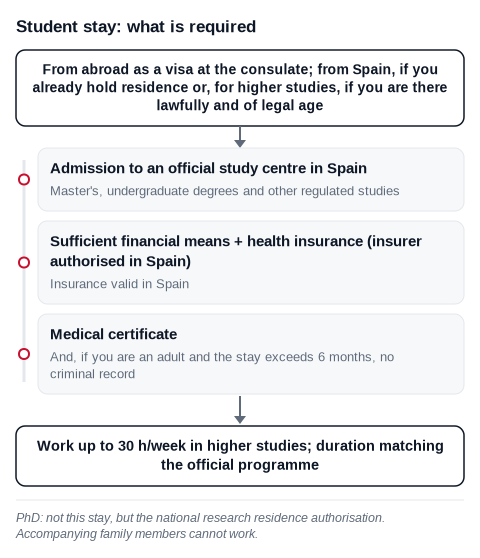
- Being admitted to an official study centre in Spain.
- Sufficient financial means.
- Health insurance with an insurer authorised to operate in Spain, with benefits similar to the basic common service package of the National Health System (the basic public cover), valid for the whole planned stay (art. 35.i).
- A medical certificate showing you do not have any disease with serious public-health consequences under the 2005 International Health Regulations (art. 35.l).
- If you are an adult under criminal law and the stay exceeds 6 months: no criminal record in the countries where you have lived in the last 5 years, for offences that are also crimes in Spain (art. 35.j).
If you work on the stay and are registered with Social Security, the insurance requirement counts as met (art. 57.5). Details and consulate practice: health insurance for a residence visa. Student case, with the practice of Bogotá, Lima and Kyiv: medical insurance for students in Spain.
Financial means: for each month of the stay, 100 % of the IPREM (check the current figure), and for family members 75 % for the first and 50 % for each of the others. The rules provide one allowance: having accommodation for the whole stay prepaid (art. 35.h); that accommodation counts as part of the figure, so that, including its value, the total must reach 100 % of the IPREM per month (SEM interpretative criteria, section 5). Sources taken into account include scholarships, grants and, if the authorisation allows work, a job contract or a firm job offer. Money you will use to pay for the studies does not count. Any means of proof is accepted, assessed case by case, including your own funds or funds from relatives. If the accommodation belongs to a relative up to the second degree, it counts as secured in advance when you prove, all at once, the family link, the title under which that relative occupies the property, and a declaration signed by them committing that you will have the accommodation throughout the authorisation; a letter from them saying they will take care of the accommodation is not enough on its own, all three elements are needed. Credit cards: the rules do not mention them. As an example, the Consulate in Lima asks for statements for the last six months and does not accept "credit cards or similar", and the one in Bogotá accepts the certificate of a student loan (ICETEX, COLFUTURO; a pre-approval is not valid) and only exceptionally another loan, paid into your current account; if a relative backs you, the one in Bogotá asks for apostilled civil-registry records proving the kinship, a notarial declaration from the relative committing to fund the studies and the stay (100 % of the IPREM for the whole period), a copy of their ID and their last six bank statements, and the one in Lima asks for the financial documents of whoever funds you, apostilled proof of a «direct family relationship» (relación familiar directa) and a notarised guarantee letter (carta aval). Family guarantor: the rules allow «means coming from relatives» (SEM interpretative criteria, section 5; Hoja 1) and do not require a particular nationality or degree of kinship from the relative; the second-degree limit above applies only to accommodation. Which documents from a guarantor the consulate that covers you accepts (for example, statements from an account in Spain, or whether a third-degree relative fits), confirm with it before you file.
Which studies count
- Higher studies (art. 52.1.a): undergraduate and master's degrees, higher artistic education, higher-level FP, and the university's own degrees (títulos propios) offered by a recognised university or higher-education centre in Spain. Full-time programme, in person or hybrid (outside universities, at least 50 % in person). In-person language courses at those institutions also count as higher studies, in a language that is not your mother tongue or your country's official language (Instrucción SEM 3/2025, first instruction).
- Post-compulsory secondary (art. 52.1.b): Bachillerato, intermediate-level FP and intermediate artistic or sports education, at an authorised, registered centre, full-time and with at least 50 % in person. If an adult Bachillerato is evening or distance learning, check that it meets that 50 %.
- Training activities (art. 52.1.e; Hoja 2), among others: an in-person course of Spanish or a co-official language at an Official Language School (Escuela Oficial de Idiomas) or a centre accredited by the Instituto Cervantes (not your mother tongue or your country's official language), or a complete (not modular) professional certificate of level 2 or 3. They last as long as the activity, up to one year, and allow only 1 extension; for languages, at an Official Language School you must have passed the course; at other centres, you must hold a DELE or SIELE diploma or be registered for the DELE exam (art. 55.5).
Blended FP and the centre's register entry: for intermediate-level FP, the centre must be registered in the Registro estatal de centros docentes no universitarios (or the corresponding official registers) and at least 50 % of the teaching delivered must be in person (art. 52.1.b). Higher-level FP, as non-university higher study, is in person or hybrid with the same 50 % minimum (art. 52.1.a; Hoja 1), and the centre can be checked, among others, in the Registro estatal de centros docentes no universitarios and the Registro de Instituciones y Centros de Enseñanza Superior. If the register shows the course as virtual while your enrolment states 50 % in person, before filing the application or the extension ask the centre in writing for the percentage of in-person teaching and ask the immigration office or the consulate which document they accept.
Own degrees and specialisation diplomas: art. 52.1.a includes university studies leading to own degrees (títulos propios) of recognised higher-education institutions (Hoja 1 names them: «Estudios Universitarios Oficiales o Títulos Propios»). The programme must be your main activity, full-time (enrolment in at least 90 % of the credits or of the programme, art. 52.2) and in person or hybrid. Full-time is measured by that enrolment, not by a minimum number of hours, and the stay must last more than 90 days (art. 52.1). Whether a diploma of about 300 hours and 30 ECTS counts as a full-time programme, confirm with the centre and the immigration office before filing.
From a language course to higher studies: art. 54.1 lets someone who is lawfully in Spain and of legal age file here for higher studies or specialised health training, at least 2 months before their legal status ends (art. 54.3). Specialised health training (art. 58) requires a Spanish or recognised (homologated) foreign degree and an awarded place. Recognition of a university degree has a legal deadline of 6 months, which in practice can run longer: recognising a foreign university degree.
If you already hold a temporary residence: temporary residence and the student stay are not compatible. If you apply for the stay from Spain while holding a temporary residence, granting the stay extinguishes your residence at the same time, as long as it had not already expired. The 2-month lead time of art. 54.3 applies and, to assess exceptions, they look at whether you proved you could not meet it while holding the residence. While the decision is pending, the application keeps your legal status, even if your residence expires in the meantime (SEM interpretative criteria, section 19).
Documents
- Valid passport or travel document with at least 1 year of validity; the consulates' pages also ask for at least two blank pages and a passport issued less than 10 years ago.
- From abroad: the signed Solicitud de visado nacional form, a recent passport-size colour photo with a light background, and a document proving you live in the consulate's district.
- Medical certificate (not required if you apply while in Spain).
- Proof of financial means for the period you request and for the return to your country.
- Proof of health insurance.
- Proof of admission and of enrolment fees paid. Paying in instalments or having an exemption is fine if you prove it; if the centre's payment deadline does not fit the application timing, it is enough to prove that and commit to paying, and the authorities may check later (Instrucción SEM 3/2025, second instruction).
- Criminal record certificate, if you are an adult under criminal law and the stay exceeds 6 months.
- If you are 17 and in the care of someone without parental authority or guardianship: authorisation of both parents (art. 35.g).
- Proof of payment of the fee. From abroad, the visa fee is paid when you apply (Hoja 1) and each consulate publishes the amount on its student visa page: for example, the embassies in Islamabad and Abu Dhabi state an amount equivalent to 80 euros, with different reciprocity rates for nationals of Australia, Bangladesh, Canada, the United States and the United Kingdom (Embassy in Islamabad), and the Consulate in Bogotá says Colombians do not pay it. If the visa is refused, it is not refunded (Consulate in Lima). Fees from Spain and for the TIE: tasa 790.
Translation and apostille (Hoja 1 and Hoja 61): every document that is not in Spanish (or in the co-official language of the place of filing) needs a sworn translation. Valid ones are those by a sworn translator and those made or checked by a Spanish consulate abroad (then legalised by the Foreign Ministry) or by the consulate in Spain of the country that issued the document (apostilled or legalised). Every foreign public document, such as the criminal record certificate or your family members' birth or marriage certificates, needs an apostille if its country is party to the 1961 Hague Convention, or legalisation through the diplomatic route if not, unless an international agreement exempts it. If you sign in Spain a notarial document that you will use abroad (for example, a notarial statement of your means), the apostille of notarial documents is issued only by the Notarial College, according to the Ministry of Justice: it is issued by the dean of the Notarial College or a notary to whom they delegate, even if the document was signed elsewhere in Spain (RD 1497/2011, art. 3). Hojas 1 and 61 ask for an apostille or legalisation on foreign public documents; if you will file a notarial statement made in Spain, ask the consulate that covers you (for example, the Spanish consulate in Chile) whether it must be apostilled before you go to the notary. As an example, the Consulate in Lima asks for the notarised guarantee letter (carta aval) to be legalised by the Notarial College and apostilled in the country where the guarantor lives. More in sworn translator and sworn translation.
If the consulate asks for more documents or refuses: a request to fix the application (subsanación, art. 27.4) asks you to complete or correct something; it is neither a grant nor a refusal, and the consulate decides afterwards. You have 10 days to reply, extendable by up to 5 more; if you do not reply in time, the application is treated as withdrawn (art. 27.4-5). A refusal must give reasons and state the appeal, the body and the deadline (art. 28.6-7). According to the consulates' pages, against a refusal of the visa or the authorisation you can file an administrative appeal (recurso de reposición) with the consulate itself within one month. You can also file a court appeal (recurso contencioso-administrativo) before the High Court of Justice of Madrid within two months, counted from the day after the notification. How to appeal: appeals against refusals.
Family members: only with higher studies (including higher-level FP) or specialised health training; with Bachillerato, intermediate-level FP or language courses as a training activity, art. 56.1 provides no visa for a spouse, partner or children; the only cases are a child born in Spain during your stay (authorisation requested within 6 months, art. 56.7) and a person who supports you if you have a disability or illness that requires it (art. 56.8). Family members are the spouse, the registered or stable partner, unmarried minor children and adult children who need support because of disability or illness. They can apply for the visa at the same time as you or later, as long as at least 90 days of your authorisation remain, and, among other requirements, must show the family link, financial means, insurance and, if they are adults staying over 6 months, a clean criminal record (art. 56.3). If you apply together, both can be granted at the same time, but theirs depends on yours being granted; if your family member is already in Spain legally and your authorisation is in force, they can also apply at the immigration office (Instrucción SEM 3/2025, fifth instruction). Children under 16 living in Spain have the right and duty to compulsory education (LO 4/2000, art. 9): enrolling a foreign child in school.
Work: with higher studies (including higher-level FP), work compatible with the studies is authorised with no extra step, up to 30 hours a week (employed or self-employed); exceeding it is a ground for ending the authorisation (art. 57.2). That permission comes from the stay itself; the TIE is the document that proves your legal status (art. 209.2) and, if the stay exceeds 6 months, you apply for it within one month (art. 209.1). With Bachillerato, intermediate-level FP or training activities such as language courses you must apply for a work authorisation and show it is compatible with your studies: for employment the employer or the student can file it (art. 57.1), according to Hoja 4 bis at the immigration office of the province of the workplace; for self-employment, the student; the decision takes up to 3 months and silence means refusal (Hoja 4 bis). Curricular placements and the company phase of FP need no separate authorisation (art. 57.1). The work authorisation is limited to the autonomous community of the stay and neighbouring localities (art. 57.3), lasts as long as the stay and is extended automatically if your stay extension is granted and the circumstances it was granted for still apply (art. 57.4). If you work, the contract or a firm offer counts as financial means in the extension, provided your authorisation allows work (art. 35.h): extension documents. Family members accompanying the student cannot work. After your studies: switch to residence and work or permit to look for a job or start a business.
Duration: it can be multi-year (matching the official programme's length); extensions have been simplified.
Steps
- Get admitted to an authorised centre and pay the enrolment, or prove payment in instalments or an exemption.
- Open the "Visados Nacionales - Visado de estudios" page of the consulate for your district at exteriores.gob.es: it has its document list, and the fee and the filing place are on it or on a linked page of the same consulate. If you live in Ukraine, visas are handled by the Spanish Embassy in Poland.
- Fill in and sign the Solicitud de visado nacional; if you are a minor, your legal representative signs it.
- Gather the documents as originals and copies: passport, admission and enrolment, health insurance and medical certificate. Add proof of means: 100 % of the IPREM per month, plus 75 % for the first family member and 50 % for each of the others (art. 35.h). If you are an adult under criminal law and the stay exceeds 6 months, add a criminal record certificate. Foreign documents must be apostilled or legalised and translated.
- Book an appointment and file the application, in person or through a representative, at least 2 months before your studies start (art. 36.1). Pay the fee and keep the receipt.
- Track the file at sutramiteconsular.maec.es and answer each request within 10 days, extendable by 5 (art. 27.4-5).
- Wait for the decision: the immigration office decides within 7 days, and no reply counts as unfavourable; if it is favourable, the consulate issues the visa within one month at most (art. 36.3-36.4).
- Collect the visa within 1 month of the notification (art. 28.4): you collect it yourself or, if you are a minor, your representative does.
- If the stay exceeds 6 months, apply for the TIE in person within one month of entering Spain (art. 209.1).
- If refused, you can file a recurso de reposición with the consulate within one month or a court appeal before the High Court of Justice of Madrid within two months.
Official source: Immigration Regulation (RD 1155/2024); information sheets on the student stay (Hoja 1), training activities (Hoja 2), access to employment (Hoja 4 bis) and legalisation and translation (Hoja 61) at inclusion.gob.es. Form: Solicitud de visado nacional; consulates' student visa pages: exteriores.gob.es.
Informational only; exact requirements and documents vary — check the official source and a professional for your case.