Notice of 13.11.2026: the recognition office works again, but only for files already in progress. According to the notice of the Ministry of Science, Innovation and Universities, the electronic sub-office of the General Secretariat of Universities (universidades.sede.gob.es), closed since 22.10.2026 as a preventive security measure, is operational again for files in progress: you can open your file, upload documents, download receipts and receive requests, communications and decisions, and the procedures and deadlines have resumed. New applications remain suspended while a new electronic system is set up. The notice gives no date. The steps on this page for filing an application apply once filing resumes. Background: the news item on the closure of 22.10.
In short: Royal Decree 889/2022 of 18 October governs foreign degree recognition in Spain: either to gain access to a regulated profession (homologación) or to certify academic level (equivalencia). The procedure is fully electronic with no appointment needed, and the period to apply is permanently open; but since 22.10.2026 new applications have been suspended (notice above).
In person or by representative? The procedure is entirely online via the Ministry of Science, Innovation and Universities electronic office, once it works again. No physical attendance required. You can sign with an electronic certificate or Cl@ve; if you have no certificate, the sede accepts access with a username and password (Valida-TE frequently asked questions). With a username, the data in the application must match your identity document and cannot be changed afterwards. Keep that access: you can only view your file with the same access method you used to start it. To act through a representative, start the application with your own access, tick the representative box and attach your signed authorisation and the representative's identity document (art. 12.3 and 13.1.f of RD 889/2022).
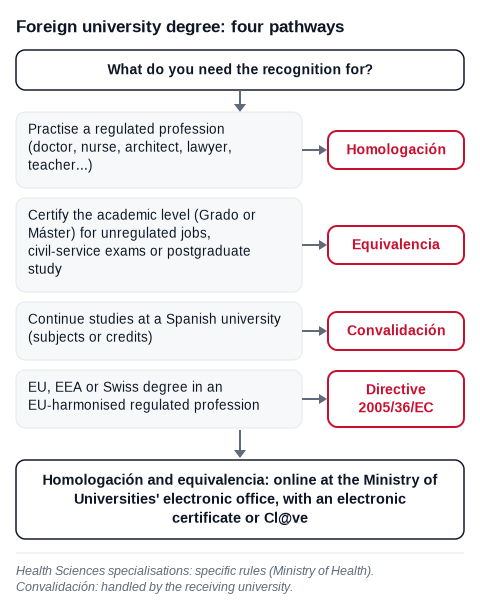
Four pathways: choose the right one
1. Homologación — Recognises your foreign degree as equivalent to a specific Spanish official degree (Grado or Máster). Mandatory for regulated professions (doctor, nurse, veterinarian, pharmacist, architect, engineer, lawyer, teacher, etc.). The Annex to RD 889/2022 lists all regulated professions requiring homologación. Competent authority: Ministry of Science, Innovation and Universities.
2. Equivalencia — Certifies the academic level of your degree (Grado or Máster level) without assigning it to a specific Spanish qualification. Does not enable regulated professions, but is sufficient for many unregulated jobs, civil service positions requiring a degree level, or postgraduate admissions.
3. Convalidación — Recognition of individual subjects or credits completed abroad, in order to continue studies at a Spanish university. Managed by the receiving university directly; contact each university for its own procedure. If you plan to study in Spain, see the MEC scholarships Spain (beca general) for foreigners.
4. EU professional qualifications recognition (Directive 2005/36/EC) — Only for graduates from EU/EEA/Switzerland countries in EU-harmonised regulated professions. Different procedure; see ENIC-NARIC or email [email protected].
Important exception: Foreign degrees in Health Sciences specialisations (specialist doctors, etc.) are governed by their own specific rules (Additional Provision 1 of RD 889/2022). Contact the Ministry of Health for those specialisations.
Before you apply: common cases
Source of the points below: art. 4, 8, 12 and 13 of RD 889/2022 and the Valida-TE frequently asked questions (revised June 2025).
- Technical degrees and other qualifications that are not Grado or Máster. This procedure only covers official university degrees at Grado level (at least three years and 180 ECTS or equivalent) or Máster level (at least one year and 60 ECTS). A university qualification shorter than three years is usually neither homologated nor declared equivalent; you can ask for partial convalidación at a Spanish university. Non-university qualifications go to the Ministry of Education, Vocational Training and Sports or, if you live in Catalonia, Galicia or the Basque Country, to your regional education authority: see recognition of vocational and non-university qualifications.
- Lawyer or procurador. With a foreign university degree, homologación is not viable under current rules. You can ask for partial convalidación at a Spanish university of your choice, or for equivalencia to Grado or Máster, which does not allow you to practise as a lawyer or to enter the qualifying master's. If in doubt, ask the Bar Association.
- How many applications you can file. An application identical to one already decided is declared inadmissible (same foreign qualification and same official Spanish degree; for equivalencia, same academic level), unless it was withdrawn (art. 4.2.c and d). Two different foreign qualifications, or one qualification for a different Spanish degree, are not identical applications. Inadmissibility does not refund the fee. Homologación and equivalencia for the same degree can be requested at the same time, with one application and one fee for each.
- Homologación and convalidación at a university. Not at the same time for the same studies: ask for partial convalidación once the homologación is decided or withdrawn. Equivalencia and convalidación can run at the same time.
- Questions about a file already submitted. The Ministry has a telephone helpline and an enquiry form for files in progress; IT problems go through the IT enquiries channel (links in the frequently asked questions).
Documents required (homologación and equivalencia)
The official Valida-TE portal is the authoritative reference. General requirements under RD 889/2022 and the Ministry's Instruction of 23 October 2024:
- Degree or diploma (or certificate of award) legalised via apostille (Hague Convention) or diplomatic channels; not required for EU/EEA/Switzerland documents; required for UK documents post-Brexit and for Ukrainian documents
- Official academic transcript listing subjects, ECTS credits (or equivalent) and grades
- Sworn translation into Spanish by a certified (jurado) translator (how to find one) if documents are not in Spanish
- Identity document (passport or TIE). If you switch from a passport to a NIE/DNI during the procedure, you can attach the copy to your file
- Proof of tasa payment
- Proof of Spanish language proficiency, for homologación only (not for equivalencia), if you are from a country where Spanish/Castilian is not an official language (Instruction art. 3.1.m); applies to Ukrainian applicants. For example a DELE B2 or a B2 certificate from an official language school works; a certificate that at least 75% of your studies were in Spanish is also enough (art. 13.2 of RD 889/2022). Infant and primary school teachers need level C1 instead of B2
The exact list may vary by country and degree type. Check the "Instructions for attaching documents" on the sede before submitting.
What to upload for each document. By rule, the degree (or the certificate that it was issued) and the academic transcript are separate documents, and both are legalised (or apostilled) and officially translated if not in Spanish. The transcript must show the official length of the study plan, the subjects taken, the hours of each and the ECTS credits, if any (art. 13.1.c and d). Subject syllabi are not on the mandatory list, but the Ministry may ask for additional documents at any time (art. 13.1.g). Some professions require extra specific documents: check the table of regulated professions on Valida-TE.
Fee
€166.50: Modelo 790, code 107. Payable online or at a collaborating bank. If someone pays on your behalf, your full name must appear in the payment reference. If you are outside Spain, the fee is paid by bank transfer to the Bank of Spain account for fees abroad (details are in the Valida-TE frequently asked questions): the amount must be the full fee, without deducting bank charges, and the reference must show the applicant's full name and the number of the identity document used to start the application. If you are in Spain, form 107 requires a Spanish NIF or NIE.
Timelines
The statutory maximum for a decision is 6 months from the date of a complete application (RD 889/2022). In practice, delays beyond 6 months are common. If the Administration fails to decide within 6 months, negative administrative silence (presumed refusal) applies, opening the path to appeal. The deadlines of procedures in progress, extended while the sede was closed from 22.10.2026, have resumed according to the notice of 13.11.2026 (notice above).
If you are asked to fix documents (requerimiento). You have a maximum of 10 working days; if you do not answer, the application is treated as withdrawn. In justified cases, if you have difficulty obtaining a document, you can ask for an extension of up to 35 working days. While the requerimiento is open, the deadline to decide is suspended (art. 14.1.b, 14.1.c and 14.2 of RD 889/2022). Requerimientos are communicated through the sede and answered the same way, so check the sede often. To ask for more time, the Ministry says to upload a signed document with the request from "Mis expedientes", under "Aportar documentación" (Ministry notice). Since 13.11.2026 the sede allows this again for files in progress (notice above).
What the Ministry can decide
The decision is made by the head of the Ministry and must state its reasons (art. 18.1 and 18.2 of RD 889/2022). There are three kinds of outcome:
- Favourable: grants homologación to a Spanish Grado or Máster degree, or declares equivalencia to an academic level (art. 18.2.a and b).
- Favourable with conditions: grants homologación only if you pass certain complementary training requirements, which the decision must list expressly (art. 18.2.d). They are set when gaps in knowledge, skills or academic practice are found (art. 19.2).
- Denied: refuses the homologación or the equivalencia (art. 18.2.c).
The complementary requirements can be a period of academic practice, an aptitude test, an academic or technical project or paper, or certain academic courses (art. 19.3). You complete them at one or more Spanish universities that offer that degree, of your choice. The maximum time is four years from notification: if it passes without you meeting them, the conditional homologación loses effect, although you can request convalidación of certain periods of study (art. 19.4). You cannot apply again for homologación of that same degree, even if it lost effect (art. 19.5). The credential is issued once you prove you have passed them (art. 20).
If your application is denied
The Ministry's decision ends the administrative route (art. 21 of RD 889/2022). You can file an optional recurso de reposición (arts. 123 and 124 of Law 39/2015) or go straight to the contencioso-administrativo courts. For the court route the RD sets two months from the day after notification (art. 21). The RD does not provide for a recurso de alzada. The notification states which appeals are available and the deadline. An application identical to one already decided is declared inadmissible (art. 4.2.c and d; see "Before you apply"). To decide on an appeal, ask a lawyer.
How to apply
Since 22.10.2026 new applications cannot be filed (notice above). The steps below are for when filing resumes. Steps 1 and 2 do not depend on the sede. Check the Ministry notice to see whether it is possible again.
Steps
- Read Valida-TE first: understand the procedure, documents and user guides before starting.
- Legalise and have documents translated (apostille or diplomatic + sworn Spanish translation).
- Pay the €166.50 fee via Modelo 790-107 (online or at a collaborating bank).
- Once the sede works again, go to: Homologación — universidades.sede.gob.es/procedimientos/.../idp/1029 or Equivalencia — idp/1030.
- Complete the electronic form with digital certificate, Cl@ve or a username and password, and upload scanned documents.
- Save your submission receipt: it is proof of filing while the case is processed.
- Track your case at universidades.sede.gob.es/procedimientos/.../idp/1407.
Questions before applying: NARIC Spain, P.º de la Castellana 162, Madrid. Tel. +34 916 038 917.
Informational only; check the official source and a professional for your specific case. RD 889/2022 and the Ministry's electronic office are the binding references.