
In short: to enroll a child in school in Spain, you ask for a place in the admission process of your autonomous region. Organic Law 4/2000 gives foreigners under 16 the right and duty to basic, free and compulsory education, and those under 18 the right to post-compulsory education. The text does not make this depend on residence. If you arrive mid-year, each region has a separate route, and the exact papers vary.
In person or by representative? The parents or guardians ask for the place. Depending on the region, the application is online, on paper at the school or at an enrolment office: in Madrid it is filed through the Virtual Secretariat or on paper at the first school chosen, and in Catalonia there is an electronic application (with or without a digital certificate), at the municipal enrolment office (OME) or at the school. We found no national rule on acting through a representative: confirm it with your region.
What the law says:
- Right to education (LO 4/2000, art. 9): foreigners under 16 have the right and duty to basic, free and compulsory education; those under 18, the right to post-compulsory education. It includes the academic qualification and access to grants and aid on the same terms as Spanish nationals. If the pupil turns 18 during the school year, they keep the right until it ends.
- Basic education (LOE, art. 4): it is compulsory and free for all persons. It is ten years of schooling, between ages 6 and 16, with the right to stay in the ordinary system until 18 (reached in the year the school year ends).
- Early childhood education (ages 0 to 6, LOE art. 12): it is voluntary. We have not checked here whether it is free or how admission works: it depends on the region.
When and how you ask for a place:
- Ordinary process. Each education authority regulates admission (LOE, art. 84) and sets the procedure. In the 2026-2027 process, applications were in March in Madrid and in Catalonia. Always check the dates for the school year your child will enter.
- If you arrive mid-year. The LOE (art. 78) guarantees enrolment of those who come from another country at compulsory school age, placed in the year that best fits their age, knowledge and academic history. The law gives no deadline or name for the procedure. Official example: in Catalonia there is admission outside the pre-registration process, open during the year, for families who do not yet have a place or have moved from another municipality. Madrid's 2026-2027 admission page only describes the ordinary process and the extraordinary one in June and July (schools with vacancies and the school support service, SAE); if you arrive during the year, ask the SAE.
- Enrolment commissions. The LOE (art. 86) lets education authorities set up admission guarantee commissions or bodies, which must exist in any case when a school in their area has more applications than places, and which supervise the admission process. Families can file the application at the school where they want a place, before the commission or before the education authority, and it must always be processed. What it is called and how it works in your area is decided by your region.
- Choosing a school. The law recognises the freedom of parents or guardians to choose, without guaranteeing a specific place.
If there are not enough places (LOE, art. 84.2): priority criteria apply, namely siblings at the school, closeness of the home or the parents' workplace, and the family's per capita income. Also taken into account are a parent working at the school, large or single-parent families, multiple births, foster care, disability and gender-based or terrorist violence. No criterion is exclusionary or exceeds 30 % of the maximum score, except closeness of the home. The law bans discrimination based on birth, racial or ethnic origin, religion or other personal or social condition (art. 84.3).
Support if the child arrives without the language or with gaps (LOE, art. 79): the authorities develop specific programmes for pupils with serious language or basic-knowledge gaps, given alongside schooling in ordinary groups. Families must get advice on the rights, duties and opportunities in the education system. Which programmes exist and how to ask depends on the region.
What the law says about papers. The law gives no single list; each region sets it. As an official example, the Catalonia procedure mentions documents proving your situation, the family book or birth certificate where relevant, and a passport or European identity document for people who are not Spanish nationals. That list does not mention the NIE, but your region may ask for other papers, so confirm there. Closeness of the home is a criterion in the law (art. 84.2), but the law does not say which document proves it: your region states it in its call (if you are not registered yet: how to register). We have not confirmed from an official source whether a vaccination record or health card is required: ask the school.
Documents (indicative; each region sets them):
- The child's identity document: passport (the Catalonia page cites a passport or European identity document).
- Family book or birth certificate, where relevant.
- Identity document of the parents or guardians.
- Documents proving your situation (for example, the criterion you want to claim) and, if you moved, whatever the region asks.
- Any other paper in your region's call (the full list is on its website).
Good to know:
- The school enrolment certificate can later help with other procedures, such as proving the child's residence when registering for public healthcare (public healthcare for foreign children).
- From year 3 of ESO there is the Social Security school insurance, with its own requirements.
- If your child has Ukrainian citizenship, the International Ukrainian School (MUSh) offers online study in addition to school, not instead of it.
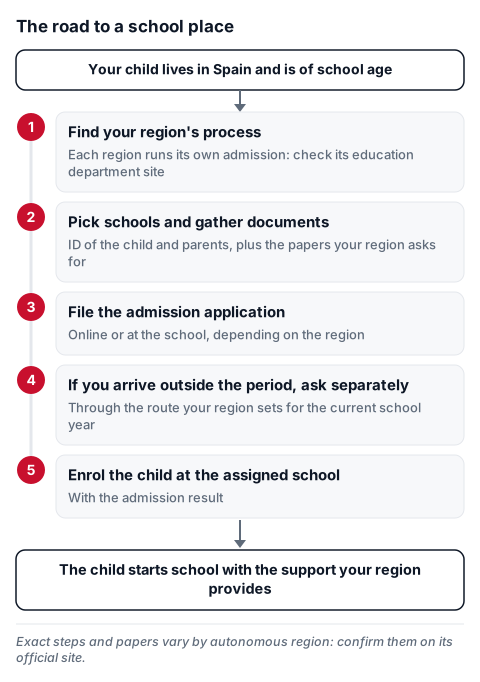
Steps:
- Find your region's process: the website of its education department. Examples: Comunidad de Madrid, Generalitat de Catalunya, Generalitat Valenciana (AdminOVA). If you live in another region, go to your own education department.
- Pick schools and gather the documents your region asks for.
- File the admission application within the ordinary process period, online or at the school, depending on the region.
- If you arrive outside the period, ask for a place through the route your region provides for the current school year (schools with vacancies, an enrolment service or commission, an enrolment office).
- Enrol the child at the assigned school, with the admission result.
What we could not confirm: response times of the commissions and real waiting lists, the exact list of papers in your region, vaccines and health card as a requirement, and Andalusia's procedures, whose education website was not accessible when we checked. If your region is not listed above, search for "admisión de alumnos" on its education department site.
Official sources: LO 4/2000, art. 9 (BOE), LOE 2/2006, arts. 4, 12, 78, 79, 84 and 86 (BOE), admission in Madrid, admission outside the process in Catalonia.
Informational only; check the official source and a professional for your specific case.