
In short: the certificado de profesionalidad is now called certificado profesional. It is the professional certificate in Spain: the official accreditation at grade C of the Vocational Training (FP) system set up by Organic Law 3/2022. It certifies that you can do a specific job, has levels 1, 2 and 3 and is valid across Spain. The old certificados de profesionalidad keep their value: the rules treat them as equivalent to the new ones of the same level.
What it is
The vocational training reform arranges all courses in five grades, A to E (art. 4 of Royal Decree 659/2023, which develops Organic Law 3/2022):
- Grade A: partial accreditation of competence, the most basic offer (levels 1 to 3).
- Grade B: certificate of competence (levels 1 to 3).
- Grade C: professional certificate (levels 1 to 3).
- Grade D: training cycles at basic, intermediate and higher level, which lead to the titles of Técnico Básico, Técnico and Técnico Superior.
- Grade E: specialisation courses.
All offers can be accredited and accumulated: small pieces add up to a certificate or a title (art. 12 of the organic law). The professional certificate is official, has professional and academic validity across Spain, and is issued by the Ministry of Education and FP and the responsible bodies of the autonomous communities (art. 79). Academic validity means it lets you continue towards a grade D title.
Certificado de profesionalidad or certificado profesional: what has changed
The certificado de profesionalidad was the earlier name, the one for certificates regulated by Royal Decree 34/2008. With the reform, its offer was folded into grade C under the name of certificados profesionales (first transitional provision, paragraph 1, of Royal Decree 659/2023). Point by point:
- Name: the certificado de profesionalidad is now called certificado profesional. Official pages mix the two names: the Community of Madrid speaks of «certificados de profesionalidad» in its offer for unemployed people, and LABORA of «certificados profesionales» (checked on 2026-10-03). When you look for a course, try both.
- Levels: levels 1, 2 and 3 stay. A certificado de profesionalidad of level 1, 2 or 3 issued under Royal Decree 34/2008 is treated as equivalent, for all purposes and for access to public and private jobs, to a professional certificate of the same level (tenth additional provision).
- Rules: Royal Decree 34/2008, the general rule for certificados de profesionalidad, was repealed except for its annex IV (sole repealing provision, paragraph 1). What stays in force, until it is changed, is the set-up of each certificate: its contents and hours are those fixed by the royal decree that created it (first transitional provision, paragraph 1).
- Words: when you read an old certificate, «módulo formativo» becomes «módulo profesional», «capacidades» becomes «resultados de aprendizaje» and «unidad formativa» becomes «bloque formativo» (first transitional provision, paragraph 2).
- Placements: the royal decree plans for the module of non-employment professional placements (prácticas profesionales no laborales) in old certificates to be replaced by training in a company, under the general or intensive regime (first transitional provision, paragraph 3, and arts. 71 and 72). Some calls still speak of prácticas no laborales.
- Accrediting work experience: the earlier procedure (Royal Decree 1224/2009) was repealed; Title VI of Royal Decree 659/2023 now applies (sole repealing provision, paragraph 4).
If you hold an old certificate, that equivalence is the rule in the text; for a specific procedure, ask the SEPE or your autonomous community.
Who can take one
Article 75 sets academic requirements by level:
- Level 1: none, but you need to communicate well enough to learn.
- Level 2: ESO or equivalent, a level 2 professional certificate, a certificate of competence included in the offer, or a level 1 professional certificate in the same professional family.
- Level 3: Técnico or Técnico Superior, Bachiller or equivalent, a level 3 professional certificate, a certificate of competence included in the offer, or a level 2 professional certificate in the same family.
If you do not hold the title that level 2 or 3 asks for, the administration must check that you have the prior knowledge, with entry checks or tests (art. 76). The fifth additional provision adds other equivalent qualifications. For studies done in another country, Royal Decree 659/2023 has an article on recognition between foreign studies and Spanish training (art. 129); ask the centre or your autonomous community how it applies.
The requirements in article 75 are academic; it does not mention a residence permit. What each course asks for (ID, registration as a jobseeker) is set by its call. Summary in courses to improve your employability.
How to get one
Article 80 lists the routes. Grouped, there are three ways:
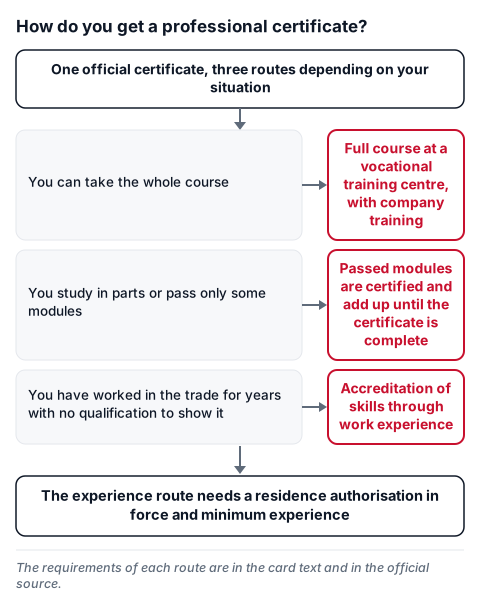
- Full course. You pass all the modules at a vocational training centre, public or private with authorisation (art. 77). The course includes training in a company; with related work experience you can be exempted from it (art. 73). Each module is scored from 1 to 10 and passed from 5; to sit the final test of an in-person module you need to have attended 75 % of the hours (art. 78).
- Modules that add up. If you do not pass everything, you receive a certification of the modules passed, which is cumulative (art. 81). It also counts to add grade B certificates of competence that complete the curriculum, or to pass by free exams modules of a grade D cycle; in both cases with an exemption from the company training or with 80 hours of it (art. 80).
- Work experience. You have all the competence standards of the certificate accredited through the official procedure, without taking the course (arts. 80 and 81). Details in the next section.
Getting your work experience recognised
This route helps if you have worked in a trade for years and have no qualification or certificate to show for it. The full guide, with steps and documents, is in accrediting skills through work experience.
- What it is: an administrative procedure open permanently, with no call (art. 175), to recognise skills gained by working, as a volunteer or through non-formal training. Skills of the Healthcare (Sanidad) professional family are left out unless the body that regulates the profession expressly authorises them or a rule allows it (art. 175.2).
- What it is for: to continue along a path to a higher qualification and to show your skills to an employer (art. 176). If you get all the standards of a certificate accredited, you can request that professional certificate (art. 81). If only part, you receive accreditations per standard and an orientation report on which qualifications you could complete (art. 186).
- Residence: you need Spanish nationality, an EU citizen registration certificate or family member card, or a residence, or residence-and-work, authorisation in force (art. 177).
- Age: 18 completed years for level 1 standards and 20 for levels 2 and 3.
- Experience or training: 3 years with at least 2000 hours worked in the last 15 years (level 1: 2 years and 1000 hours); or 300 hours of related training in the last 10 years (level 1: 200 hours); or volunteering with the same hour figures as work experience.
- Proof (art. 177): employees, a certificate from the Tesorería General de la Seguridad Social (company, category and period) and a contract or company certificate; self-employed, a Tesorería certificate of registration periods and a description of the activity. If you are over 25 and cannot prove it with documents, you can ask for provisional registration with other evidence admitted in law; the adviser or the commission decides. The text lists Spanish Social Security proof: if your experience is from another country, ask your autonomous community what evidence it accepts.
- Phases and deadline: advice (compulsory), assessment, and accreditation with registration (arts. 183 to 186). The maximum time to resolve is 6 months from when the application enters the electronic register (art. 179).
- Where: registration is done where each autonomous community decides, also electronically; vocational training centres and adult education centres must give information and guidance (arts. 181 and 182).
Where to look for courses
- Each autonomous community has its own course search; the SEPE gathers the links in Training in the autonomous communities.
- The SEPE Catalogue of Training Specialities lets you search specialities with filters.
- TodoFP is the vocational training portal of the Ministry of Education.
- If you already know the trade, there are guides by profession: social and health care, forklift operator, hospitality and cleaning. Who can join the free SEPE courses, depending on your work document, is in free SEPE courses for unemployed people.
- The professional certificate is issued by the competent administration (art. 81), not by the centre that gives the course. Before paying, check with your autonomous community that the course leads to a professional certificate.
Arraigo socioformativo
The immigration regulation (Royal Decree 1155/2024) includes a full grade C course, at an authorised centre, among the training accepted for arraigo socioformativo (a single module does not count). What exactly counts (full course, authorised centre, integration report) is in courses for arraigo socioformativo and in arraigo socioformativo.
Official source: Royal Decree 659/2023, BOE.
Informational only; check the official source and a professional for your specific case.