
In short: accreditation of work experience in Spain is the official procedure for having the skills you have gained at work recognised, without taking the whole course. It requires a residence authorisation in force, age 18 or 20 depending on the level, and provable experience. The rules make it permanent, but each region runs it in its own way: in Madrid, on 3 October 2026, new applications are not being accepted.
In person or by representative? Mixed. Registration is done at the places or by the electronic means each region sets (art. 182.1). The royal decree does not regulate representation, but this is an administrative procedure and Law 39/2015 allows acting through a representative. To file the application on your behalf, the representative must prove the representation, for example with an apud acta authorisation (art. 5.1, 5.3 and 5.4). The later phases are yours: the adviser summons you when needed (art. 184.2). Evaluation may involve an interview, observation at work or a simulation, in person or by electronic means, and the result is checked with you or signed by you (art. 185). Advice can be individual or group, in person or remote (art. 184.1). Check on your region's website how registration is filed.
What it is and what you get
It is an administrative procedure open permanently, with no call for applications, to have the skills you acquired through work, volunteering or non-formal training recognised (art. 175.1 of Royal Decree 659/2023). Title VI of that royal decree develops it from Organic Law 3/2022 (title VI, arts. 90 to 93). What gets accredited is the professional competence standard, what used to be called a competence unit (sixteenth additional provision, paragraph 4). Skills of the Health professional family are left out unless the body regulating the profession authorises them (art. 175.2).
At the end you receive:
- an accreditation of each standard in which you prove your competence, entered in a state register (art. 186);
- a guidance report on the vocational training (FP) certificates or titles you could obtain in whole or in part (art. 186.1);
- the full professional certificate or title, if you accredit all the standards of that offer and request it (arts. 81.1.b and 140.b).
Its effects are professional and educational: moving on towards a higher qualification and showing an employer what you can do (art. 176). It is not a residence or work permit. To see what a professional certificate is and how else you can get one, read professional certificate: what it is.
Who can apply
- Residence. Art. 177.2.a requires Spanish nationality, an EU citizen registration certificate, an EU citizen family card, or a residence authorisation, or residence-and-work authorisation, in force. Without any of those, the ordinary procedure is not open to you. Only specific, exceptional procedures are foreseen for groups tied to international agreements or to strategic plans for productive sectors.
- Temporary protection. The resolution granting it includes a residence and work authorisation (art. 5.1 of Order PCM/169/2022). The royal decree does not name it, so confirm with your region that it accepts your card.
- International protection applicants. The royal decree does not mention them. The Catalan FAQ lists the international protection application under art. 16 of Law 12/2009 among the accepted documents. In other regions, ask.
- NIE. The Catalan FAQ asks for a DNI or NIE to register, not just a passport.
- Age. 18 completed years when you register for level 1 standards and 20 for level 2 and 3 standards (art. 177.2.b). Each standard sets its level.
Experience required (art. 177.2.c)
One of these three, related to the skills you want accredited:
- Work: 3 years with at least 2000 hours worked in total, in the last 15 years before you apply. For level 1 standards: 2 years and 1000 hours.
- Related training: at least 300 hours in the last 10 years (level 1: 200 hours). If the standard's modules are shorter, the hours of those modules are required.
- Volunteering: the same figures as work.
If the standard has extra requirements by its nature, you will need a document proving them (art. 177.2.d).
Documents
- If you were an employee: a certification from the General Treasury of Social Security showing the company, the category (contribution group) and the period. You also need an employment contract or a company certificate with the duration, the activity and the time interval (art. 177.3).
- If you were self-employed: a Treasury certification of your registration periods in the relevant scheme and a description of the activity with the time interval.
- If you were an intern: a certification from the person in charge at the organisation with the activities, the year and the total hours.
- If you were a volunteer: a certification from the organisation with your details, the date you joined, the duration, the tasks and the place.
- If you use non-formal training: a document with the detailed programme of contents and the hours (art. 177.5).
- An ID document with NIE or DNI and the one proving your residence authorisation.
- Whatever your region asks for on its form. This list is the royal decree's; your region may ask for more, so check its website.
If you do not have all the documents. If you are over 25, meet the experience or training requirement and cannot justify it with those documents, you can ask for a provisional registration and submit other evidence admitted in law (art. 177.6). The adviser or the evaluation committee decides whether you can take part; if yes, the registration becomes definitive. In Catalonia you tick that option on the registration form and, according to its FAQ, the adviser guides you on how to justify experience when you have lost contracts. The rules do not list which evidence works, nor how undeclared work or experience in another country is treated. Before submitting anything, ask your region or consult an organisation or a professional.
Phases and deadlines
- Advice (compulsory, art. 184). An adviser reviews your history and evidence and issues a favourable or unfavourable report that is not binding. If it is unfavourable, they tell you which complementary training to take and where.
- Evaluation (art. 185). Your competence is checked using that report, your documents and, if needed, an interview, observation at work or simulations. Each standard is recorded as "demonstrated" or "not demonstrated". You can complain to the evaluation committee and file an appeal (recurso de alzada).
- Accreditation and registration (art. 186). You receive the accreditation of each standard you demonstrated and the guidance report.
The maximum time to resolve is 6 months from when the application enters the electronic register (art. 179.10). Catalonia estimates 3 to 4 months from when an adviser is assigned until you finish, plus 2 to 3 months to have the certificate, and warns that resolution may now exceed 6 months.
Where to apply: each region organises it
Registration is done at the places or by the electronic means each region sets (art. 182). Vocational training centres and adult education centres must inform and guide on the procedure (art. 181.2). The official pages say the following on 3 October 2026:
- Community of Madrid: its page on accreditation of work experience presents it as an open and permanent call, but warns that it is not accepting new applications until a new model is in place, with no date given.
- Valencian Community: LABORA explains who can take part and which documents are needed, and refers to the calls. Its main page does not say whether a period is open.
- Catalonia: the Agència FPCAT says registration is online and available 365 days of the year. You first pick your standards group in its search tool; some groups linked to regulated professions are not available.
- Aragon: its evaluation and accreditation procedure runs with a permanent period, electronically or by appointment at an office.
- Andalusia and the rest: the responsible department varies. Search "acreditación de competencias profesionales" on the vocational training or employment portal of your region. The Ministry of Education and FP gathers information on TodoFP.
How much it costs. The royal decree sets no price and leaves management to each administration. The pages of Madrid, the Valencian Community, Catalonia and Aragon that we reviewed show no amount. Administrations may also set incentives for people who use the procedure (additional provision thirteen). Do not assume it is free or that it costs: ask before you register.
Afterwards: completing what is missing
- If you accredit all the standards of a professional certificate, you can request it (art. 81.1.b). For an FP title, the rules foresee the same route (art. 140.b). If you accredit only part, the administration tells you the steps to get the qualification or to have the matching modules recognised or waived (art. 186.3).
- When you enrol on a course, you ask for recognition of the accredited standards after formalising the enrolment (art. 128.1). Work experience and non-formal training only count towards recognising modules if they first went through this procedure (art. 128.2).
- With accreditation of at least 30% of the standards of an intermediate or higher-level cycle, you are exempt from the entrance test for that cycle (arts. 110.5 and 114.5).
- To look for a course and see who can join for free, read free SEPE courses for unemployed people.
If you work in care, cleaning or cooking. The procedure is the same for all trades. What changes is which standards each region offers at any given time. Check your region's list for one close to your job and see which level it has.
And socioformative arraigo. They are two different things. This accreditation requires you to already hold a residence authorisation in force, and the sources we reviewed do not list it as training for socioformative arraigo (search 2026-10-03). Which training counts for that arraigo is in courses for socioformative arraigo.
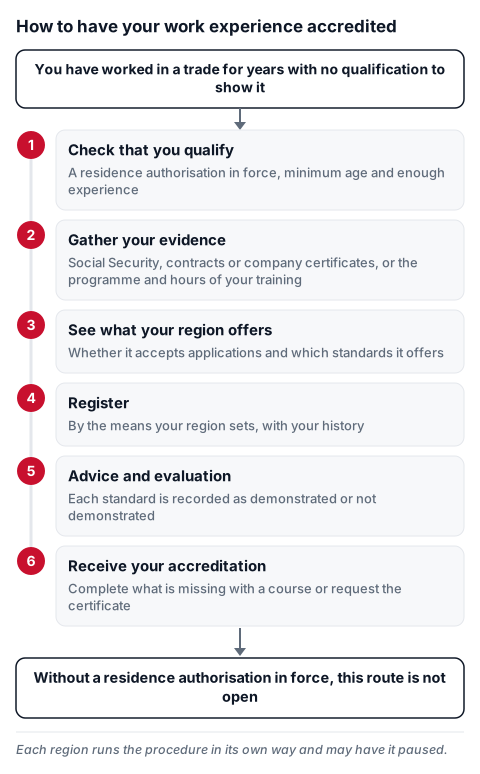
Steps:
- Check that you qualify: a residence authorisation in force, minimum age and enough experience or training.
- Gather your evidence: Social Security certification, contracts or company certificates, or the programme and hours of your training.
- Check your region's website to see whether it accepts applications and which standards it offers.
- Register by the means your region sets, with your personal and training history.
- Go through the advice and evaluation phases and receive your accreditation with the guidance report.
- Complete what is missing with a course, or request the certificate once you have accredited all the standards.
Official source: Royal Decree 659/2023, title VI (arts. 175 to 188), BOE.
🎓 To add skills to your CV in the meantime, Alison offers online courses with their own certificate. They are not a professional certificate, do not replace this accreditation and do not count for arraigo. If you want to use a course as proof of training, first ask your region whether it accepts it (🤝 our partner).
Informational only; check the official source and a professional for your specific case.
