
In short: Courses for arraigo socioformativo: the Ministry of Inclusion publishes an official list of training types (Annex II of its guide and of Instruction SEM 1/2025). It includes bachillerato, mid-level FP, a full professional certificate, in-person adult education and courses promoted by the public employment service. To apply, an admission request is enough; the employment-service course is taken after the arraigo is granted. Language courses, online-only courses and courses at unauthorised centres do not count, with one exception for temporary protection (RD 1155/2024, art. 127.d).
This page does not repeat the requirements or the steps of the procedure (2 years in Spain, integration report, form EX-10): they are in the arraigo socioformativo guide.
Official list of training (Annex II): Annex II gathers the training in three columns and adds the employment-service courses.
- Post-compulsory secondary education (art. 52.1.b): bachillerato; mid-level FP cycle; mid-level artistic education in plastic arts and design; mid-level sports education; professional artistic education in music and dance; and, within FP, the specialisation course leading to the Specialist title. It must be full-time, at an authorised centre, ending in a recognised title. It can be in person or blended, with at least 50 % of classes in person. Compulsory supervised work placements count as study.
- Grade C professional certificate, levels 1, 2 and 3 (art. 52.1.e 5.º): the whole certificate, not a module or a part, at an authorised centre, with the specific course authorised and at least 50 % in person. Level 1 counts for this arraigo, but not for the study stay.
- Adult education, in-person offer only, for people over 18 (mayores de 18): Enseñanzas Iniciales (2 courses), Compulsory Secondary Education for Adults or ESPA (2 courses) and Basic Vocational Training Cycles (Ciclos Formativos de Grado Básico de FP). These three options only count for this arraigo. Annex II does not name the Spanish-for-foreigners courses of the CEPA centres.
- Training promoted by the public employment service for occupations in the hard-to-fill catalogue. It is a commitment, not an enrolment; the rules are below.
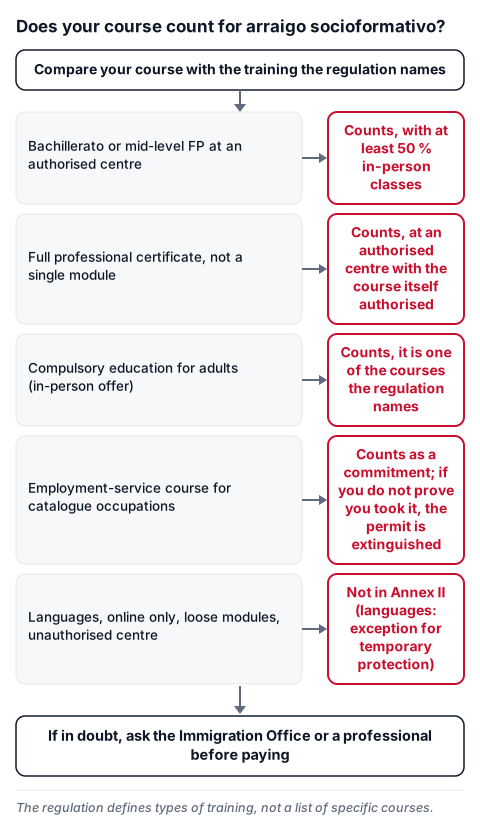
Before paying for a course, four checks:
- Does it end in an official title or professional certificate?
- Is it the whole certificate, not a single module?
- Is the centre in the official register of your region (or in the State Register of non-university teaching centres) and is the course itself authorised?
- Are at least 50 % of the classes in person?
If any answer is no, that course does not fit what Annex II lists. Annex II defines types of study and there is no official list of accepted courses or centres, so when in doubt ask the Immigration Office or a professional before you enrol.
What does not count (it is not in Annex II):
- Language courses: the regulation provides for courses in Spanish or a co-official language under the study stay (art. 52.1.e 2.º), not for this arraigo; courses in other languages are on neither list. Temporary protection has an exception (below).
- Language assistants and MIR exam preparation courses: same.
- Online-only courses: at least 50 % of classes must be in person.
- Loose modules or parts of a professional certificate.
- Unauthorised centres (for example, a private academy that is not in the official register).
- Certificates from open online platforms: good for your CV, not for this arraigo (see courses for employability).
- Higher-grade FP and university studies (art. 52.1.a): they are not in Annex II either.
If you have temporary protection (Ukraine). If you are already studying and cannot use the modification to a residence-and-work permit (art. 191), Instruction SEM 2/2026 (Fourth) lets you apply for arraigo socioformativo without art. 127.d being applied. It is enough to show one activity under art. 52.1, which includes in-person Spanish courses at an official language school or at a centre accredited by the Instituto Cervantes, and to keep it up when you extend. How each office applies this is not stated in the sources we reviewed. More in arraigo with temporary protection.
Rules from Instruction SEM 1/2025 (QUINTA) that people ask about most:
- An admission request is enough to apply. The instruction lets you apply if you are enrolled, studying or have filed the admission request for a training in Annex II. If enrolment has an official window, the arraigo application is filed in the 2 months before that window opens, together with the admission request. If the window has closed but places remain and you are admitted, you can apply once you have the proof of enrolment (Ministry guide, socioformativo section, question 4).
- Proof of enrolment within 3 months. After approval you hand it in at the Immigration Office within 3 months; otherwise the authorisation is extinguished. In justified cases you can enrol in a different training from the one planned, if it meets the requirements (art. 127.d).
- The employment-service course comes after the arraigo. To apply for the permit it is enough to commit in writing, on form EX-10 or in a statement (Hoja 30). The course can only start once you hold the granted arraigo and the NIE, have registered as a job seeker (how to register) and the course is scheduled and authorised. It is delivered by entities in the State Register of Training Entities. For the registration, the instruction uses the term «demandante de servicios previos al empleo» (job seeker for pre-employment services); the type of registration you get depends on your employment service. With a positive assessment you receive a diploma or a professional certificate (art. 7 of RD 694/2017). If you do not prove you took it, the authorisation is extinguished.
- Once every 3 years. Because of its exceptional nature, the same person cannot hold this arraigo more than once in a period of 3 years.
Arraigo por formación: the old name. Many people still say «arraigo por formación» or «arraigo para la formación». That is the name of the arraigo under RD 557/2011, which stopped applying on 20.05.2025. RD 1155/2024 keeps that figure and calls it arraigo socioformativo; the conditions on this page are those of the new text. If you held the old permit, Instruction SEM 1/2025 (SEXTA) provides three cases:
- If your old permit was still valid on 20.05.2025: apply to modify it to a residence-and-work permit (art. 191) once you have finished the training and meet its requirements.
- With that same permit still valid, and exceptionally: extend it under art. 132 if you finished your studies, are looking for work and are registered with the employment service.
- If your permit was granted under RD 1155/2024 for a higher-grade cycle, which no longer fits arraigo socioformativo: extend it to finish that training.
Which route applies to you, confirm at your office. The detail on deadlines and fee is in the arraigo renewal guide.
How many hours the course must have. The official sources we reviewed (RD 1155/2024, Instructions SEM 1/2025, the Ministry guide and Hoja 30) set no minimum number of course hours or weekly hours. What they do ask for is full-time study in post-compulsory secondary education (enrolment in at least 90 % of the programme, art. 52.2), at least 50 % of classes in person and, for a professional certificate, the whole certificate and not a module (what a professional certificate is). If a centre tells you a specific number of hours or a single module is enough, ask for the rule or instruction that says so.
How to find a course in practice.
- Pick the route: regulated education (Education department), professional certificate (employment service or authorised centre) or employment-service course (after the arraigo).
- Look for the offer in the official sources below. Each region sets its own deadlines and places, and the offer changes every school year.
- Check that the centre is in an official register: SEPE's search for in-person training entities or your region's register of teaching centres.
- Ask the centre for a document proving your admission request or enrolment. Hoja 30 lists it among the procedure's documents and, in Catalonia, the SOC asks for it for professional certificates.
- On form EX-10 (section 6) state the type of training. The SOC explains the three options (post-compulsory secondary education, professional certificate and training promoted by the employment services) and asks for a specific course, with its entity, length and planned start date, not a sector such as hospitality. In other regions, confirm the criterion at your Immigration Office.
Where to look (official sources only; the offer depends on your autonomous community and changes every school year):
- Bachillerato, mid-level FP and adult education: run by the Education department of your region. Examples: FP in the Community of Madrid, adult education in Madrid (CEPA centres) and the FP portal of the Generalitat Valenciana. At state level, the Education Ministry's TodoFP portal.
- Professional certificates and employment courses: SEPE gathers each region's search tool on one map (training offer of the autonomous communities). Examples: Labora, Comunitat Valenciana, Andalusian Employment Service and the course search of the Servei d'Ocupació de Catalunya.
- Training commitment: it is not an enrolment. You commit in writing to take a course promoted by the employment service and aimed at occupations in the catalogue. The SEPE catalogue is published for each province and each quarter, and lists occupations, not courses. Which specific course your region promotes, you find in its search tool or at its employment office. According to the SOC, if the course you named is no longer available, you can sign up for another one once you have the resolution and are registered at the Oficina de Treball (SOC FAQ). We did not find an equivalent criterion for other regions.
If you finish the course and have no contract. The permit lasts 1 year and so does its extension (art. 132.1). To extend, if you are still studying a basic or mid-level cycle, they ask for the centre's report certifying that you move on to the second year. If you finished the training before the year ended, they ask for proof of the title or certificate, active job search and registration with the public employment service (art. 132.2.b). The regulation sets no minimum job-search time. Meanwhile you can work as an employee up to 30 hours a week (art. 131.b). Once you find a contract, the Ministry guide provides for modifying the permit to residence and work (art. 191). Deadlines, fee and doubtful cases are in the arraigo renewal guide.
What RD 316/2026 changed. RD 316/2026 (in force since 16.04.2026) amended the regulation. For arraigo socioformativo:
- Art. 127.d did not change. The list of training, the commitment to the employment service, the 2-month window and the proof of enrolment within 3 months stay the same. The course or the commitment is still required.
- New art. 126.h. You cannot apply for any arraigo if you already hold a stay or residence authorisation, or have a procedure open to obtain, extend, renew or modify one. Hoja 30 already shows it. Temporary protection has an exception (above).
- Integration report (art. 127.c, which art. 127.d refers to): it is issued by the autonomous community, or by the town hall if the community has so set, within 1 month of your request. If it does not arrive in time, you can prove the requirement by any means.
- Extension. The change to art. 132.2.a (exceptions for illness, disability or retirement age) is for second chance, socio-labour and social arraigo. Socioformativo (art. 132.2.b) did not change.
- Extraordinary routes. RD 316/2026 also opened two one-off routes (additional provisions 20 and 21). They do not depend on a course and their deadline closed on 30.06.2026 (RD 316/2026 guide).
How to recognise a doubtful centre or a promise of a guarantee.
- Nobody can guarantee the permit. The Immigration Office decides and, besides the course, requires other conditions (continuous residence, integration report, criminal record). A centre that assures you the permit promises something it does not decide.
- Ask for the full name of the centre and check it. For regulated education, look at the state register of non-university teaching centres or your region's. For certificates and employment-service courses, the State Register of Training Entities. Besides the centre's registration, the specific course must be authorised.
- Demand the course details in writing: name, entity, length and start date, plus the admission document. The SOC asks for those details in the application.
- Check what you pay. According to LABORA, students on courses for unemployed people do not pay for the training; read what your region's call says. If a centre charges you for a place on an employment-service course, ask for the official call. A paid professional certificate at a private centre only counts if the centre and the course are authorised.
- Doubt anything that contradicts Annex II: online only, a single module or a language course. If they say these count, ask for the rule that backs it and check with the Immigration Office or a professional before you pay.
Official source: RD 1155/2024, consolidated (BOE) · RD 316/2026 (BOE) · SEM Instructions.
Informational only; check the official source and a professional for your specific case.