
In short: arraigo socioformativo (arraigo for training) is a residence authorisation on exceptional grounds for people with 2 continuous years in Spain (absences ≤90 days) who are enrolled in regulated training. A commitment to a SEPE-promoted course for hard-to-fill occupations also counts. A social-integration report is always required (Hoja 30, inclusion.gob.es).
In person or by representative? The applicant files it or a representative does (art. 197.4 RD 1155/2024; Hoja 60). The representative can be anyone holding a notarial power of attorney or an apud acta power in the Electronic Register of Powers of Attorney. For a minor or a person with a disability who needs support, the legal representative or support person files (art. 130.1). Sheet 30 only names that legal representative, but refers to Hoja 60. It is filed at the provincial Immigration Office: sheet 30 does not list an online channel for this type. The TIE card, however, is requested in person at the police after approval (step 6). More detail: SEM 1/2024.
Qualifying studies (Hoja 30)
- Post-compulsory secondary education full-time at an authorised centre, leading to a recognised diploma (art. 52.1.b RLOEX) — e.g. bachillerato.
- Grade-C professional certificates, levels 1-3 (Organic Law 3/2022 on vocational training) and the in-person offer of compulsory adult education (art. 52.1.e RLOEX).
- A commitment to training promoted by the Public Employment Services aimed at hard-to-fill occupations.
Always required on top: the social-integration report from the region or town hall of your habitual residence (see SEM 4/2025 instructions). Common requirements: not an international-protection applicant (that time does not count); no criminal record (Spain + countries where you lived during the 5 years before entering Spain); fee.
Special deadlines for this type
- If enrolment has an official window, the application must be filed in the 2 months before that window opens.
- After approval you have 3 months to prove enrolment to the Immigration Office; otherwise the permit can be extinguished.
Decision: 3 months; no reply = rejected by administrative silence (what to do). Duration: 1 year; renewal requires the centre's report certifying promotion to the second year (basic/mid-level cycles) or, if you finished early, the diploma/certificate + active job search with public-employment-service registration.
Work: this permit allows working as an employee up to 30 hours a week in total, paid at least the minimum wage (SMI) or the collective-agreement rate pro rata (art. 131.b RD 1155/2024). If you hold an arraigo para la formación granted under the previous regulation (RD 557/2011), check your resolution: it may say «No autoriza a trabajar» (does not allow work). For those permits the Ministry's official guide points to a modification to residence and work (art. 191 RD 1155/2024), with a job contract or self-employment; more in arraigo renewal.
When the permit ends: extension, modification and hours
- Extension (same type). It is requested in the 2 months before the permit expires, and filing in that window keeps the previous authorisation valid until the decision. Filing within the 3 months after expiry also keeps it valid, but a penalty procedure may be opened against you (art. 132.3). If you are still studying, the condition is the centre's report on promotion to the second year, which the regulation provides for basic or mid-level cycles (art. 132.2.b). If you finished before the year ended: diploma or certificate, active job search and registration at the public employment service.
- More than 30 hours: modification to residence and work (art. 191). With arraigo socioformativo you cannot go above 30 hours (art. 131.b). To work more you must apply for another authorisation. With less than 1 year of residence, all the requirements of art. 74 apply, including the national employment situation, and the new permit lasts 1 year (art. 191.2). With at least 1 year and a permit that already allowed work, the requirements of art. 80 (employee) or art. 86 (self-employed) apply and the new permit lasts 4 years (art. 191.3). With at least 1 year and a permit that did not allow work (the case of the arraigo para la formación under the previous regulation), art. 74 applies except the national employment situation, it lasts 1 year and takes effect only once you are registered with Social Security within 1 month (art. 191.4). Sheet 55 details the cases and documents: form EX-26, filed in person at the Immigration Office or through Mercurio, fee 790 code 052 (heading 2.5.2) paid by the worker and code 062 paid by the employer, decision in 3 months with a negative administrative silence. To find out which paragraph applies to you, ask your Immigration Office.
- Fewer hours. Art. 131.b sets only a maximum (30 hours a week in total) and mentions no minimum; pay must be at least the minimum wage (SMI) or the collective-agreement rate in proportion to the hours. A 10- or 20-hour contract is within the maximum.
- Another arraigo while you hold the permit. Since 16.04.2026 (RD 316/2026) every arraigo requires that you are not the holder of a stay or residence authorisation and have no open procedure for granting, extending, renewing or modifying one (art. 126.h; Sheet 30). While your permit is valid or a procedure is open, you do not meet this requirement for a new arraigo. The requirements of social arraigo (art. 127.c: family ties with residents plus financial means or, without ties, a social-integration report) are in our arraigo social card. When you could apply once your permit expires, ask the Immigration Office.
- Higher vocational training (FP grado superior). Art. 127.d admits only the training in art. 52.1.b (post-compulsory secondary; in vocational training, mid-level cycles and Specialist titles), the professional certificates in art. 52.1.e.5 and the in-person offer of compulsory adult education. FP grado superior is not on that list: the Ministry's Sheet 1 places it under higher studies (art. 52.1.a of RD 1155/2024). For those studies there is the stay for studies, which can be requested from Spain with a residence authorisation, at least 2 months before your legal situation expires (art. 54.1 and 54.3). If your extension was refused, the reason is in the resolution: see what to do.
What happens after the extension
- Each extension lasts 1 year. Art. 132.1 gives arraigo socioformativo and its extensions a validity of one year. The same condition of art. 132.2.b applies to each one. If you are still studying: the centre's report on promotion to the second year (basic or mid-level cycles). If you finished the training before the year ended: the diploma or certificate, active job search and registration at the public employment service. Ask the Immigration Office (Oficina de Extranjería) of your province how many extensions in a row your case allows.
- A new or permanent contract is not a ground for extension. The conditions for the extension are those of art. 132.2.b, not the type of contract. If you already work the 30 hours and want more hours, the route is the modification to residence and work (art. 191). This permit's limit is set in hours and pay (art. 131.b): up to 30 hours a week in total, paid at least the minimum wage (SMI) or the collective-agreement rate pro rata.
- The modification has its own requirements. With at least 1 year of residence and a permit that already allowed work (this one allows up to 30 hours, art. 131.b), the requirements of art. 80 (employee) or art. 86 (self-employed) apply and the new permit lasts 4 years (art. 191.3). If the previous permit has already expired, the new one takes effect from the day after it expired. Sheet 55 lists the cases; one is having worked at least 3 months per year and having a new contract that meets art. 74, starting once the permit is granted. Ask your Immigration Office which one applies to you and when to file.
- If you did not take the course. The extension is conditional on the centre's report or on the diploma or certificate (art. 132.2.b). The modification under art. 191 is a separate procedure: its cases in Sheet 55 are work-related (contract, benefit, social-security contributions, a family member who can sponsor you) and none consists of taking a course. Under art. 127.d, it is a ground for extinguishing the authorisation if you do not prove enrolment within 3 months of being notified of the approval or, if the permit was granted on a SEPE training commitment, if you do not prove you did that training. Confirm at the Immigration Office which route applies to you.
- Moving to arraigo social. Sheet 28 asks for continuous stay in Spain for at least the 2 years before the application, with absences of up to 90 days, and the same Sheet 28 requires that you do not hold a permit or have an open procedure (art. 126.h, see above). Confirm at the Immigration Office how the two conditions apply to someone coming from a socioformativo.
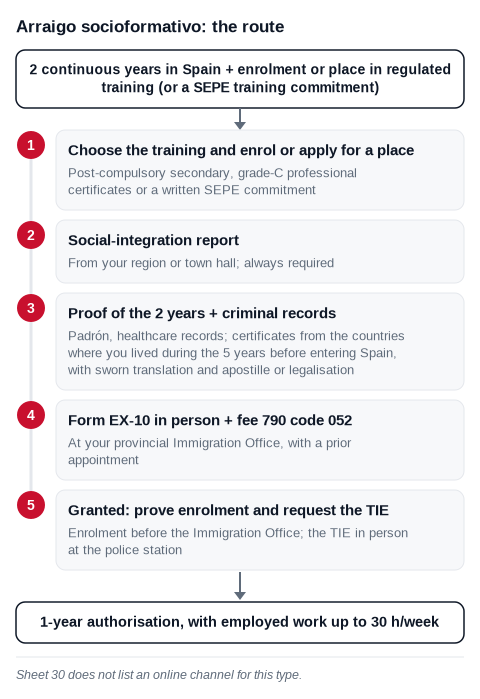
Steps
- Choose the training and enrol or apply for a place (or prepare the written SEPE training commitment).
- Request the social-integration report from your region/town hall.
- Gather proof of the 2 years (padrón, healthcare records, official documents) and criminal-record certificates (countries where you lived during the 5 years before entering Spain, sworn translation, apostille/legalisation where needed).
- File form EX-10 in person (you or your representative) at your provincial Immigration Office (book a cita previa).
- Pay the fee, form 790 code 052 (heading 2.3.1) within 10 working days.
- If granted: prove enrolment within 3 months and apply in person for the TIE card within 1 month (documents).
Official source: Information sheet 30 — inclusion.gob.es · RD 1155/2024.
Informational only; check the official source and a professional for your specific case.
