
In short: arraigo social is a residence authorisation on exceptional grounds for people with 2 continuous years in Spain (absences ≤90 days) who either have family ties to a legal resident plus economic means (200% of IPREM). Without such ties, the alternative is a favourable social-integration report from their region or town hall (Hoja 28, inclusion.gob.es).
In person or by representative? The applicant files it or a representative does (art. 197.4 RD 1155/2024; Hoja 60). The representative can be anyone holding a notarial power of attorney or an apud acta power in the Electronic Register of Powers of Attorney, or a professional authorised under an agreement (lawyer, gestor administrativo, graduado social), who files it online. For a minor or a person with a disability who needs support, the legal representative or support person files (art. 130.1). Hoja 28 only names that legal representative, but refers to Hoja 60. File at your provincial Immigration Office or online via Mercurio. The TIE card, however, is requested in person at the police after approval (step 6). More detail: SEM 1/2024.
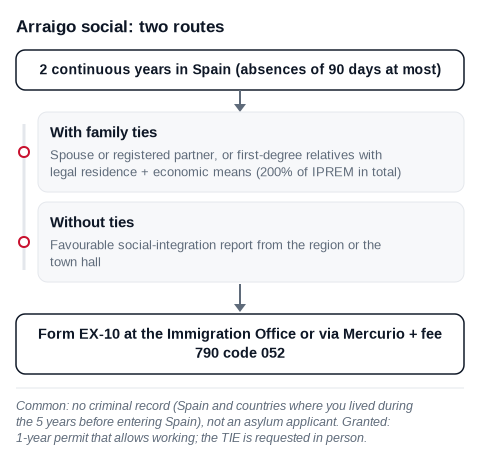
The two routes (Hoja 28)
- With family ties: spouse or registered partner, or first-degree direct-line relatives, holding a residence permit. Means: 100% of IPREM proven by the resident relative + 100% for the applicant (200% total, available in Spain and coming from those relatives; self-employment income may qualify under art. 84).
- Without ties: a favourable social-integration report from the region (or town hall) of your habitual residence (issued within 1 month; if not issued on time and you can prove it, any valid evidence may substitute). It assesses time at your address, means and integration programmes — see SEM 4/2025 instructions on the arraigo report.
Common requirements: not an international-protection applicant when filing or during processing (time as an asylum applicant does not count towards the 2 years); not an EU/EEA/Swiss citizen or family member under the EU regime; no criminal record in Spain or in the countries where you lived during the 5 years before entering Spain; pay the fee.
Decision: 3 months; no reply = rejected by administrative silence (what to do). The permit lasts 1 year and allows working (employed or self-employed); renewal requires still meeting the requirements + active job search and registration with the public employment service (except illness, disability or retirement age).
Steps
- Gather proof of the 2 years (documents from Spanish administrations: padrón, healthcare records, etc.). If you have worked in Spain, also get your vida laboral so your registration periods are at hand.
- Depending on your route: family-tie documents (marriage/partner-registry or birth certificates) + proof of 200% IPREM, or request the social-integration report from your region/town hall.
- Criminal-record certificates from the countries where you lived during the 5 years before entering Spain (sworn translation; apostille/legalisation where needed).
- File form EX-10 at your provincial Immigration Office or via Mercurio.
- Pay the fee, form 790 code 052 (heading 2.3.1) within 10 working days.
- If granted: apply in person for the TIE card within 1 month (documents).
Official source: Information sheet 28 — inclusion.gob.es · RD 1155/2024, arts. 124-127 & 130-132.
Informational only; check the official source and a professional for your specific case.
