
In short: the free SEPE courses Spain offers to unemployed people are run by each autonomous community's employment service, and to join you need to be registered as a job seeker (demandante de empleo). If you are a non-EU foreigner, that registration requires a document recognising your right to work: without it, these courses are not open to you. Fundae is a different thing: it manages training for people who work.
Who can enrol, by your situation. The way in is registration as a job seeker (the proof is called DARDE). How to do it is in registering as a job seeker as a foreigner. What changes is the document that proves your right to work:
- You live in Spain with a work authorisation: yes. You present that document when you register (arts. 7.1.d and 9.1.b of Royal Decree 438/2024).
- You have temporary protection (for example, Ukrainians): yes. The decision that grants it includes the residence and work authorisation (art. 5.1 of Order PCM/169/2022). The receipt of the application only authorises you to stay in Spain and receive social aid (art. 3).
- You are an asylum seeker: not at first. You may work six months after the date of your application if it was admitted for processing and is still unresolved for reasons not your fault. It is shown by the entry «autoriza a trabajar» in your applicant document (fourteenth additional provision of Royal Decree 1155/2024). While you wait, the reception system includes language classes, labour guidance and support to access training (arts. 19 and 22 of Royal Decree 220/2022).
- You have no work authorisation: no, unless a specific call says otherwise. Without that document you cannot register as a job seeker, and the courses for unemployed people start from that registration. What does exist (adult education, NGOs, online courses) is in free courses without papers. The law recognises the right to education of people over 18 who are in Spain according to the education legislation (art. 9.2 of Organic Law 4/2000), which does not guarantee a place on a particular course. If your work authorisation is being processed, the eighth additional provision of Royal Decree 438/2024 lets the Ministry of Labour regulate how you can register. We have not confirmed that this procedure is running yet, so ask your employment service.
- You are applying for or hold arraigo socioformativo: if your arraigo relies on training promoted by the public employment services for hard-to-fill occupations, it comes after the arraigo. You can only take it once the arraigo is granted, you have an NIE and are registered as a job seeker, and the training action is scheduled and authorised. To apply for the arraigo, being enrolled or having submitted an admission application for a training in Annex II is enough. You cannot hold this arraigo more than once in three years (fifth instruction of Instrucciones SEM 1/2025). Details in courses for socioformativo arraigo.
Registration requirements. The training offer for unemployed people is for those registered as job seekers with a public employment service (art. 5 of Royal Decree 694/2017); young people in the Youth Guarantee System do not need to register. In general, priority goes to people with low qualifications. To register, Royal Decree 438/2024 (art. 7) asks you to be over 16, have a DNI or NIE and live habitually in a municipality of the region. People without a DNI or NIE can register "according to current regulations". Each employment service applies the procedure in its own way: confirm what yours asks for.
How to find a course. The SEPE gathers each region's search tool on a map of training offers. For example: Community of Madrid, Andalusia (SAE), Catalonia (Servei d'Ocupació) and Valencian Community (Labora). Each region sets its own deadlines, places and way to apply; courses can be in person, online or mixed depending on the call.
Courses by trade. If you already know which job you want, see the guides by profession: social and health care, forklift operator, hospitality and cleaning. If you have worked in a trade for years and have no qualification, you can have your skills accredited without taking the course: accrediting skills through work experience.
Courses with company placements. Many certificates include training in a company. Under Royal Decree 659/2023, in the general regime it takes between 25 % and 35 % of the certificate's length (20 % at level 1). In the intensive regime it takes between 35 % and 50 % (arts. 71 and 72). People who can prove related work experience may be exempted (art. 73). In the old certificates this part was a separate module of non-employment professional placements (prácticas profesionales no laborales). The same royal decree plans to replace it with training in a company (first transitional provision, paragraph 3), and some calls still use the old name. To search, open your region's course search, filter for courses leading to a full certificate and check in the call whether there are placements and how many hours. One example: the Community of Madrid training offer includes pathways with a full certificate and placements extended to 500 hours for unemployed people, with preference for young people aged 16 to 30 and people over 45. You must live in Madrid and be registered there as a job seeker, and your employment office does the pre-selection. We have not reviewed an equivalent offer in other regions: ask your employment office.
What you get. If the course leads to a certificado de profesionalidad (now called certificado profesional, see what a professional certificate is), you receive the certificate or cumulative partial accreditations. Otherwise you receive a diploma if you pass the assessment, or an attendance certificate (art. 7 of Royal Decree 694/2017). Training is one of the services the law recognises for people who register with the public employment service as job seekers (art. 56.1.d of Law 3/2023 on Employment). The law itself speaks of a public and free employment service (art. 8.4.f), but check the call for the course to see that there is no enrolment fee or tasa. Finishing a course does not mean you get a job. If you want a course for socioformativo arraigo, not every free course qualifies: see courses for socioformativo arraigo.
If you receive unemployment benefit. According to the SEPE page on obligations, people receiving unemployment benefit must take part in the employment programmes and in the vocational promotion, training or retraining actions set by the public employment service. Refusing, without a justified reason, the actions set out in your itinerary or personalised plan is a serious infraction: loss of the benefit for three months the first time, six the second and termination the third, as long as no more than 365 days pass between a serious infraction and the previous one. The page does not detail what counts as a justified reason; ask your employment office.
Fundae, for people who work. Fundae (the State Foundation for Employment Training) manages training for employed people: the training your company programmes using bonuses on its Social Security contributions, and the calls for subsidised courses, searchable in the Fundae course finder. If you are unemployed and take part in training actions for unemployed people, art. 25 of Royal Decree 694/2017 provides for transport, meal, accommodation and childcare or family-care aid, in the amount set by a ministerial order. The Fundae website does not mention requirements for foreigners.
Documents
- ID document with NIE (or DNI): required to register as a job seeker.
- Registration as a job seeker with your region's employment service.
- If you are not from the EU, the document that authorises your right to work (art. 9.1.b of Royal Decree 438/2024): your TIE with a work authorisation, the temporary protection decision, or the asylum applicant document with the entry «autoriza a trabajar». If you have another one, ask your employment service what they accept.
- Whatever each course or call asks for (the list varies): check the call.
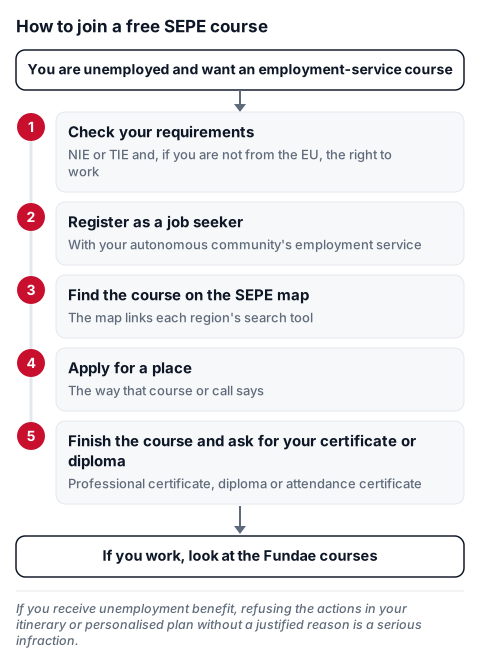
Steps:
- Check your requirements: NIE or TIE and, if you are not from the EU, the right to work.
- Register as a job seeker with your region's employment service.
- Find the course on the SEPE map, which links each region's search tool.
- Apply for a place the way that course or call says.
- Finish the course and ask for your professional certificate, diploma or attendance certificate.
For the wider picture (what counts as regulated training and which online courses only add to your CV) see courses and training to improve your employability.
🎓 Want to add skills to your CV while you look for a place? Alison offers online courses with its own certificate. It is not a certificado de profesionalidad and does not count for arraigo (🤝 our partner).
Informational only; check the official source and a professional for your specific case.