In short: a care worker certificate Spain recognises across the country comes as one of two level 2 certificados de profesionalidad, now called certificados profesionales. SSCS0108 prepares you to care for people at home and has 600 hours. SSCS0208 prepares you to care for dependent people in institutions and has 450 hours. The free courses are run by the SEPE and the regions for unemployed people who are registered as job seekers (demandantes de empleo) and have the right to work. If you have been caring for people for years, there is another route with no course: having your experience accredited.
In person or by representative? You take the course yourself: classes and work placement are personal. Registering as a job seeker and applying for a place depend on each region; check its portal.
What the two certificates are. Royal Decree 1379/2008 creates them in the professional family of Sociocultural and Community Services. They are official and valid across Spain, but the decree itself says they do not regulate the practice of the profession (art. 1). Level 2 is the middle one of the three levels these certificates have. The hours and modules are those of the decree as published in the BOE.
- SSCS0108, Social and health care for people at home. In total, 600 hours. Modules: hygiene and health care at home (170 hours), psychosocial care and support at home (210) and home support and family nutrition (100). On top of that come 120 hours of non-work professional placement. The decree links it with jobs such as home care assistant or carer of older people, people with disabilities or people convalescing at home.
- SSCS0208, Social and health care for dependent people in social institutions. In total, 450 hours. Modules: support in organising interventions in institutions (100 hours), social and health care in institutions (70), hygiene and food care in institutions (70) and psychosocial support, relational and communication care (130). On top of that come 80 hours of non-work professional placement. The decree links it with carer of dependent people in institutions and gerocultor (care-home assistant), in residential and day centres.
Do you need the certificate to work? It depends where. The decree that creates the certificates does not regulate the profession. Another rule, however, asks for a qualification in one specific area: the Agreement of the Territorial Council of Social Services and the SAAD of 28 June 2022, published in the BOE on 11 August 2022. The SAAD is the public system of care for dependent people. The agreement sets common accreditation and quality criteria for its centres and services, including residential care and home help. For first-level direct-care staff (carers, gerocultores and home help assistants), the agreement asks for one of these qualifications. They are the Technician in Nursing Auxiliary Care qualification, the Technician in Care for People in Situations of Dependency qualification, or one of the two certificates on this page. Exceptionally, each certificate is also valid for the other setting. An exceptional habilitation also counts as a qualification: an individual certificate from the social services administration for people who already had proven experience when the agreement came into force. Each region applies the agreement with its own powers. The text makes it enforceable once the habilitation processes, and the work-experience accreditation or training processes started before 31 December 2022, have ended. We have not found any requirement in the agreement for other care jobs, for example if a family hires you. Before enrolling, ask your region's social services department or the centre where you want to work.
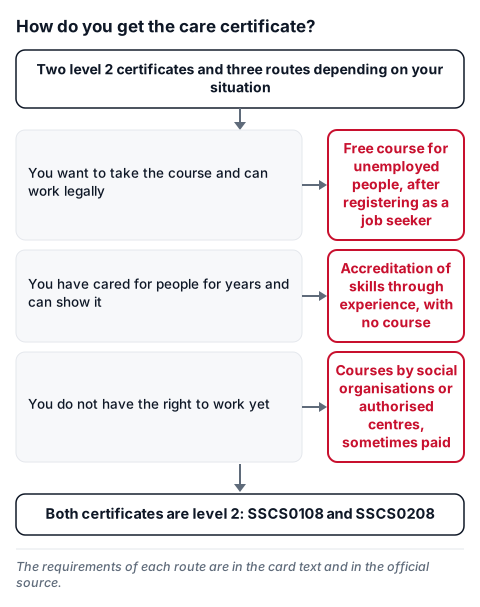
Three routes to the certificate
- Free course for unemployed people (SEPE and regions), as described below.
- Accredit your experience, with no course. The procedure is open all year, with no call (art. 175 of Royal Decree 659/2023). For levels 2 and 3 you must be at least 20 and hold one of these: Spanish nationality, an EU citizen registration, an EU family member card, or a residence (or residence and work) authorisation in force (art. 177). You also need experience: at least 3 years with 2000 hours worked in total, in the last 15 years, or 300 hours of related training in the last 10. Experience is shown with a certificate from the General Treasury of Social Security and with the contract or an employer's certificate. If you are over 25 and cannot document it, a provisional registration with other evidence exists, and the adviser or the evaluation committee decides. More in accreditation of skills through work experience.
- Other routes if you cannot register as a job seeker yet: courses run by social organisations and full courses at authorised centres, sometimes paid.
Who can take it free, by situation
- With authorisation to work (for example, a TIE for residence and work): you can register as a job seeker and apply for a place in the public offer. If you are not from the EU, registration asks for the document recognising your right to work (Royal Decree 438/2024, arts. 7 and 9).
- With temporary protection (Ukraine): the decision granting it includes the residence and work authorisation (Order PCM/169/2022, art. 5.1), so you can register as a job seeker.
- International protection (asylum) applicant: you may work 6 months after the date of your application, if it was admitted for processing and is still unresolved for a reason that is not yours. This is set by the fourteenth additional provision of Royal Decree 1155/2024. It is shown by the note "autoriza a trabajar" on your document. Until then, the SEPE offer is not open to you: ask the organisation supporting you in the reception system.
- Without authorisation to work: you cannot register as a job seeker, so the SEPE and regional courses are closed. That leaves courses run by social organisations, whose access depends on each project (see courses and training to improve your employability), and full courses at authorised centres, which may be paid. For socioformativo arraigo, see the section below.
Access requirements for the certificate. For level 2 you need the ESO (compulsory secondary education) or equivalent (art. 75 of Royal Decree 659/2023). A level 2 certificado de profesionalidad, a certificate of competence or a level 1 certificate in the same professional family also works. If you do not have the qualification, the administration checks with a test that you can follow the course (art. 76). For studies done in another country, ask the centre how they are validated. Ask too in which language the course is taught; if your Spanish is still basic, look first at the free Spanish classes.
How the course works. It can be in person or virtual, depending on the call. To sit the final test of a module you must have attended 75 % of its hours or, if it is virtual, have done and passed 75 % of the learning activities in at least 70 % (art. 78 of Royal Decree 659/2023). The 2008 decree provides a non-work placement module: 120 hours in SSCS0108 and 80 in SSCS0208. Under Royal Decree 659/2023, once its transitional period ended on 31 December 2024, that module is replaced by company training within the same total duration (first and sixth transitional provisions). Under the general regime it takes between 25 and 35 % of the duration (art. 71). If you have related work experience, the administration may exempt you from the company part (art. 73). How many hours you spend in a company is set by the call.
Free for whom? In the public offer for unemployed people, students do not pay for the training and may receive aid for attending; LABORA in the Valencian Community says so, for example. Art. 25 of Royal Decree 694/2017 provides transport, meal, accommodation and care-responsibility aid for unemployed people, in the amount set by a ministerial order. A private course for these certificates is another matter and may cost money: check in each call that there is no enrolment fee.
How to find the course in your region. Look for the specialty by its code, SSCS0108 or SSCS0208, or by name in the search tool of the SEPE Catalogue of Training Specialties. To see courses with open places, use your region's course finder: the SEPE gathers them on a map of training offers. For example: Community of Madrid, Andalusia (SAE), Catalonia (Servei d'Ocupació) and Valencian Community (Labora). Each region sets its own deadlines and places, and this page gives no call dates.
Does it count for socioformativo arraigo? Annex II of the official arraigo FAQ guide lists the level 2 professional certificate among the valid training (arts. 52.1.e 5.º and 127.d of Royal Decree 1155/2024). It must be the full certificate, not a single module, at an authorised centre entered in the official register, and at least 50 % of classes must be in person. SSCS0108 and SSCS0208 are level 2, so a full course that meets those conditions fits that category; whether the immigration office accepts it in your case is checked there. An online-only course, a single module or a platform diploma does not count. If the centre has an official enrolment period, the arraigo application is filed in the two months before it starts, with the admission request. Courses promoted by the employment service are taken after you hold the arraigo and the NIE and have registered as a demandante de servicios previos al empleo (pre-employment services). Also, you cannot hold this arraigo more than once every 3 years (SEM instructions 1/2025, instruction five). Those courses count only if aimed at occupations in the hard-to-fill occupations catalogue; we could not check whether care occupations are in the SEPE catalogue for your province. The full arraigo requirements are in socioformativo arraigo and courses for socioformativo arraigo.
Documents
- ID document with NIE (or DNI), or the TIE: required to register as a job seeker.
- If you are not from the EU, the document recognising your right to work in Spain.
- Proof of your registration as a job seeker (the DARDE, the document for registering and renewing your job-seeker status).
- ESO certificate or equivalent, or proof of the access test the centre asks for.
- Whatever each call asks for; the list varies and this one may be incomplete, check the call.
Steps:
- Check that your situation gives you the right to work (if you are not from the EU), because job seeker registration requires it.
- Register as a job seeker with your region's employment service; the registration records your work experience.
- Look for the certificate by its code, SSCS0108 or SSCS0208, in the SEPE catalogue and in your region's course finder.
- Check the access requirement (ESO or equivalent, or the test) and apply for a place the way the call says.
- Take the modules and the company training.
- Ask for your certificate, or the certification of the modules you passed.
Official source: Royal Decree 1379/2008 in the BOE.
🎓 If you only want to add health knowledge, Alison offers free online courses; its certificate is paid and does not replace a certificado de profesionalidad or count for arraigo (🤝 our partner).
Informational only; check the official source and a professional for your specific case.