In short: free courses in Spain without a residence permit are limited. The free SEPE courses and those of the regional employment services are closed if you have no work authorisation, because they require registration as a job seeker (demandante de empleo). Three routes remain: adult education centres (CEPA), programmes run by some NGOs, and the training that lets you apply for socioformativo arraigo. Each centre and each programme sets its own requirements.
What does not exist: SEPE and regional-service courses. The training offer for unemployed people is for those registered as job seekers (art. 5 of Royal Decree 694/2017). The same article allows exceptions where a specific rule does not require that registration, but we have not found any for people without work authorisation. To register, a non-EU foreigner must have a recognised right of access to the labour market and present the document that authorises it (arts. 7.1.d and 9.1.b of Royal Decree 438/2024). With no work permit at all, that door is closed. The same rule lets the Ministry of Labour regulate registration for people whose residence and work authorisation is still being processed (additional provision 8). We have not found that the Ministry has approved that procedure yet; ask your employment service before you go.
If you have temporary protection, are an international-protection applicant with the «autoriza a trabajar» annotation, or have already been granted an arraigo, you can in principle register. In principle, the same goes if you applied for the extraordinary regularisation (the window closed on 30 June 2026) and you have the notice of start, which provisionally authorises you to work until your application is decided. See how to register as a job seeker.
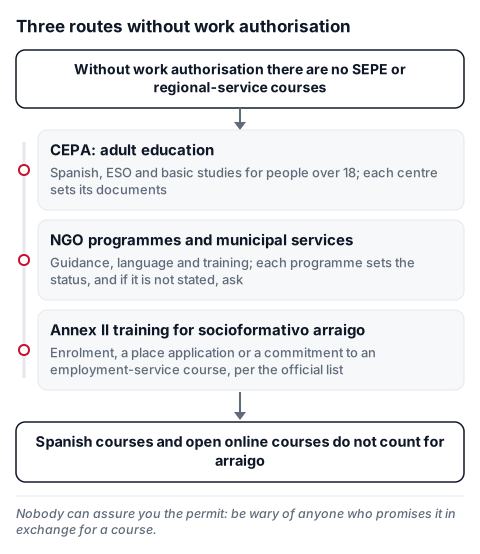
What is open: three routes
Adult education (CEPA). Public education for people over 18. In the Community of Madrid, the CEPA offer includes Spanish for foreigners, initial education, ESO for adults and basic FP; in other regions these centres are called CEPER, EPA or CFPA. It is not job training: it gives you language and basic studies that open the door to other training. The law recognises the right to education for foreigners over 18 who are in Spain, in line with education legislation (art. 9.2 of Organic Law 4/2000), but it does not reserve you a specific place. Requirements change from one centre to another:
- the admission page of the Madrid CEPA asks for a photocopy of a DNI, NIE card or passport and says nothing about people without a permit;
- Torrelaguna's CEPA requires living in the Community of Madrid and having your paperwork in order (DNI or NIE);
- the page of another Madrid CEPA says its Spanish course is free except for the book and mentions no documents.
Ask at the secretariat of the CEPA for your area.
NGO programmes and municipal services. Several organisations offer guidance, language and training to migrants, but many set requirements on administrative status and their pages do not always state them. What is on record:
- Cepaim Emprende (self-employment) serves migrants with legal residence and a work permit. The Cepaim employment service is aimed at people in the reception and international-protection system.
- Accem: AccemARIADNA is for international-protection applicants and beneficiaries; EmpleaIN is for immigrants at risk of social exclusion, and the page does not state their status.
- Cruz Roja Interlabor@ serves non-EU migrants in vulnerable situations. The page states no status requirements and no cost: ask at your local office.
- CEAR offers integration itineraries to international-protection applicants, refugees and migrants. Requirements depend on the project: a 2023 project in Madrid asked for a residence and work permit and empadronamiento, so treat it only as an example.
- Incorpora, from the "la Caixa" Foundation, includes migrants among the people at risk of exclusion and is accessed through member social organisations. It states no status requirements: ask.
- Municipal services: the Madrid municipal offices for immigrants have free and open access, with a Spanish area and an employment area, and their website mentions no residence-permit requirement. The SAIER in Barcelona is a free public service for anyone living in the city, with training and job guidance and information on where to learn languages.
Training that lets you apply for socioformativo arraigo. This route requires meeting the requirements of socioformativo arraigo, including two continuous years in Spain. If you meet them, you can apply while enrolled, or with your application for a place already filed, in training from Annex II of Instruction SEM 1/2025. It covers bachillerato, mid-level FP, mid-level arts and sports education, specialisation courses and full professional certificates of level 1, 2 or 3. In person only and for people over 18, it also covers initial education, ESPA and basic FP. A commitment to take training promoted by the public employment service for an occupation on the hard-to-fill jobs catalogue also counts (art. 127.d of Royal Decree 1155/2024). That course comes later: once the arraigo is granted, you have a NIE and you are registered with the employment service (paragraph QUINTA.1.d). If you then cannot prove you took it, that is a ground for ending the permit. This route is not a free course as such: it is a residence permit you reach by studying, and where there is enrolment, the cost depends on the centre. Spanish courses are not on the list. Also, you cannot hold this arraigo more than once in 3 years (paragraph QUINTA.3). To choose a course and check the centre, follow the card on courses for socioformativo arraigo.
Common traps
- Academies selling «courses for arraigo». Only the training on the list above counts, at an authorised centre and with at least half of the classes in person. An online-only course or one from an unauthorised academy does not qualify. Before paying, run the four checks on the card on courses for socioformativo arraigo.
- Promised results. Nobody can assure you the permit or a job: the Immigration Office decides the permit. Be wary of anyone who promises it in exchange for paying for a course.
- Online courses. Those on open platforms help your CV, but they are not regulated training or a professional certificate and they do not count for arraigo. The Grow with Google catalogue separates paid and free certificates and mentions no residence requirements.
Documents
- Passport, or DNI or NIE if you have one: the admission page of the Madrid CEPA accepts a photocopy of any of the three.
- Two recent passport-size photos.
- Proof of address: a utility bill or the empadronamiento certificate.
- Documents of previous studies, if you have them.
- Whatever each centre or programme asks for: the list varies, confirm it before you go.
🎓 To add skills to your CV, Alison offers online courses. They do not give a professional certificate or count for arraigo (🤝 our partner).
Informational only; check the official source and a professional for your specific case.