In short: non-lucrative temporary residence lets you live in Spain without working (neither employed nor self-employed), by proving sufficient financial means and a health insurance. The initial permit lasts one year and is applied for as a visa at the Spanish consulate in your country of residence (arts. 61–63 RD 1155/2024).
In person or by representative? It is mixed. You apply for the visa in person at the Spanish consular office for where you live, or at the external service provider or the consulate designated by the Foreign Ministry (information sheet 6). Art. 26.1 of RD 1155/2024 also allows electronic filing where a dedicated online system exists. It also allows a representative where the law provides for it (for example, a minor's legal representative, according to sheet 6) or, exceptionally, for distance, transport or illness that make travel hard. Once it is granted, you collect the visa personally within a month of the notification (sheet 6). In Spain, you apply for the TIE in person at the police station within a month of entry (art. 63.5). The renewal goes to the immigration office (art. 64.1): in person, online via Mercurio or through a representative with a notarial power of attorney or an apud acta authorisation (art. 197.1 and 197.4). Information sheet 7 (May 2025) only mentions Mercurio and the holder: that route was mandatory under art. 197.2 b), which the Supreme Court annulled (ruling). Since the official sources do not match, the safest option is to file it yourself.
It is the usual route for people with their own income who do not need to work (pensioners, rentiers, people with sufficient savings). It does not allow working: to carry out an activity you must apply for a different permit or a modification.
Requirements (arts. 61–62)
- Sufficient financial means for the authorisation period, or a regular income source: 400% of the IPREM monthly for the holder + 100% of the IPREM per dependent family member (minimum amounts; the figure in euros depends on the current IPREM — check the current value).
- Health insurance (public or private, with cover in Spain).
- Not being within a no-return commitment assumed when voluntarily returning to your country of origin.
- No criminal record and not posing a threat to public order, security or public health.
- Paying the processing fee.
Work, income, duration and switching permits
- Work, including online. Art. 61.1 allows you to reside «without carrying out employment or professional activities» and does not separate on-site from remote work. The Houston consulate asks on its page for a notarised sworn statement promising not to do any paid work, in person or online, while you live in Spain. To work remotely for companies or clients outside Spain there is a different permit: international telework (digital nomad). If your case is occasional income or monetised content, ask your consulate or the immigration office first.
- Means you can prove. You need means for the whole period or a source of regular income (art. 62.1), shown by any means of proof admitted in law, for example title deeds, certified cheques or credit cards with a bank certificate of the available credit (art. 62.3). If the means come from shares or holdings in Spanish, mixed or foreign companies based in Spain, you need a certificate that you do not work in them and a sworn declaration (art. 62.3). Whether one particular type of income (for example, withdrawals from a pension fund) is enough is judged by the consulate: ask it.
- Duration. The initial authorisation lasts one year (art. 61.4). A renewed one lasts two years, unless you already qualify for long-term residence (art. 64.7). A renewal is decided within three months, and silence means approval (art. 64.8).
- From the visa to the immigration office. The initial authorisation is requested together with the visa at the competent consular office (art. 63.1): it is not filed directly at the immigration office in Spain. The Houston and Montréal consulates state on their pages that they serve people who live in their district. Houston adds that B-1/B-2 visa holders cannot apply in the US and must do so in their country of permanent residence. Check the rule of the consulate that covers you. Only someone who held a family-member card of an EU citizen or of a Spanish national and stopped qualifying can move to non-lucrative residence inside Spain without a visa (art. 191.8).
- Switching to a work permit without leaving Spain. Non-lucrative residence is temporary residence: you can apply for a residence and work authorisation without a visa (art. 191.1), and this route is not among the excluded ones in art. 191.7. With at least one year in Spain in residence, the requirements of art. 74 apply except the national employment situation (paragraph 1.a) and, where relevant, art. 84 for self-employment. The new authorisation lasts one year and takes effect only when you are registered with Social Security, within a month of the notification (art. 191.4). With under a year, for employment all of art. 74 applies, including the national employment situation (art. 191.2). The employer or you can file it (art. 191.5).
- Studies. Art. 61.1 excludes only employment or professional activities. If the master's will be your main activity, there is the stay for full-time higher education studies leading to a recognised higher-education degree (art. 52.1.a). Someone who holds a residence authorisation and is in Spain can apply for it without leaving (art. 54.1), at least two months before their legal situation expires (art. 54.3). What happens to your residence once the stay is granted: stay for studies. Before you enrol, confirm your case with the immigration office or the consulate.
Visa documents (arts. 38 + 61–62): application form (form EX01) completed and signed; passport or travel document valid for at least one year; criminal-record certificate from the countries of residence over the last five years; medical certificate proving no diseases with serious public-health impact (International Health Regulations 2005); proof of sufficient financial means; proof of health insurance; proof of fee payment. (Each consulate may require legalisations/translations and additional documents; form EX01 and the information sheets detail the list per case.)
Examples of what some consulates ask for (according to their official pages, checked on 29.10.2026; each consulate publishes its own rules and may change them, so confirm with yours):
- Houston (consulate page): appointment through BLS Houston; bank statements for the last twelve months with a stable balance of at least $33,400 a year, plus $8,330 per dependent family member; if you are retired, original pension documents (with the monthly amount, the grant date and the payment period) and statements for the last five months; health insurance with no waiting periods, exclusions, co-payments or coverage limits; an FBI criminal-record certificate with federal apostille, less than six months old; proof of residence in the district (Alabama, Arkansas, Louisiana, Mississippi, New Mexico, Oklahoma, Tennessee and Texas) and, if you are not a US citizen, of legal residence in the US; a notarised sworn statement. Each family member files their own visa application and their own EX-01.
- Montréal (consulate page): the appointment is requested by email to [email protected], with the subject «Visado de residencia no lucrativa - Solicitud de cita», your full name, intended travel date and attachments (passport, proof of residence in the district and, if you are not Canadian, proof of legal status in Canada); its page quotes 2,400 € a month (the 2025 figure) plus 600 € per family member; an RCMP criminal-record certificate with fingerprints and apostille; insurance with no waiting period, co-payment or coverage limit; proof of residence with a permanent resident card or a Canadian passport.
Cost
There are two fees. The authorisation fee is paid with form 790 code 052: Orden PJC/617/2025 sets 10.94 € for «residencia temporal no lucrativa (titular principal y sus familiares)» (non-lucrative temporary residence, main holder and family members); check the figure in the form before you pay (how to fill in and pay tasa 052). The visa fee is published by each consulate on its visa page (Citizen services, Exteriores), and LO 4/2000 provides that these fees are adjusted to any amount set under the principle of reciprocity (art. 48.4), so the amount may not be the same for every nationality. For example, the Houston consulate states on its page (checked on 18.11.2026) $153 for US nationals, $13 for the initial authorisation and $140 for the visa, and for other nationalities it refers to its list of consular fees.
Steps
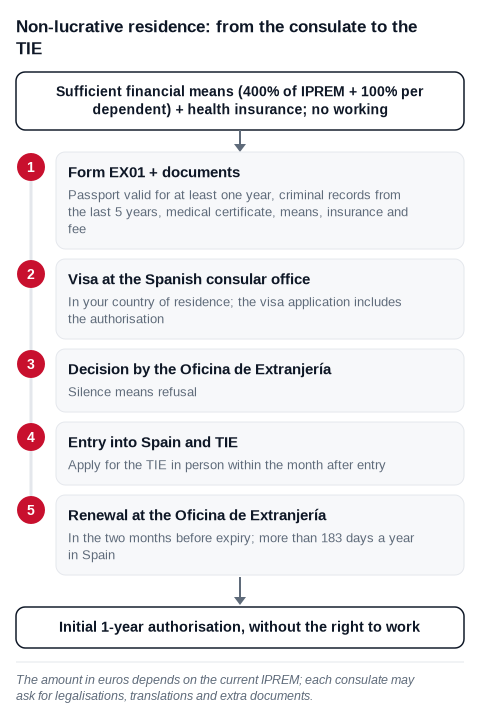
- Gather the documents and fill in form EX01 (Application for non-lucrative temporary residence, inclusion.gob.es).
- Apply for the non-lucrative residence visa at the Spanish consular office in your country of residence (the visa application includes the authorisation; art. 63.1). Consular info: Citizen services — Exteriores.
- The immigration office decides on the authorisation within a maximum of one month from the consular communication; silence means refusal (art. 63.4).
- Once the visa is granted, enter Spain and, within the month after entry, apply in person for the TIE (foreigner identity card) (art. 63.5).
- To keep it, renew during the two months before it expires at the Oficina de Extranjería, proving means, insurance and, if you have dependent minors, their schooling; you must have resided more than 183 days in the calendar year (art. 64). Once the renewal is granted, apply for the new TIE in person within a month (art. 64.9).
Official source: RD 1155/2024, arts. 61–64 (BOE-A-2024-24099); form EX01 and information sheets at inclusion.gob.es.
See also: the former residence-by-investment route (Golden Visa) no longer exists, see Golden Visa abolished and alternatives.
Informational only; requirements, documents and the IPREM amount vary — check the official source, your consulate and a professional for your specific case.