
In short: Widow's pension Spain (pensión de viudedad) for foreigners: the legal requirements concern the deceased and the relationship, not your nationality. What counts are the deceased's contributions and your marriage or unmarried partnership (pareja de hecho) with them. Since 21.10.2026, an unmarried partner with children in common needs only 2 years of living together proved with the padrón (town register). Children receive the orphan's pension (orfandad). The law does not require you to live in Spain to receive them; residence matters only for the minimum-pension supplement.
In person or by representative? You do not need to go in person: you can apply online, by post or through a representative (section 1.3 of the MS-3 form). You can also go to a Social Security office (CAISS) with an appointment.
It is managed by the National Social Security Institute (INSS). It is a contributory pension: it depends on the deceased's contributions and, as a rule, not on your income. The widow's pension is compatible with working (LGSS, art. 223).
Requirements
- Contributions of the deceased. If registered with Social Security (de alta) or in an equivalent situation: 500 days of contributions in the 5 years before death or 15 years in total. If not registered: 15 years of contributions. If registered and the death was caused by an accident, at work or not, or by an occupational disease, no prior contributions are needed (LGSS, art. 219). If the deceased was already a pensioner, the Social Security widow's pension page states that no contribution period is required.
- Marriage. If the death was caused by a common illness that existed before the wedding, the marriage must have lasted at least 1 year or there must be children in common; it also works if prior cohabitation as a couple and the marriage add up to more than 2 years (art. 219.2).
- Unmarried partner (pareja de hecho). Neither of you could be married to someone else, have another pareja de hecho, or have any other impediment to marry. General rule: 5 uninterrupted years of living together right before the death, proved with the padrón certificate, and the couple registered in a regional or municipal register, or in a public deed, at least 2 years before the death. With children in common, since 21.10.2026 it is enough to have 2 uninterrupted years of living together right before the death, proved with the padrón, without registration (LGSS, art. 221.2, as worded by Real Decreto-ley 31/2026, validated in the BOE of 20.11.2026). An earlier marriage that was never dissolved, including one in the home country, rules out the pension even if there are children, because art. 221.2 defines a pareja de hecho as a couple with no marriage bond to another person. How to form a pareja de hecho: requirements and registration.
- Deaths before 21.10.2026. If your unmarried partner died before that date, had the required contributions and there was no right to the pension under the rules of that time, you can apply if you meet the new rule in art. 221.2. The deadline cannot be extended: until 21.10.2027 (12 months from the entry into force of Real Decreto-ley 31/2026 on 21.10.2026). Payment starts on day 1 of the month after the application, without the 3 months of arrears of the general case (transitional provision 48 of the LGSS, added by Real Decreto-ley 31/2026).
- Separation or divorce. You must have had a compensatory pension (pensión compensatoria) that ends with the death; this is not required of women who are victims of gender violence. If there are several beneficiaries, at least 40 % goes to whoever was the spouse or partner at the time of death (art. 220).
- Recent marriage or registration. If you do not qualify because the marriage lasted less than 1 year without children, or the couple had been registered for less than 2 years, there is a temporary benefit for 2 years of the same amount (art. 222).
- New marriage or new partner. The widow's pension ends, with exceptions for older people or people with a disability and low income (art. 223; Order of 13 February 1967, art. 11).
- Orphan's pension. Each child of the deceased, whatever the type of parentage, under 21 or unable to work; up to 25 if they do not work or their yearly income is below the minimum wage. The deceased must have been registered with Social Security, in an equivalent situation, a pensioner or, if not registered, have 15 years of contributions (art. 224, which refers to art. 219.1). According to the orphan's pension page, if the death was after 1.1.2008 while registered, no contribution period is required. For a minor, it is paid to whoever looks after the child.
- Residence. The requirements in arts. 219 to 224 concern the deceased and the relationship; the law does not require the person receiving the pension to live in Spain. The MS-3 form accepts foreigners resident or not resident in Spain. Residence is required only for the minimum-pension supplement (LGSS, art. 59).
- Padrón. If you are not from the EU or the European Economic Area and do not hold long-term residence, your padrón registration must be renewed every 2 years; if it is not renewed, the town hall can declare it expired (Ley 7/1985, art. 16). This is a padrón rule, separate from the pension, but an unmarried partner proves living together with the padrón certificate. How to get it: padrón certificate.
- Death at work. If it was a work accident or an occupational disease, the worker counts as registered even if the employer did not register them, and there is also a one-off payment: 6 months of the regulatory base for the widow or widower and 1 month for each orphan; the surviving pareja de hecho is also entitled to this payment (LGSS, art. 227). Lacking a work permit does not invalidate the contract as regards the worker's rights. Details and rules: who pays for the funeral.
How much you get. If the deceased was working, the regulatory base (base reguladora) is the sum of their contribution bases for 24 consecutive months, chosen within the 15 years before death, divided by 28; if they were already a pensioner, it is the base of their pension (Decreto 1646/1972, art. 7).
- Widow's pension: 52 % of the regulatory base (Decreto 3158/1966, art. 31).
- 60 % from age 65, if you have no other public pension, Spanish or foreign, do not work and your other income does not exceed the limit set by the budget law (Real Decreto 900/2018).
- 70 % with family dependants (you live with children under 26 or unable to work, or with fostered minors, and family income per person does not exceed 75 % of the minimum wage), if the pension is at least 50 % of your income and that income stays under a limit (Decreto 3158/1966, art. 31.2).
- Orphan's pension: 20 % of the base for each child. For full orphans (both parents have died or only one parent is known), if nobody receives a widow's pension, another 52 % is added, shared equally among the orphans (Decreto 3158/1966, arts. 36 and 38). As a rule, widow's and orphan's pensions together do not exceed 100 % of the base (LGSS, art. 229).
- 2026 minimums, per year (Real Decreto-ley 3/2026): widow's pension with family dependants, €17,592.40 (about €1,256.60 a month in 14 payments); at 65 or over, or with a disability of 65 % or more, €13,106.80 (about €936.20); from 60 to 64, €12,262.60 (about €875.90); under 60, €9,931.60 (about €709.40); orphan's pension, €4,011 per child (about €286.50), and for a full orphan €9,931.60 a year is added, to be shared. These amounts are reached through the minimum-pension supplement (complemento a mínimos): only if you live in Spain (stays abroad of 90 days or less a year) and your other income does not exceed €9,442 a year. For pensions that started from 1.1.2013, the supplement cannot exceed the amount of the non-contributory pension (minimum-pension supplements).
- The widow's pension is taxed in IRPF (income tax); the orphan's pension is exempt (Social Security pages).
If you live outside Spain or the deceased worked in other countries
- The MS-3 form has a section for payment abroad: cheque or bank transfer, with your bank's BIC and IBAN. Social Security pays people living in other countries free of charges for the pensioner (Social Security magazine).
- EU, EEA and Switzerland: the pension is not reduced for living in another member state, and periods of contributions in each country are taken into account (Regulation 883/2004, arts. 6 and 7). Regulation 1231/2010 extends these rules to nationals of other countries legally resident in the EU, to their families and to their survivors, if their situation involves more than one EU country.
- Ibero-America: the Ibero-American Multilateral Convention covers contributory survivors' pensions and provides that they are not reduced for living in another state party. According to the INSS guide of 2017, it was applied by Argentina, Bolivia, Brazil, Chile, Ecuador, El Salvador, Paraguay, Peru, Portugal and Uruguay; check the current list with the INSS.
- Bilateral conventions: if the deceased worked in Andorra, Argentina, Australia, Bolivia, Brazil, Cabo Verde, Canada, Chile, Colombia, South Korea, Ecuador, El Salvador, the United States, the Philippines, Japan, Morocco, Mexico, Moldova, Paraguay, Peru, the Dominican Republic, Russia, Senegal, Tunisia, Ukraine, Uruguay or Venezuela, the MS-3 tells you to ask for the bilateral conventions form. Ask the INSS what the convention with each country covers.
- Ukraine: the Spain–Ukraine convention covers death and survivors' benefits for Ukrainian citizens and their family members; pensions are not reduced for living in the other country, and insurance periods in both countries are added up. The application goes to the institution of the country where you live. The pension paid by Ukraine is a different procedure: Ukrainian pension from Spain.
- Other countries: the form lets you give a foreign bank account; ask the INSS how it applies to your case.
- Proof of life: anyone receiving a Spanish pension while living abroad must prove they are alive. From 2027, in January, May and September, with the VIVESS app, a certificate of life from the local authority, the consular Civil Registry or the Labour Office (Consejería de Trabajo) (Social Security).
- Living outside Spain, you do not receive the minimum-pension supplement (pensions caused from 1.1.2013).
Also useful. Whoever paid the funeral can also claim the death grant (auxilio por defunción) of €46.50 (who pays for the funeral). First steps after a death: what to do when a relative dies. If there is no right to a widow's pension and you are 65 or over or have a disability, look at the non-contributory pension.
Documents
- Application: MS-3 form or the online form.
- TIE; or passport (or your country's identity document) and NIE, which the Tax Agency requires for payment.
- Death certificate. You request it on the Ministry of Justice e-office, with or without Cl@ve.
- Marriage: family book (libro de familia), Civil Registry record or equivalent foreign document, legalised or stamped where required and translated, proving the marriage and your current marital status. If the marriage lasted less than 1 year and there are no children in common, a medical certificate with the date the illness began; if you lived together before marrying, a padrón certificate or other proof of that cohabitation.
- Separation, divorce or annulment: the court ruling and the document granting the compensatory pension, or proof of gender violence, and the responsible declaration on the compensatory pension (INSS model).
- Unmarried partner: padrón certificate proving you lived together; certificate of registration in the partners' register or public deed (not needed if there are children in common); Civil Registry records proving neither of you was married to someone else.
- Children in common and orphan's pension: family book or birth certificates (or equivalent foreign document); adoption or foster care certificate, if relevant. Orphan's pension for inability to work: disability certificate or medical reports.
- Minimum-pension supplement, if you are a foreigner living in Spain: Central Register of Foreigners certificate or TIE (deaths from 1.1.2013).
- If a representative acts for you: proof of representation (not needed if they are listed in the electronic register of powers of attorney).
- Bank account for payment, in Spain or abroad (BIC and IBAN).
- Documents from another country must meet the legalisation requirements to be valid in Spain.
- The full list for your case (support for people with disabilities, emancipated minors, violence against women) is in the MS-3 form.
- The MS-3 form (version 49, of 10.08.2026) predates Real Decreto-ley 31/2026: it still asks for the couple's registration and does not include the 2-year padrón rule with children in common. The rule in force is art. 221.2 of the LGSS.
Deadlines
- There is no deadline to apply for the widow's or orphan's pension: the right does not expire. If you apply within 3 months of the death, payment starts the day after the death (if the deceased was already a pensioner, on day 1 of the month after the death); if you apply later, only 3 months of arrears are paid (LGSS, art. 230).
- Unmarried partner who died before 21.10.2026, if there was no right under the old rules: until 21.10.2027 (12 months from 21.10.2026), without arrears.
- If a document is missing, you have 10 days from when they ask for it.
- Decision: the portal states about 10 days, and the maximum is 90 days. If 90 days pass without an answer, the application is deemed refused. Against a notified refusal you have 30 working days to file the prior claim (reclamación previa).
Where
- INSS, at the CAISS offices; sea workers, at the Instituto Social de la Marina. If the death was caused by a work accident, the mutua (Social Security collaborating mutual) may also be involved.
- Appointment: Social Security e-office.
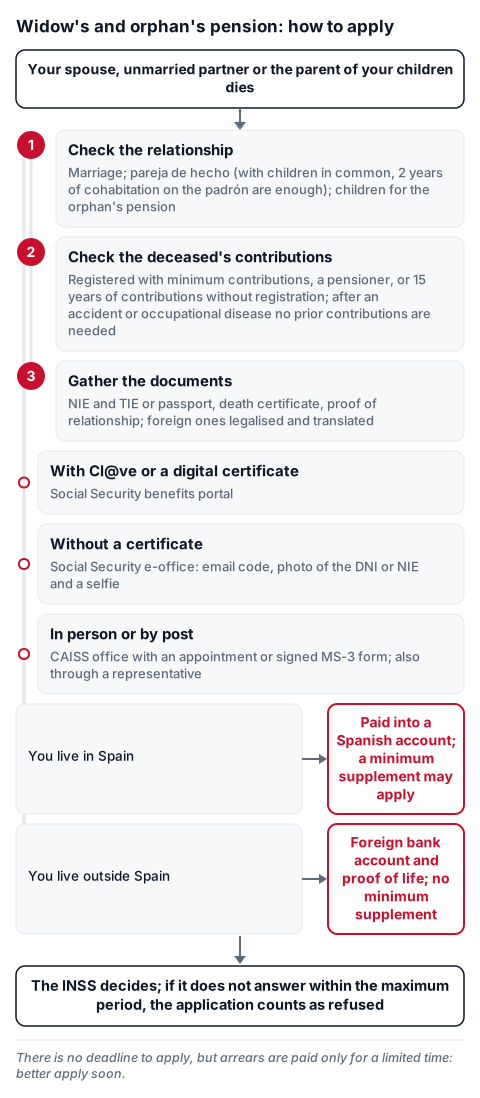
Steps
- Gather the documents on the list; those from another country, legalised and translated.
- Request the death certificate on the Ministry of Justice e-office.
- With Cl@ve or a digital certificate, apply on the benefits portal: widow's pension or orphan's pension. Both can go in the same application. How to get Cl@ve: Cl@ve and digital certificate.
- Without a certificate or Cl@ve: on the Social Security e-office, service «Solicitud SIN certificado de trámites de prestaciones», option for widow's, orphan's and family members' benefits (there are versions for EU regulations and bilateral conventions). You confirm your email with a code, upload a photo of both sides of your DNI or NIE and take a selfie holding the document (how it works). This route requires a DNI or NIE.
- In person: book an appointment at a CAISS and bring the signed MS-3 form with the documents. By ordinary post: send the signed MS-3 with the documents.
- If someone applies for you, fill in section 1.3 of the MS-3 and add the proof of representation.
- Give the account for payment; if you live abroad, use the section for payment abroad.
Official source: General Social Security Act (LGSS), arts. 219 to 230 (BOE) and the rules linked in each point.
Informational only; check the official source and a professional for your specific case.