
In short: the certificado de empadronamiento (padron certificate) is the document in which your Ayuntamiento (town hall) confirms that you are registered on the padrón. The town hall secretary signs it, and the law gives it the value of a "public, reliable document for all administrative purposes" (art. 16.1, Ley 7/1985). You request it online in the electronic office, in person and, in some municipalities, by phone or post. Any cost depends on the municipality.
In person or by representative? It depends on your municipality. The Padrón technical instruction lets residents access their data in person or through a legal or voluntary representative, and covers the online, in-person, phone and postal channels with safeguards. Which channels your town hall opens and what proof of representation it asks for, you will see on its own site.
This page is for when you are already registered. If you are not yet, start with how to register on the padrón. The padrón does not prove legal residence, and neither does the certificate.
Volante or certificado. The volante is purely informative and does not need the formalities of a certificado (art. 61 of the Reglamento de Población); the technical instructions add that it does not require any official's signature. The certificado is signed by the town hall secretary, or by the nationally qualified civil servant who stands in, and may be issued in an automated way with an electronic seal and a secure verification code. If whoever asks for it specifies "certificado", the volante is not enough.
Individual, collective or historical. The individual one is the usual choice. The collective one lists everyone registered at your home, never just some of them; the town hall issues it if everyone consents or there is a legitimate interest it weighs up. The historical one shows your registration and deregistration dates and your previous addresses. To prove continuous stay (for example arraigo social) or years of residence (nationality by residence), ask the authority whether it wants a historical one: the padrón rules do not impose it, the body asking decides. Available types vary by municipality; València, for example, offers individual, individual historical and a dwelling certificate (it shows your registration and the total number of people registered at the home, meant for family reunification or invitation letters); the family certificate is requested through a separate link.
Documents
- Identity document: passport, TIE or NIE. The technical instructions require padrón information to reach only the person concerned or their representative, so you will be asked to identify yourself.
- Online: an identification system your office accepts (digital certificate, DNIe, Cl@ve or another). See how to get Cl@ve and the electronic certificate.
- If someone else requests it for you: the authorisation your Ayuntamiento requires; the exact form varies.
- The exact list depends on the Ayuntamiento: confirm it on its site.
Where
- Your Ayuntamiento's online office (fastest). Examples: València, Certificat d'empadronament, Barcelona, Certificat d'empadronament and Madrid, electronic office (on the front page, "Padrón Municipal. Solicitud de certificado de empadronamiento").
- Padrón office or citizen service desk, normally with a prior appointment (cita previa).
- Phone or post: only where the municipality offers it (València has it via 010, with delivery by ordinary or electronic mail). By post, the instructions say it goes only to the address on the padrón. By phone, they only confirm the registration to someone who shows they know specific data about the resident.
Cost
- It depends on the municipality. The Padrón technical instructions set no fee, and València's procedure page states no cost. If your Ayuntamiento charges, you will see it on its site before you apply.
Deadlines
- The rules give the certificate no expiry date. Whoever asks for it may require a recent date: ask what maximum age they accept.
- How long it takes to reach you depends on the channel and the Ayuntamiento: València's procedure page sets no maximum resolution time.
- Watch your registration itself: foreigners from outside the EU, the EEA and Switzerland without long-term residence must renew it every two years (art. 16.1 Ley 7/1985 and art. 54 bis of the Reglamento), and if it is not renewed it can be declared expired.
Steps
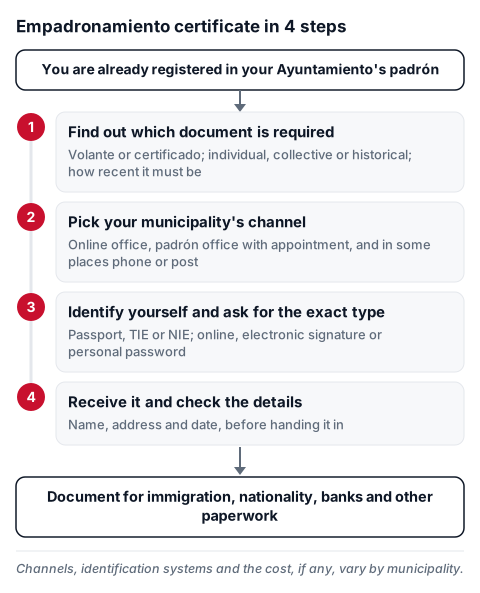
- Ask the body requesting it what it needs: volante or certificado; individual, collective or historical; and how recent it must be.
- Pick the channel your municipality offers: online office, padrón office with cita previa and, where available, phone or post.
- Identify yourself (passport, TIE or NIE; online, electronic signature or personal password) and ask for the exact type.
- Receive it and check name, address and date before handing it in.
Official source: Technical instructions on Padrón management (BOE-A-2020-4784), Ley 7/1985, arts. 15 to 18 and Reglamento de Población y Demarcación Territorial, arts. 53, 54 bis and 61 (BOE-A-1986-21944). Informational only; check the official source and a professional for your specific case.