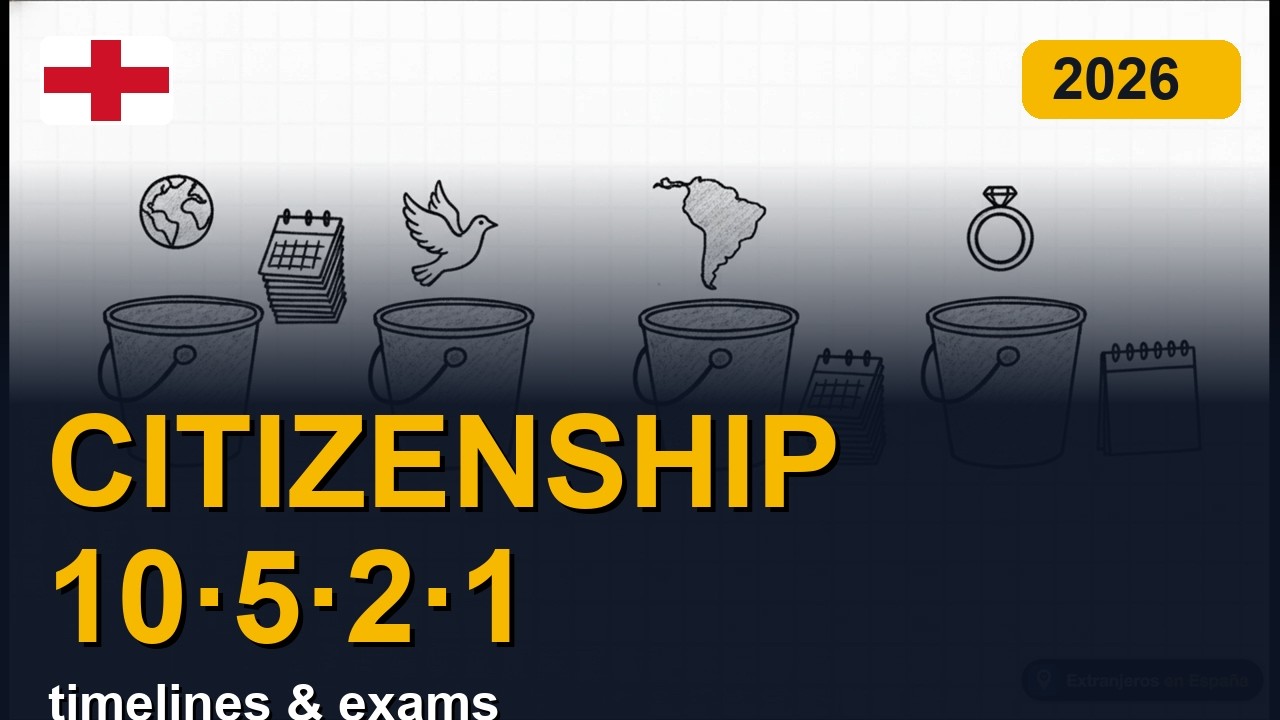
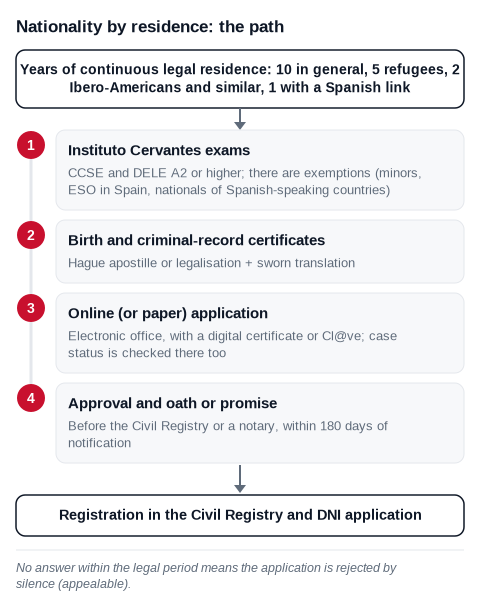
In short: you can apply for Spanish citizenship (nationality) by residence depending on years of legal residence: 10 in general, 5 refugees, 2 Ibero-Americans and similar, 1 in cases with a Spanish link. You must pass the CCSE and DELE A2 exams (there are exemptions) and show good conduct.
In person or by representative? The main route is online, at the Ministry of Justice's electronic office. You identify yourself with a digital certificate or Cl@ve, and the office asks you to have the AutoFirma signing app installed to complete the application. You can also file it on paper through the channels in art. 16.4 of Law 39/2015, for example at a registry assistance office or at Correos (the Ministry calls this «solicitud presencial»). A representative with a mandate or power of attorney can file it for you (art. 5.1.a of RD 1004/2015). The CCSE and DELE A2 exams and the oath are done in person. The step by step of the online application is in Apply for Spanish citizenship online by residence.
Continuous legal residence periods
- 10 years — general regime.
- 5 years — refugees.
- 2 years — nationals by origin of Ibero-American countries, Andorra, the Philippines, Equatorial Guinea or Portugal, and Sephardim (art. 22.1 of the Civil Code). "By origin" means, under that country's law, that you have held that nationality since birth, not acquired it later, for example by naturalisation. This shorter period does not exempt you from the DELE: Brazil is in the 2-year group, but Spanish is not its official language, so a Brazilian national still needs the DELE A2 or an A2, B1 or B2 certificate from an Escuela Oficial de Idiomas (art. 10 of Orden JUS/1625/2016). The same applies to Portugal, Andorra and the Philippines.
- 1 year — those born in Spain; married to a Spaniard; children/grandchildren of a Spaniard by origin; widow(er) of a Spaniard, among others.
In every case the residence must be legal, continuous and immediately before the application (art. 22.3 of the Civil Code). If you have spent periods outside Spain and are not sure whether they count as continuous residence, ask the Ministry of Justice (Subdirección General de Nacionalidad y Estado Civil) before you file.
Exams (Instituto Cervantes)
- CCSE (constitutional and sociocultural knowledge): pass 15 of 25 questions; valid 4 years.
- DELE A2 (Spanish language) or a higher level. You do not need it if you are a national of a country where Spanish is an official language (listed in art. 6.5 of RD 1004/2015) or if you already hold a DELE A2 or higher. An official A2, B1 or B2 Spanish certificate from an Escuela Oficial de Idiomas also counts instead (art. 10.3 of Orden JUS/1625/2016).
Exam exemptions
- Under-18s and people whose legal capacity has been modified by a court: they take neither the CCSE nor the DELE (art. 10.6 of Orden JUS/1625/2016).
- ESO (compulsory secondary education) completed in Spain after schooling here: exempt from both exams. You do not need to request it beforehand; just attach the certificate to the application (art. 10.5 of the Orden).
- Bachillerato, intermediate or higher vocational training (FP) or a university degree obtained in Spain: exempt from the DELE only; you still have to pass the CCSE. Studies done outside Spain do not count (Ministry of Justice FAQ, no. 14).
- If you cannot read or write or have learning difficulties, you can ask the Ministry of Justice for an exemption. That request goes before the nationality application, and you cannot file the nationality application until the exemption is decided or 6 months pass without an answer (silence means a refusal). If you file both at the same time, the nationality application is archived (art. 10.5 of the Orden).
Practise for free: interactive CCSE test — 25 practice questions with answers. More on the two exams: CCSE and DELE.
🎓 Preparing for DELE A2 / CCSE: one option is italki, the world's largest online language platform, with private Spanish tutors (1-to-1 lessons, flexible schedules and prices). 🤝 Our partner.
Requirements for Spanish nationality (besides the years and exams): good civic conduct; birth certificate and criminal-record certificate (with Hague apostille or legalisation, and sworn translation). Refugees and stateless people do not provide the birth certificate, the passport or the criminal record of the country of origin (art. 5.1.b, 5.1.c and 5.3 of RD 1004/2015, on the terms set by the Ministry of Justice). Refugees provide instead the TIE showing refugee status and the certificate from the Asylum and Refugee Office, as detailed in the online application. The decision period is the same for everyone: 1 year.
Criminal record certificate from the country of origin. The Ministry of Justice accepts the certificate from the country of origin, translated and legalised, or a consular certificate of conduct issued after consulting the competent authorities of that country, also translated and legalised (annex of Orden JUS/1625/2016, document 4). If the certificate states no validity period, it is taken as valid for 6 months from issue. For the federal states the Orden lists (Germany, Argentina, Australia, Brazil, the United States, India, Mexico, Russia and Venezuela) it must cover the whole country; if no single certificate is issued for the whole country, you attach those of each state where you lived in the five years before the application. If the country of origin cannot issue it for reasons of force majeure relating to that country, you provide a certificate from each country where you lived in the five years before the application. How to request the certificate at your country's consulate in Spain, ask that consulate.
Fee 790-026: before filing you must pay the fee (form 790, code 026). The Ministry of Justice states an amount of 104.05 € on its information page; check the current amount at the electronic office before paying. Without payment, the application is not processed (art. 6 of Orden JUS/1625/2016).
How long does Spanish nationality take? Filed with the Ministry of Justice (electronic office). Legal resolution period: 1 year; law firms estimate 12-24 months (IG Abogados) or 6-18 months (Cohen & Aguirre) in practice, according to The Local (08.05.2026); these are estimates, not a Ministry figure. No answer within the legal period means the application is rejected by silence (and can be appealed).
How to check your case status ("cómo va lo mío"). Once filed, you can track which stage your file is at on the Ministry of Justice's electronic office —often searched as "cómo va lo mío" or telematic consultation of nationality cases—, using your case details. Remember the legal period is 1 year and silence is negative. Always check it from the official source.
While your file is being processed.
- If your TIE or authorisation expires during the procedure. The Civil Code requires legal, continuous residence, «inmediatamente anterior a la petición» (immediately before the application; art. 22.3). Your documents had to be valid when you filed (Orden JUS/1625/2016, section 4). During the procedure, the Ministry of the Interior issues a mandatory report on your conduct and your situation regarding entry and residence obligations (art. 8.2 of RD 1004/2015). Nationality does not renew your authorisation, so keep it in order. If you apply for renewal in the 2 months before it expires, the previous authorisation stays valid until a decision is made. This also applies if you apply in the 3 months after expiry, although a fine is possible (for example, arts. 64.1, 80.1 and 185.2 of RD 1155/2024; more in renewal of authorisations). A change to another type of authorisation is also handled by Extranjería, under its own rules.
- If you move or change your padrón. Tell the Subdirección General de Nacionalidad y Estado Civil your new address, with your details and your R file number. You can use the Ministry of Justice's electronic registry (the «escritos y solicitudes» section of its electronic office), the single electronic registry or post to calle La Bolsa 8, 28012 Madrid (Ministry of Justice FAQ no. 4). If you hold a residence authorisation, also report the change of address to the Comisaría de Policía where you live within 1 month (art. 213 of RD 1155/2024). After approval, the oath is taken at the relevant Registro Civil or before a notary; the notification includes the instructions (no. 12).
- «Pendiente recepción de informes». During the procedure, the Ministry requests the necessary reports from other administrations on its own initiative. A report from the Ministry of the Interior is mandatory; one from the Delegación or Subdelegación del Gobierno is requested when considered necessary (art. 8 of RD 1004/2015). The decision may rely on the report of the Centro Nacional de Inteligencia (art. 11.2). One year is the deadline for the whole procedure, not for each stage (art. 11.3). «Cómo va lo mío» is for information only and is not an official notification (FAQ no. 7); official notifications arrive separately, as explained in how to check your file.
After approval: the nationality oath (jura). Approval is not the end: within 180 days of notification you must request the oath or promise (loyalty to the King and obedience to the Constitution, and where applicable renunciation of your previous nationality) before the Civil Registry of your address or a notary. Getting an appointment within those 180 days is enough, even if the date you are given is later (Ministry of Justice FAQ, no. 12). After the oath, your birth is registered in the Civil Registry and you can apply for the DNI. If you let the 180 days pass, the approval lapses (art. 21.4 of the Civil Code; art. 12 of RD 1004/2015). How to get the appointment: the nationality oath.
Renouncing your previous nationality (art. 23.b of the Civil Code): at the oath you declare that you renounce your previous nationality. This is not required of natives of Ibero-American countries, Andorra, the Philippines, Equatorial Guinea and Portugal, or of Sephardim originating from Spain; since 1 April 2022 it is not required of French nationals either, under the Spain-France nationality convention (DGSJFP Instruction of 31 March 2022). Ukraine is not on that list, so a Ukrainian national has to make this declaration. This exemption only means Spain does not ask you for the declaration; whether you keep your previous nationality is decided by your country's law.
If your nationality application is refused. You can file a recurso de reposición, which is optional, within 1 month of notification (art. 14 of RD 1004/2015 refers to the general rules; art. 124 of Law 39/2015), or go straight to the courts (contencioso-administrativo, art. 22.5 of the Civil Code) within 2 months of notification (art. 46 of Law 29/1998). If you file the reposición, the 2 months run from notification of its decision. If a year passes with no express decision, the application is deemed rejected (art. 11.3 of the RD) and the appeal deadlines are different: confirm them with a lawyer. More in appealing a refusal.
What about your residence permit if your nationality is refused? Nationality and the residence authorisation are separate procedures, and your authorisation follows its own renewal rules. If you hold national long-term residence, the TIE is renewed at 5 years and then every 5 years until age 30 and every 10 years after that. Not applying for renewal on time does not end the authorisation, although the immigration office will check that the conditions that gave you access to it still hold (art. 185.1 and 185.3 of RD 1155/2024). With any other type of authorisation, check its own renewal deadlines.
Can you lose Spanish nationality later? Someone who is not Spanish by origin loses it in two cases (art. 25.1 of the Civil Code): if for three years they use exclusively the nationality they declared they renounced when acquiring the Spanish one, or if they voluntarily enter military service or hold political office in a foreign State against the Government's express prohibition. Also, a final court ruling that finds falsehood, concealment or fraud in the acquisition annuls it; the action is brought by the public prosecutor within 15 years (art. 25.2). The first case refers to the nationality you declared you renounced, so it does not affect someone who did not have to renounce.
New laws, a change of government and pending files. A proposal, a bill or an election manifesto does not change the rules: what counts is a law published in the BOE, which enters into force 20 days later unless it says otherwise (art. 2.1 of the Civil Code) and is not retroactive unless it provides so (art. 2.3). If a reform reaches files already in progress, its transitional provision will say so. Today arts. 21 to 23 of the Civil Code and RD 1004/2015 apply. If you already have the approval, the Civil Code provides that it lapses if you do not appear within 180 days of notification (art. 21.4); an appointment obtained within that period is valid even if the assigned date is later (Ministry of Justice FAQ, no. 12).
Official source: Nationality by residence — Ministry of Justice.
Informational only; exact requirements and exemptions vary — check the official source and a professional for your case.