In short: to apply for Spanish citizenship online (nationality by residence), you file at the Ministry of Justice electronic office: you log in with Cl@ve, fill in the form, attach scanned documents and sign with AutoFirma. You have 2 months from creating the application to sign and file it; after that the draft is deleted automatically.
In person or by representative? The whole application can be done online. The form can be filled in by the applicant, by a legal representative (parental authority, guardianship or curatorship) or by a representative with a mandate or power of attorney. A voluntary representative provides the «mandato o poder» and their own identity document (art. 5.1.a of RD 1004/2015 and the Ministry information page). The law does not require a specific type of document: representation is proved by any means valid in law that leaves reliable proof of it, and it is taken as proved if granted apud acta (in person or on the electronic office) or entered in the competent administration's electronic register of powers of attorney (registro electrónico de apoderamientos) (art. 5.4 of Law 39/2015). If the Ministry considers the document insufficient, it has to give you ten days to correct it (art. 5.6). If you are unsure whether a private document signed by you and your representative is enough, ask the Ministry of Justice before filing. A paper route through the channels in art. 16.4 of Law 39/2015 also exists. The Instituto Cervantes exams and the oath are done in person.
This page covers how to fill in and file the application and what happens next. Years of residence, exams and the oath are in Spanish citizenship by residence.
Requirements
- Identify yourself with a digital certificate, permanent key or PIN key (Cl@ve; how to get it).
- Have the AutoFirma app installed on your computer: the office states that with it you complete the procedure. The official download page offers AutoFirma for Windows, Linux and macOS, and also apps for Android and iOS (firmaelectronica.gob.es); the electronic office does not say whether the nationality application can be signed from a phone.
- CCSE and DELE A2 exams passed, or an exemption. The exemption for people who cannot read or write or have learning difficulties is a separate online procedure (with Cl@ve) and goes first: the nationality application cannot be started until it is decided, and if you file both at once the nationality application is archived. The exception is the exemption for ESO completed in Spain, which you attach to the application. More in CCSE and DELE.
Documents Official list for adults, from the Ministry of Justice information page. In the online application the documents are attached as digital copies.
- Standard application form (modelo de solicitud normalizado).
- Foreigner identity card (TIE), residence card of a family member of an EU citizen, or certificate from the Central Register of Foreigners or the EU citizen register.
- Full, valid passport of your country of origin, and the previous one according to the residence period required in your case (all pages, not only the data page).
- Birth certificate, translated and legalised. The official list asks for the «certificación de nacimiento del interesado»; if your country only gives you a parish baptism record (partida de bautismo), ask the Ministry of Justice (Subdirección General de Nacionalidad y Estado Civil) beforehand whether it accepts it.
- Criminal record certificate from your country of origin, translated and legalised under the international conventions, or a consular certificate of conduct issued after consulting the authorities of the country of origin, also translated and legalised.
- Instituto Cervantes diplomas for the CCSE and the DELE. They can be replaced by the authorisation for the Ministry of Justice to check them, included in the application form. If you are a national of a country where Spanish is an official language and are exempt from the DELE: valid passport or a nationality certificate proving the exemption. Spanish can also be proved with official certificates of Spanish as a foreign language from the Escuelas Oficiales de Idiomas and the education authorities.
- If you hold the ESO certificate: you do not need to request the exemption beforehand, just provide the certificate with the application.
- If a voluntary representative files: mandate or power of attorney and the representative's identity document.
Other documents are added depending on your case. Married to a Spaniard: full birth certificate of the spouse and marriage certificate, both issued by the Spanish Civil Registry, and a certificate of cohabitation or joint registration at the same address (empadronamiento). Minors and people whose legal capacity has been modified by a court have a different list. The other cases (born in Spain, widow(er)s, descendants of a Spaniard, Sephardim, guardianship or foster care) and the details are on the same Ministry page.
Refugees. RD 1004/2015 does not require them to provide the birth certificate from the country of origin, the passport or the criminal record of the country of origin (art. 5.1.b, 5.1.c and 5.3), on the terms set by the Ministry of Justice. The official list asks instead for the TIE showing refugee status, the 1951 Geneva Convention blue passport if you have one, and the certificate from the Asylum and Refugee Office, valid 6 months from issue, showing your full name, date and place of birth, your parents' names and that you keep refugee status. The legal period for a decision is the same, 1 year.
Legalisation and translation. Foreign documents are submitted translated and legalised under international conventions. Public documents from an EU country are exempt from legalisation; under the Hague Convention an apostille (a single stamp) is enough; in all other cases they must be legalised through diplomatic channels. Legalisation at the Legalisation Service of the Ministry of Foreign Affairs, in Spain, is free; consular legalisation abroad carries a fee. The translation can be done or certified at a Spanish consulate abroad or at your country's consulate in Spain (and then legalised), or done by a sworn translator appointed by the Ministry of Foreign Affairs (sworn translation). Between EU countries no translation is needed if the document comes with the standard multilingual form of Regulation (EU) 2016/1191.
Deadlines
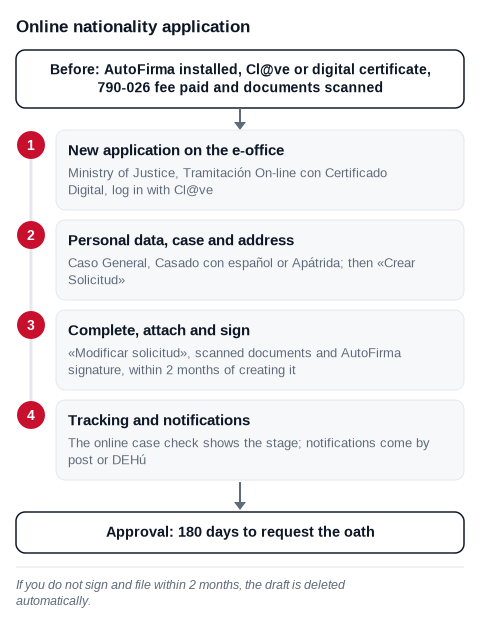
- 2 months from creating the application to sign and file it; otherwise it is deleted automatically.
- All documents must be valid when you file. Certificates are valid for the period stated on them; a criminal record certificate with no stated period is taken as valid for 6 months from issue. The only document that can be older than six months is the birth certificate (Ministry of Justice FAQ, no. 3).
- Legal period for a decision: 1 year, with silence meaning refusal. After approval, 180 days to request the oath. Details on the general page.
Cost
- Fee 790-026: the Ministry of Justice states a price of 104.05 € on its information page; check the current amount before paying. Form 790 is downloaded on the office site (section «Descarga del formulario 790 026»), filled in and paid before filing the application at a financial institution that collaborates with the Tax Agency. Payment is proved by the institution's machine validation or authorised signature on the «Ejemplar para la Administración» copy.
- Payment is always made in the applicant's name, even if a voluntary or legal representative pays. Payment in Spain is accepted only from people with an NIE or DNI.
- Do not photocopy the form: it carries a numeric code that is unique for each application. Without payment, the application is not processed (art. 6 of Orden JUS/1625/2016).
Steps
- Go to the Ministry of Justice electronic office, Spanish nationality procedure with AutoFirma already installed and click «Tramitación On-line con Certificado Digital».
- Choose Cl@ve as the identification method.
- Click «Nueva solicitud».
- Choose who files: «Realizada por el interesado» (the applicant), «Realizada por el representante que ejerce la patria potestad, tutela o curatela» (legal representative) or «Realizada por el representante dotado de un mandato o poder» (representative with a mandate or power).
- Fill in NIE, support number, first name and both surnames exactly as on the identity document. Select civil status, sex, country, town and date of birth.
- Fill in «Residente en España desde el año» (resident in Spain since year), «Hijo/a de (1)» and «Hijo/a de (2)» (child of), and select the main nationality. Mark whether you have a judicially modified capacity and whether you belong to the armed forces.
- Under «Seleccionar una opción» choose the case: «Caso General», «Casado con español» (married to a Spaniard) or «Apátrida» (stateless), and complete the data that section asks for (name, surnames, civil status and sex).
- Fill in the section «Domicilio del Interesado» (applicant's address) and click «Crear Solicitud».
- When «Solicitud guardada correctamente» appears, click «Modificar solicitud», complete the information and click «Guardar».
- Attach the digitised documents, sign with AutoFirma and file within the 2 months from creation. The official guide ends at «Guardar»; the rest of the procedure is shown on the office site itself.
If your document has only one surname. The official guide asks you to write the first name and surnames "exactly as they appear on the identity document". Write your surname as it appears on the document. If the electronic office does not let you continue with one surname, ask the Ministry of Justice (Subdirección General de Nacionalidad y Estado Civil) or file through the channels in art. 16.4 of Law 39/2015, which the Ministry also accepts. For the Civil Registry, the law lets you keep surnames you hold in a form different from the legal one if you declare it when acquiring the nationality or within the following two months, provided they are not contrary to international public order (art. 56 of Law 20/2011).
After filing
- File status. The «Consulta telemática de expedientes» («cómo va lo mío») shows the stage and lets you download the approval decision, but it is not a notification. How to use it: status of your nationality file.
- Notifications. Requests (requerimientos) and decisions are notified only by post or through the single enabled electronic address (DEHú); email is only an alert. In DEHú, search «Notificaciones pendientes» and «Notificaciones realizadas» with a date range of 18 months. If an electronic notification is not opened within 10 calendar days, it shows as rejected; the Ministry states that in principle this does not affect the file, but the 180-day period for the oath counts from those ten days (FAQ, no. 9).
- More documents or a requerimiento. They go through the same procedure on the office site, «Solicitud de Nacionalidad Española por Residencia». If you are answering a requerimiento, choose «en respuesta a un requerimiento de la Administración» as the reason. The channels in art. 16.4 of Law 39/2015 also work, quoting your file number (expediente R) (FAQ, no. 4). A change of address is reported through the channels in art. 16.4 of Law 39/2015, quoting your expediente R (FAQ, no. 4). To change how you are notified or the representative's details, the request goes through the same channels, with the representation mandate when needed (FAQ, no. 8).
- Originals and paper documents. If you uploaded the documents digitally, for example a paper birth certificate that you scanned, keep the originals: the Ministry cannot make copies of paper originals it does not hold (FAQ, no. 4), and when the nationality is registered the Civil Registry may compare the documents with their originals, which you must show (art. 12.2 of RD 1004/2015). If you lose one, ask the issuing authority for a duplicate.
- Decision and oath. If your nationality is granted, you have 180 days from notification to request the oath: nationality oath (jura). If it is refused, there are appeals: what to do after a refusal.
Official source: Spanish nationality by residence, Ministry of Justice electronic office. Ministry of Justice procedure page.
Informational only; check the official source and a professional for your specific case.