In short: non-contributory pension Spain foreigners: requirements of legal residence, age and low income. The non-contributory pension (pensión no contributiva, PNC) is a Social Security benefit for people without enough income, and it depends on legal residence in Spain, not on nationality. There are two: retirement (from age 65, with 10 years of legal residence) and disability (age 18 to 64, with 5 years of legal residence and a disability or chronic illness of 65% or more). In 2026 the full amount is about €629 a month. Your autonomous community handles it; in Ceuta and Melilla, IMSERSO.
In person or by representative? You file the application at the social services offices of your community, at IMSERSO or at any Social Security office, or by post. The procedure is started by the applicant or their representative (RD 357/1991, art. 22.1). To find out how it is filed in practice in your community and whether you must go in person, ask its social services.
Requirements
- Two different pensions. Retirement (art. 369 LGSS) and disability (art. 363 LGSS). IMSERSO says the retirement one is incompatible with the disability one and with some benefits (welfare pensions under Law 45/1960 and the subsidios de garantía de ingresos mínimos y de ayuda por tercera persona); in that case you must choose one of the two benefits (RD 357/1991, art. 18).
- Retirement: age and residence. Be 65 or over and have lived legally in Spain for 10 years between age 16 and the date the pension accrues. Of those 10 years, 2 must be continuous and right before the application.
- Disability: age, residence and degree. Be over 18 and under 65, have lived legally in Spain for 5 years (2 of them right before the application) and have a disability or chronic illness of 65% or more. The degree is set by the assessment team of your community or of IMSERSO (RD 357/1991, art. 21); how to request the certificate: disability certificate for foreigners.
- What counts as residence. It must be legal residence (types of residence). RD 357/1991 (art. 23.1.b) provides for checking it preferably with padrón certificates (how to get one), but the padrón on its own does not prove that your residence was legal: years when you were on the padrón with irregular status do not count. You may also be asked for a document proving your periods of legal residence; ask social services which one. Whether your time under temporary protection or with an asylum application counts towards those 10 or 5 years, ask your community's social services before counting on the pension.
- Income. Income is insufficient when yours in 2026 is below €8,803.20 a year (the annual amount of the pension). If you live with relatives, the requirement is met only when the combined income of the whole unidad económica (relatives living together) is below the limit below.
- Unidad económica. It is made up of the people who live with you and are your spouse or relatives by blood or adoption up to the second degree (according to IMSERSO: parents, grandparents, children, grandchildren and siblings). Someone who lives in the home without that kinship is not included. Income limits for the unit in 2026:
- If you live only with your spouse or second-degree relatives (grandparents, grandchildren, siblings), without parents or children: 2 people, €14,965.44 a year; 3 people, €21,127.68; 4 people, €27,289.92.
- If parents or children are among them: 2 people, €37,413.60 a year; 3 people, €52,819.20; 4 people, €68,224.80.
- 2026 amount. Full: €8,803.20 a year, that is €628.80 a month (about €629), in 14 payments (12 monthly plus 2 extra). Minimum, 25%: €2,200.80 a year (€157.20 a month). If there are 2 PNC recipients in the same unidad económica, each gets €534.48 a month; if there are 3, €503.04 a month. The amount is individual: it depends on how many PNC recipients there are in the unit, on your income and on the unit's. Your own income does not reduce the pension as long as it stays at or below 35% of the annual amount; anything above that 35% is deducted (art. 364.2 LGSS). If the unit's income plus the pension goes over the limit in the table above, the pension is cut down to that limit (art. 364.3). It never goes below the minimum above (art. 364.4). Figures from IMSERSO under Royal Decree-law 3/2026 of 3 February; check the current amount, because it is updated every year.
- Children. The PNC does not include a separate amount per child. Children you live with are part of your unidad económica, and with children or parents at home the income limit is higher (table above). Social Security child allowances (hijo a cargo) are not counted as income (RD 357/1991, art. 12.4). Help for children is claimed separately: the minimum living income is a different benefit, with a higher amount if there are minors in the household.
- Living in Spain. Yes, you must reside in Spain: residence conditions both the right to the pension and keeping it (art. 369.2 LGSS). Residence is not broken by absences of fewer than 90 days over each calendar year, or by an absence due to duly justified illness (RD 357/1991, art. 10.2). If you move your residence out of Spain for longer, the right ends (arts. 7 and 9 of the same RD). Before a long trip, ask the body that pays you.
- After you start receiving it. Report within 30 days any change in living arrangements, marital status, residence or income that affects the pension (RD 357/1991, art. 16.1). If you receive too much because you did not report a change, you must repay the excess from the 1st day of the month after the change. Every year, in the first quarter, file the income declaration of your unidad económica for the previous year (art. 368 LGSS); if you do not, after a formal request the payment can be suspended (RD 357/1991, art. 16.2).
- What else it gives. According to IMSERSO, the retirement PNC includes free medical and pharmaceutical care and complementary social services. People who receive non-contributory pensions pay 0% at the pharmacy: pharmacy co-payment.
Documents
- Application form, provided by the offices where you file.
- Identity document showing your date of birth: RD 357/1991 (art. 23.1.a) names the DNI for age; if you are a foreigner, ask social services which document they accept.
- Padrón certificates with your periods of residence (empadronamiento) and, if asked, a document proving that this residence was legal.
- Statement of who you live with: living arrangements are proved by your own statement (RD 357/1991, art. 23.1.c).
- Income: the managing body can obtain your data from the tax administration, and you can provide other documents that prove it (art. 23.1.d).
- For the disability pension: the degree of disability or chronic illness is set by the assessment team (art. 21).
- The full list is defined by the form and the service in your community and may be longer; confirm it with social services.
Steps
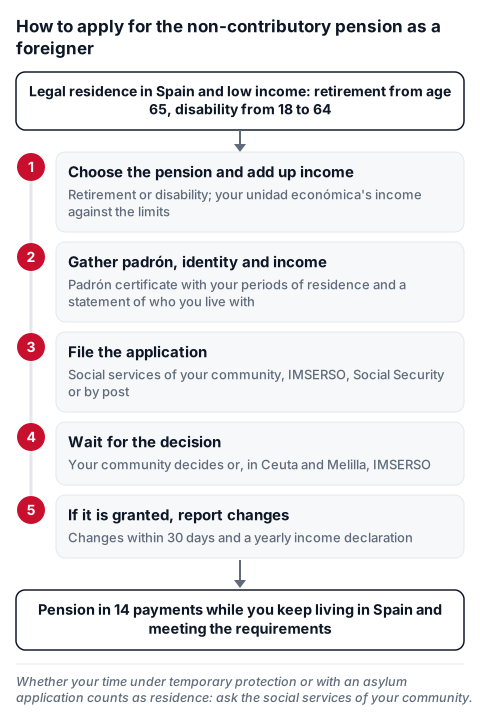
- Check which pension fits you (retirement or disability) and compare your unidad económica's income with the limits above.
- Request the padrón certificate with your periods of residence and gather identity, living arrangements and income data.
- File the application at the social services of your community, at IMSERSO or at any Social Security office, or by post (where to apply for a PNC).
- Wait for the decision of the managing body: your community or, in Ceuta and Melilla, IMSERSO.
- If it is granted, report changes within 30 days and file the income declaration every year.
Deadlines
- Payment start: from the 1st day of the month after you file the application (art. 371 LGSS for retirement; RD 357/1991, art. 15.2).
- Changes: 30 days to report them.
- Income declaration: in the first quarter of each year.
- Amounts: updated every year; the 2026 ones are in this card.
Where
- Application: IMSERSO, where to apply for a non-contributory pension.
- Retirement requirements and amounts: IMSERSO, rules and requirements.
- Rules: General Social Security Law, arts. 363 to 372 and Royal Decree 357/1991.
- If you have no income while you wait or do not meet the requirements: help for immigrants with no money in Spain (social services, Cáritas, Red Cross).
Official source: Royal Legislative Decree 8/2015, General Social Security Law, BOE, Royal Decree 357/1991, BOE and IMSERSO: non-contributory pensions.
Informational only; check the official source and a professional for your specific case. Figures and requirements checked on 1 November 2026.