
In short: What to do when someone dies in Spain depends first on where the death happened: a doctor certifies it, the death is registered at the Civil Registry, and the Registry issues the licence for burial or cremation. This also applies if the deceased is a foreigner. The funeral home you choose usually handles the paperwork.
In person or by representative? Those obliged to report the death for registration are the hospital where it happens, the doctor who certifies a death outside hospital, and the relatives or the person they authorise (Ley 20/2011, art. 63). The relatives can request the burial licence, although the funeral home usually does it (Comunidad de Madrid). The death and last-wills certificates are requested online at the Ministry of Justice e-office; the last-wills one also in person.
1. Who certifies the death
- In a hospital. The hospital reports the death to the Civil Registry electronically, with the official form and the medical certificate (Ley 20/2011, art. 64). In public hospitals of the Madrid region, for example, the family receives a guide with the medical certificate and a list of funeral homes and funeral parlours (Comunidad de Madrid).
- At home, if the death was expected. The usual family doctor certifies it.
- At home unexpectedly, or outside the home. Call emergency services (112).
Without a medical death certificate the death cannot be registered (Ley 20/2011, art. 66).
2. Accident, violence or suspicious death
If the death is violent or suspicious, a court steps in and forensic doctors carry out the autopsy (LECrim, arts. 340 and 343). According to the Cádiz IML leaflet, the court also steps in if a natural death was unexpected or if the doctor does not certify the death. In these cases registration alone does not give the burial or cremation licence: the licence is issued once the court authorises it (Ley 20/2011, art. 67.2). The body goes to an Institute of Legal Medicine. The one in Cádiz explains in its leaflet for families that the court orders the release of the body and that the funeral home chosen by the family collects that order. According to the same leaflet, autopsy reports are requested from the court handling the case. Ask at the duty court (juzgado de guardia) where the death happened.
3. Choose a funeral home
Funeral services are liberalised (RDL 7/1996, art. 22): you choose the funeral home. According to the Comunidad de Madrid (consumer affairs), the company must give you its itemised prices; ask for a written quote for the whole service. You do not have to buy everything from the same funeral home: flowers, coffin or funeral parlour can be separate. If something goes wrong, the funeral home must have complaint forms.
If there was funeral insurance (seguro de decesos), the insurer must let you choose the provider within the limits of the contract. It must also give you a list of providers, unless the policy names a single one (Insurance Contract Act, art. 106 quáter). What happens if the family arranges the service itself: see the repatriation guide, section «Who pays».
4. Register the death
Registration is mandatory (Ley 20/2011, art. 62) and the Civil Registry also records events concerning foreigners that happen in Spain (art. 9). It is done with the official form and the medical certificate, at the Civil Registry of the town where the death happened or, where applicable, at the Juzgado de Paz (Comunidad de Madrid). Once registered, the Registry issues the death certificate and the licence for burial or cremation.
5. Time limits
Under the national rule, the body stays at least 24 hours and at most 48 from the death; if embalmed, up to 96 hours, and with temporary preservation, up to 72 (Decreto 2263/1974, art. 15). Each region has its own mortuary health decree and the time limits can differ: in Galicia, for example, burial can take place from 12 hours (Decreto 129/2023, art. 19.2). Ask the funeral home which limit applies in your region. If a court is involved, you have to wait for its authorisation.
6. Burial or cremation in Spain
Every municipality must provide a cemetery service (Ley 7/1985, art. 26.1.a). In municipal cemeteries, a niche or grave is not bought: it is granted for a period. Madrid's municipal cemeteries offer niches for 10 years, extendable, or for 75 years (grant catalogue of Servicios Funerarios de Madrid). In Alicante the grant is for 5 or 75 years; if the family does not request a new one when it ends, the remains go to the common grave (Alicante Cemetery Ordinance, arts. 16 and 17). Before choosing, ask when the grant expires and how much renewal will cost.
Price guide: in Madrid, the 2025 municipal tariff for cremation of a body was €565.46 before VAT (IVA), for the cremation alone (2025 tariffs of the municipal company Servicios Funerarios de Madrid, BOAM no. 9.788, 30.12.2024). Check the current amount: it changes every year and in every municipality. The full price of the funeral is in the funeral home's quote.
7. Documents after the funeral
- Death certificate. Issued by the Civil Registry; request it online at the Ministry of Justice e-office: with Cl@ve or a digital certificate it may be issued on the spot; without them it arrives by post. How to get Cl@ve: Cl@ve guide.
- Certificate of last wills (actos de última voluntad). Shows whether the deceased made a will and before which notary. You can request it once 15 working days have passed since the death, paying fee 006, online or in person (Ministry of Justice e-office). If it will be used outside Spain, it must be legalised: when you need an apostille. If the death was registered at a Juzgado de Paz, apply in person or by post, with the full death certificate (certificado literal).
- Certificate of insurance contracts with death cover. Lists life insurance with death cover and accident insurance covering death (Ley 20/2005, art. 4). You request it after 15 working days and the Registry issues it within 7 working days at most (RD 398/2007, arts. 12 and 13); information and application at the Ministry of Justice. Look for funeral insurance in the deceased's papers and bank direct debits; the Comunidad de Madrid also advises checking whether funeral cover was included in another policy, for example a life policy.
8. If the family is outside Spain
Relatives can authorise another person to report the death for registration (Ley 20/2011, art. 63), and the chosen funeral home handles the formalities for burial or cremation (Comunidad de Madrid). To take the body or ashes to another country: repatriation of a body from Spain.
9. Who pays
With funeral insurance, the insurer provides the services in the policy. Without insurance, the family bears the costs. If there are no resources, some administrations have social funeral services, each with its own conditions (Comunidad de Madrid, consumer affairs). Who pays in each situation and where to ask for help: who pays for a funeral in Spain.
Steps
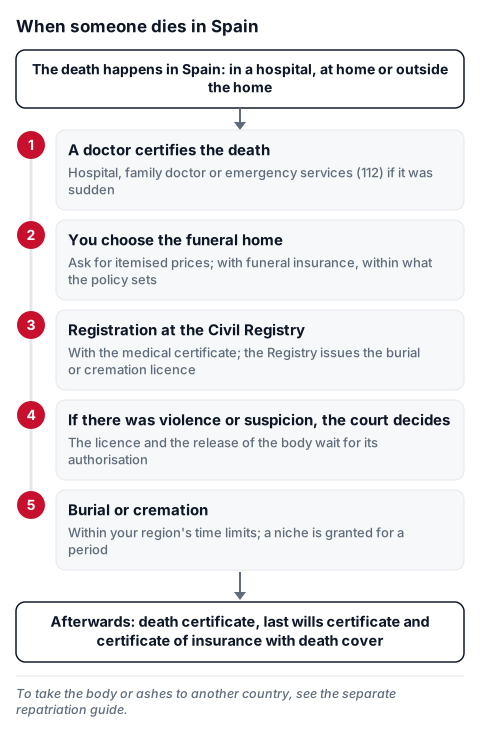
- Get the medical death certificate: hospital, family doctor or, if the death was sudden, emergency services (112).
- Choose a funeral home and ask for a written quote; if there was funeral insurance, tell the insurer.
- Register the death at the Civil Registry, or let the funeral home do it, and collect the burial or cremation licence.
- If a court is involved, wait for its authorisation for the licence and the release of the body.
- Hold the burial or cremation within your region's time limits.
- After 15 working days, request the certificates of last wills and of insurance contracts with death cover.
Official source: Ley 20/2011 on the Civil Registry, arts. 62 to 67.
Informational only; check the official source and a professional for your specific case.