
In short: Who pays for a funeral in Spain when there is no insurance? As a rule, the family. But in several situations someone else pays: the town hall, if the deceased and the family have no means; the vehicle insurance, after a road accident; Social Security, with €46.50 and pensions; and sometimes the organisation of the reception system. What counts is the padrón (town register), income, contributions and the cause of death.
In person or by representative? It depends on the step. In Madrid, the declaration for the social funeral service can be filed by any relative, neighbour or friend, online or at the municipal funeral homes. In Zaragoza you apply in person at the social services centre, without an appointment. For Social Security benefits, ask the INSS whether a representative is accepted.
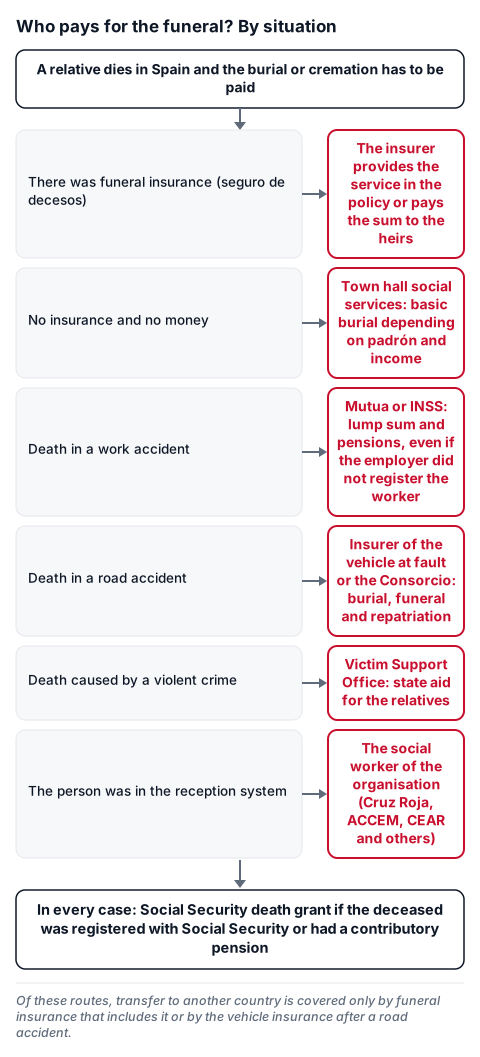
1. There was funeral insurance (seguro de decesos)
- The insurer provides the funeral service agreed in the policy. If the family arranged the service another way, or the insurer could not provide it, it pays the sum insured to the heirs (Insurance Contract Act, art. 106 bis).
- You can choose the provider within the limits of the contract; the insurer must give you a list, unless the policy sets a single provider (art. 106 quáter).
- Transfer to the home country is covered only if the policy includes it. How it works: repatriation of a body or ashes from Spain.
- Not sure whether there was a policy? Check the papers and bank statements of the deceased (what to do when someone dies in Spain).
2. No insurance and no money: burial paid by the town hall
- The national rule obliges the town hall where the death occurs to provide the coffin for people without means and to pay transport within the town for families on the welfare register (Decreto 2263/1974, arts. 9 and 45).
- Several regions make the town hall pay the funeral services of people without means who die there: Canarias, Illes Balears, Castilla-La Mancha (Decreto 72/1999, art. 59) (coffin, transport and burial), País Vasco and Castilla y León.
- Each city has its own rules. Three examples:
- Madrid (Reglamento 16/2025, BOCM of 30.12.2025, arts. 29 to 34). Conditions: death in Madrid and registration on the Madrid padrón or on no other town's padrón. The deceased's income must not exceed the non-contributory pension, and that of the spouse, parents and children must not exceed 2 times the monthly IPREM per family member. There must also be no funeral insurance or other cover. It covers collection, coffin, paperwork and a temporary niche for 10 years, or cremation with a basic urn if the family asks, only in municipal cemeteries and crematoria and with no extras. You apply with a responsible declaration (declaración responsable) on the website of Servicios Funerarios de Madrid (24-hour phone: 91 510 81 00) or at its funeral homes.
- Barcelona (municipal funeral services leaflet, November 2025). Free service for a person registered in Barcelona with income below 0.66 IRSC (Catalonia's income indicator), with a favourable report from municipal social services. It includes coffin, transport within the city, civil registry and burial with 5 years of grave use, or cremation.
- Zaragoza (free burials). Lack of means, no burial insurance and home in Zaragoza; you apply at the municipal social services centre where the deceased was registered, without an appointment. According to the municipal protocol, it covers coffin, hearse and a niche for 5 years, without a ceremony. Apply before booking a funeral home.
- The conditions are the same for any resident: depending on the rule, padrón registration, death in the town or both, plus low income. If it later turns out there were means, the town hall can claim the cost back: Sevilla and Zaragoza provide for this.
- These services do not pay for transfer to another country.
- Go to your town hall social services as soon as possible: burial usually takes place between 24 and 48 hours after death.
3. Social Security: grant and pensions
- Death grant (auxilio por defunción): €46.50, once, to whoever paid the funeral. The deceased must have been registered with Social Security (or in an equivalent situation) or receiving a contributory retirement or permanent disability pension. You have 5 years to claim it (Seguridad Social).
- Pensions: widow's pension (viudedad) for the spouse or unmarried partner (pareja de hecho), and orphan's pension (orfandad) for children under 21 (up to 25 if they do not work or earn less than the minimum wage). There is no deadline to apply, but if you apply more than 3 months after the death, only 3 months of arrears are paid. If the deceased was registered with Social Security (or in an equivalent situation) and the death was caused by an accident, at work or not, the widow's pension needs no prior contributions (LGSS, art. 219). Requirements, amounts, payment abroad and how to apply: widow's and orphan's pension in Spain for foreigners.
- Since 21.10.2026, an unmarried partner (pareja de hecho) with children in common only needs 2 years of living together, proved with the padrón, without registration in a partners' register (Real Decreto-ley 31/2026, already validated by Parliament). If the partner died before that date, had the required contributions and the pension still could not be paid, there are 12 months from 21.10.2026 to apply, proving the partnership under the new rules.
- If you live outside Spain, the INSS form lets you receive payment into a bank account in that country. For your case, ask at an INSS office.
4. Death at work
- For work accidents, the worker counts as registered with Social Security even if the employer did not register them (LGSS, art. 166.4).
- Lacking a work permit does not prevent the benefits that may apply, if they are compatible with the person's situation; unemployment benefit is excluded (Ley Orgánica 4/2000, art. 36.5).
- On top of the pensions, there is a one-off payment: 6 months of the regulatory base for the spouse or unmarried partner (pareja de hecho) and 1 month for each orphan (LGSS, art. 227; Order of 13 February 1967, art. 29).
- If the death was caused by a work accident, the benefits may be granted by the mutua (Social Security collaborating mutual); otherwise by the INSS. Ask at an INSS office which one applies.
5. Road accident
- The insurer of the vehicle at fault pays for moving the body, the burial and the funeral according to local custom, and also repatriation to the home country (Real Decreto Legislativo 8/2004, art. 79).
- If the vehicle was unknown, uninsured or stolen, the Consorcio de Compensación de Seguros compensates the damage.
- Keep all invoices for the funeral and the transfer.
6. Death caused by a violent crime
- The State pays death aid to the relatives: spouse or partner (2 years of living together, or no minimum if there are children in common), dependent children and, if there is no spouse, partner or child, dependent parents (Ley 35/1995, art. 2). Spanish and other EU relatives can claim it. For others there are two routes: habitual residence in Spain, which the regulation reads as legal residence, or nationality of a country that gives similar aid to Spaniards (Real Decreto 738/1997, arts. 2 and 3). Ask how it applies to your case. There are specific rules for gender and sexual violence.
- Funeral costs are refunded only when a minor, or a person declared incapacitated before adulthood, dies, and only if the parents do not receive the death aid: they go to the parents or guardians, up to 5 months of the minimum wage (Real Decreto 738/1997, arts. 6 and 16).
- Deadline: 1 year from the crime (5 years for sexual or gender violence); it is paused while the criminal case lasts (Ley 35/1995, art. 7).
- Ask at the Victim Support Office (Oficina de Asistencia a las Víctimas) at your court or prosecutor's office (Ley 35/1995, art. 16).
7. The person was in the reception system
- The management guide of the reception system, in its 2020 version, provides that the organisation may pay the funeral costs of a person in the system, at funeral-service rates, when there is no public cover. This aid does not cover repatriation. The guide links it to having formally applied for international protection. The family or the organisation hands in the death certificate at the Asylum Office. Ask the organisation whether this aid still applies.
- For people from Ukraine staying more than 30 days in first-reception or emergency facilities, the instruction of 8 April 2022 lists «otras ayudas de carácter excepcional, previa autorización» (other exceptional aid, with prior authorisation).
- Talk as soon as possible to the social worker of the organisation (Cruz Roja, ACCEM, CEAR or another). If the organisation does not cover it, routes 2 to 6 remain.
8. Other situations
- Temporary protection outside the reception programme, residence permit, arraigo, EU citizens or people without papers: the routes are those in points 1 to 6, each with its own conditions. The death is registered at the Civil Registry whatever the status of the deceased. If the person was not on the padrón, ask social services anyway: in Madrid, the padrón condition is also met if the person was not registered in another town (the other conditions still apply). How to register: empadronamiento.
- Family in another country: the funeral home or someone close can handle the steps in Spain (steps when someone dies). In Madrid, a neighbour or friend can file the declaration for the social service, and the income of the spouse, parents and children is assessed. Social Security pensions can be paid into a bank account in another country.
- Ukraine: if the deceased received a Ukrainian pension, the Pension Fund of Ukraine pays whoever arranged the burial an aid into their bank account: normally 2 pensions (for military pensions, 3 months of pension). If the death was outside Ukraine, a legalised death certificate is needed; ask the Fund how to claim from abroad. For a citizen living alone or whose family declines the burial, Ukrainian Government Resolution No. 1963 of 2003 applies. The transport of the body is paid by whoever carries out the person's wishes, not by the State. The burial in Ukraine is paid by the local budget if the person left those wishes in writing and the Ukrainian local council agreed. The Embassy certificate to bring in the urn or coffin costs €28 (repatriation).
- Other countries: ask your consulate whether it gives any help and on what conditions.
Deadlines
- Death grant: 5 years.
- Widow's and orphan's pensions: no deadline, but only 3 months of arrears.
- Unmarried partner who died before 21.10.2026: 12 months from that date.
- Violent crime aid: 1 year (5 years for sexual or gender violence).
Cost
- Without insurance or aid, the family pays. As a guide, in Barcelona the funeral home service without a wake starts at about €1,700, and cremation or the cemetery is paid separately: cremation at Montjuïc from about €500 (municipal leaflet of 2025, VAT included). Always ask for a written quote.
Where
- Funeral insurance: the insurer.
- No means: town hall social services (in Madrid, Servicios Funerarios de Madrid).
- Social Security: INSS; for a work accident, it may also be the mutua.
- Road accident: the vehicle insurer or the Consorcio. Crime: Victim Support Office.
- Reception system: the social worker of the organisation.
Official source: Mortuary Health Regulation, Decreto 2263/1974 (BOE) and the rules linked in each point.
Informational only; check the official source and a professional for your specific case.