
In short: convenio especial Spain cost: the special agreement (convenio especial de prestación de asistencia sanitaria) lets you use Spain's public healthcare for a monthly fee, €60 a month if you are under 65 and €157 a month if you are 65 or over. It is for people who have no right to public care by another route (Law 16/2003, art. 3.3) and meet three requirements: one year of effective residence, padrón registration and no other access to public health protection.
In person or by representative? It depends on the region, which is the party that signs the agreement. As an example, the Comunidad de Madrid e-office accepts the application electronically (with a recognised digital signature) or in person, with an appointment at some offices; if someone else files it, a notarised power of attorney is asked for, and each family member files their own application. Confirm the channel in yours.
What the law says:
- Legal basis: people who have no right to publicly funded healthcare under art. 3.2 can obtain it by paying the fee of a convenio especial (Law 16/2003, art. 3.3). Royal Decree 576/2013 sets the basic requirements.
- Who can (art. 3): people who live in Spain and have no right to public healthcare by another route, with three requirements: one continuous year of effective residence right before the application; being registered on the padrón at that moment in the region that signs the agreement; and having no access to public health protection under any other title (national rules, EU Social Security regulations or bilateral agreements).
- Who it is aimed at, according to the Ministry of Health: economically inactive foreigners who need health insurance in order to reside in Spain. Residence periods in other EU, EEA, Swiss or UK states count towards the required year. It is not needed by foreigners with a public pension who prove (for example with form S1) a right to care paid by the country that pays it, nor by EU or EEA citizens with five years of continuous legal residence, who already have the right to reside permanently and to public care.
- Cost (art. 6): €60 a month if you are under 65 and €157 a month if you are 65 or over; these are the figures in the decree and the ones the Ministry publishes today. Regions may raise the fee if they add services from their complementary portfolio, and the decree provides for revising the amounts by ministerial order: confirm the current figure in your region.
- What it covers: all benefits of the basic common portfolio of the National Health System (prevention, diagnosis, treatment and rehabilitation, in primary care, specialist care and hospital, plus urgent health transport), which the Ministry says come without copayments or waiting periods (months before cover starts). You pay 100% of outpatient pharmacy, outpatient orthoprosthetics, dietary products and non-urgent health transport. You get an individual health card, also valid for temporary trips to other regions.
When it is not your route:
- You already have the right to public healthcare, for example with legal and habitual residence and no need to prove other mandatory cover: see the health card.
- You have no legal residence: there is another route, RD 180/2026. Check there whether you fit before paying a fee.
- It is for a child: there is a separate card, public healthcare for foreign minors. With temporary protection (Ukraine): healthcare with temporary protection.
- You want to apply for a residence visa: the convenio is not a shortcut. You cannot sign it before arriving: it requires living in Spain and being registered on the padrón when you apply. If you come from the EU, the EEA, Switzerland or the UK, the year of residence can also be proven with periods in those countries, but registration on the padrón in Spain is still essential. What insurance visas and consulates ask for is in the card on health insurance for a residence visa. Whether public insurance is enough for non-lucrative residence or family reunification, the rules we reviewed there do not say: ask your consulate.
Documents (list from the Ministry of Health page; your region may ask for others):
- ID document, NIE, passport or residence card.
- Proof of one year of effective residence: a resident certificate from the National Police or a padrón certificate (for people coming from the EU, the EEA, Switzerland or the UK, the Ministry also accepts a consular document, a public proof of address or any means valid in law).
- Padrón certificate from a Spanish municipality (how to register).
- A responsibility declaration or a certificate of non-export of the right to health cover from your home country. The Ministry says this is asked only of people from countries covered by the EU Social Security coordination regulations, the EU-UK agreement or bilateral agreements (Andorra and Chile).
After signing: the agreement takes effect on the day it is formalised and ends (art. 7) if you die, stop meeting the requirements, gain a right to public healthcare by another route, leave the padrón of that region, withdraw, fail to pay the first fee, two fees in a row or three non-consecutive ones, or breach its conditions. If you move to another region, you can ask for it to stay valid for up to three months while you sign a new one. If it ends by your decision, non-payment or breach, you cannot apply for a new one until a year has passed.
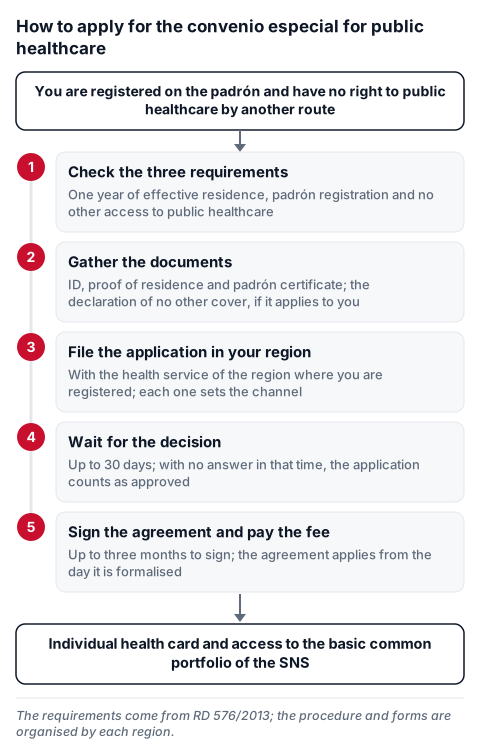
Steps:
- Check the three requirements and that you have no right to public healthcare by another route (health card).
- Register on the padrón if you are not (empadronamiento) and gather proof of the year of residence and the other documents.
- Find your region's health service in the Ministry's directory; in Ceuta and Melilla it is signed with INGESA (Order SSI/1475/2014). Example: Castilla y León publishes the application form and FAQ.
- File the application through the channel the region sets. The administration must decide and notify within 30 days; if it does not, the application is deemed approved (art. 4).
- Formalise the agreement within three months of the notification (or of the approval by silence); otherwise the procedure lapses. Pay the monthly fee and use the health card.
Official sources: Ministry of Health, convenio especial, Royal Decree 576/2013 (BOE), Law 16/2003, art. 3.
Informational only; check the official source and a professional for your specific case.
