
In short: getting married in Spain as a foreigner, including to a Spanish citizen, starts with a marriage file or notarial act (expediente or acta matrimonial): the Civil Registry or a notary where one of you lives checks that you can marry. With the authorisation, the wedding is held before the mayor or a councillor, a Letrado de la Administración de Justicia (court clerk) or a notary, and is then registered in the Civil Registry. Residence as a spouse is applied for separately.
In person or by representative? Mixed. To open the file at the Civil Registry you both attend with two witnesses; the Comunidad de Madrid lets one partner start it alone only with a notarial power of attorney from the other. Whoever handles the file hears each partner «privately and separately» (Ley 20/2011, art. 58.5). At the wedding, one partner may marry through a proxy with a special power of attorney, but the other must be present (Civil Code, art. 55).
Requirements
- Being of age or an emancipated minor and not being married (Civil Code, art. 46). Relatives in the direct line and collateral relatives up to the third degree cannot marry each other (art. 47); a judge can waive the third degree (art. 48).
- Address: the file is handled by the Civil Registry or the notary where one of you lives (Ley 20/2011, art. 58.2). That is why they ask for the padrón (address registration); if you do not have it yet, see how to register at your address.
- If you are both foreigners, you can marry in the Spanish form or in the form set by the personal law of either of you (art. 50).
- Immigration status: the Civil Code gives everyone the right to marry (art. 44), and its arts. 46 to 48 list who cannot marry; holding a residence permit is not among those requirements. Consent is checked, though: marrying for profit or to obtain a residence right improperly is a serious offence (LO 4/2000, art. 53.2.b), unless it is a crime.
- With a Spanish citizen: the file is the same. What changes is what comes after: residence and nationality (see below).
Documents
List from the Comunidad de Madrid for the Civil Registry; it may be incomplete for your case, and other offices may ask for more. Confirm it with yours.
- Completed application form («instancia»).
- Valid DNI, passport or NIE, original and photocopy.
- Full birth certificate («certificado literal») issued less than one year ago.
- Padrón certificate, valid for three months from issue; people living outside Spain bring an equivalent certificate. How to get it.
- Single foreigner: certificate of capacity to marry («certificado de capacidad matrimonial») or, where applicable, certificate of single status, according to the law of their country.
- Divorced or with an annulled marriage: full certificate of the previous marriage with the divorce or annulment note. Widowed: full certificate of the previous marriage and full death certificate of the spouse.
- Foreign documents: originals duly legalised and a sworn translation if they are not in Spanish (sworn translator). If the issuing country is a party to the Hague Convention, the apostille replaces legalisation (when you need an apostille).
- Two witnesses to open the file (they can be different from the wedding witnesses).
- If you do not speak Spanish, you attend with a sworn translator.
- At a notary, the Madrid Notarial Association asks for the application signed by both, a valid DNI, NIE or passport and a padrón certificate no older than 3 months; the assigned notary asks for the rest.
Where
- File at the Civil Registry where one of you lives (Letrado de la Administración de Justicia or head of the Civil Registry) or notarial act before a notary (Civil Code, art. 51.1; Ley 20/2011, art. 58.2). Book through the Civil Registry appointment page or your region's page (Madrid: civil marriage).
- If your town has no Civil Registry office, the juzgado de paz (local peace court) receives applications in person and gives information (Ley 20/2011, fifth additional provision).
- Notary: in Madrid the Notarial Association assigns a notary, and only in the region where one of you lives.
- Wedding (Civil Code, art. 57; Ley 20/2011, art. 58.8): if the Letrado handled the file, before that Letrado, another Letrado, or the mayor or a councillor; if the head of the Civil Registry handled it, before the mayor or a councillor; if a notary handled it, before that or another notary, or the mayor or a councillor. Date and room are booked with the town hall or the notary.
- If one or both of you live outside Spain, the Spanish consulate for the area where you live can handle the file (art. 58.9).
Deadlines
- The authorisation lasts one year: after one year from the notices or substitute steps without a wedding, they must be repeated (Ley 20/2011, art. 58.5). The Madrid Notarial Association counts it from the hearing of the witnesses.
- Validity Madrid asks for: birth certificate under one year, padrón three months.
- How long the file takes depends on the office: ask when you book.
- If it is refused, the decision must give reasons and can be appealed to the Dirección General de Seguridad Jurídica y Fe Pública (art. 58.3, 58.4 and 58.7).
Cost
- The town hall may charge a fee for the civil wedding (Ley 20/2011, fifth final provision); the amount is in its bylaw.
- Notary: fees approved by the Government (fifth final provision bis). The Madrid Notarial Association says the notary handling the file tells you the cost.
- Certificates from your country, apostille and sworn translation are paid separately.
After the wedding: registration
- The record (mayor or Letrado) or the deed (notary) is signed by the officiant, both spouses and two witnesses. Each spouse gets a copy, and the officiant sends it electronically the same day to the Civil Registry for registration (art. 58.8).
- The marriage has effect from the wedding, but full recognition requires registration (Civil Code, art. 61). Then ask for the marriage certificate.
- The decision on the file sets the matrimonial property regime that applies (art. 58.6); if you want a different one, the marriage agreement («capitulaciones») must be made in a public deed before a notary (Civil Code, art. 1327).
After the wedding: residence and nationality
- Spouse of a Spaniard: residence as a family member of a Spanish citizen (RD 1155/2024, form EX-24, 5 years). Spouse of a citizen of another EU country: EU family member card. In both cases you apply separately and the office reviews your case.
- Nationality: the residence period drops to one year if, when you apply, you have been married to a Spanish citizen for one year and are not legally or de facto separated (Civil Code, art. 22.2.d). See nationality by residence.
- Without a wedding, another route is a registered partnership: pareja de hecho for foreigners.
Marriage celebrated abroad
- A Spaniard can marry abroad in the local form (Civil Code, art. 49). That marriage enters the Spanish Civil Registry by registering the foreign certificate, if it is valid under Ley 20/2011 (art. 59.2). You apply at the Spanish consulate for that area or at any general office of the Civil Registry (art. 10). Ask there which documents they need.
- If you plan to marry abroad and that country asks for a certificate of capacity to marry, it is issued by the Civil Registry, notary or consulate where one of you lives, after the file (art. 58.11).
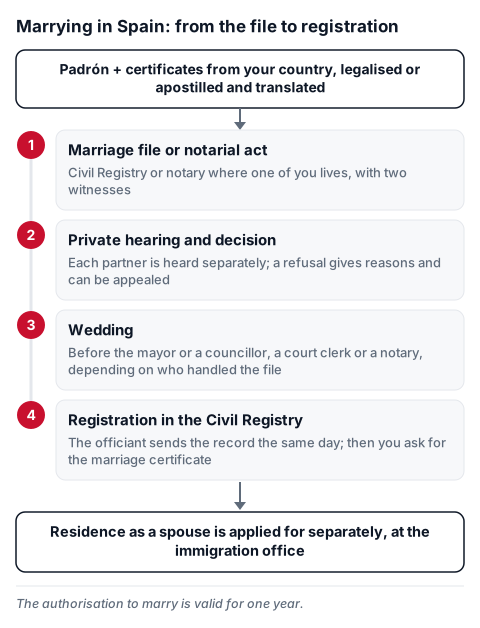
Steps
- Register at your address if you have not yet, and choose where to file: Civil Registry or notary where one of you lives.
- Ask your country for the birth certificate and the marital-status certificate (capacity to marry or single status); have them legalised or apostilled and order the sworn translation.
- Book an appointment and open the file or act with your partner and two witnesses.
- Attend the private hearing and wait for the decision.
- Book the date with whoever applies (town hall, Letrado or notary) and marry with two witnesses.
- Check the registration, ask for the marriage certificate and, if it applies to you, then apply for residence as a family member.
Official source: Civil Code, arts. 44 to 65, Ley 20/2011 on the Civil Registry, arts. 58 and 59, Comunidad de Madrid, civil marriage and Madrid Notarial Association. Terms in the glossary.
Informational only; check the official source and a professional for your specific case.
