
In short: a non-EU foreign national with a family link to a Spanish citizen can apply for the temporary residence authorisation as a family member of a Spanish national (RD 1155/2024, Chapter VII, arts. 93-97). It allows you to live and work and is granted for 5 years. It is its own route, separate from general reunification and from the EU regime.
In person or by representative? Mixed procedure; it depends on where the Spaniard and the relative are (information sheet 18; art. 97 of RD 1155/2024). If the Spaniard lives in Spain and the relative is still abroad, the Spaniard files the application at the Oficina de Extranjería of their province, in person or through a representative (art. 97.2). Once it is granted, the relative applies for the visa at the Spanish consulate within a month of the notification (art. 41.2). If both are outside Spain, the foreign relative files it at the consulate together with the visa (art. 97.3). In both cases with a visa, art. 26.1 requires the visa application in person. Exceptions: an external service provider, online filing where available, or a representative where the law provides for it or exceptionally. If both are in Spain, either of them may exceptionally file it at the Oficina de Extranjería (art. 97.1 c and 97.4). This applies only to the relatives in letters a) to h) of art. 94.1, not to «other dependent relatives». Sheet 18 (April 2026) does not include children or ascendants in this case: if that is you, confirm before filing. According to sheet 18, applications at the Oficina de Extranjería can also be filed online (Mercurio). In every case, the foreign relative applies for the TIE in person at the police station within a month of the grant or of entry (art. 97.7).
Don't confuse them — three different family routes
- Family member of a SPANIARD (this card): the person granting the right is a Spanish citizen. RD 1155/2024, Ch. VII; form EX-24.
- Family reunification (general regime): the sponsor is a foreigner with legal residence. RD 1155/2024, general regime; form EX-02. → see family reunification card.
- Family member of an EU/EEA/Swiss citizen (EU regime): the relative is from another EU country, not Spanish. RD 240/2007; form EX-19. → see EU family member card.
Who can apply (relatives of the Spaniard, provided they live or will live together; art. 94.1):
- Spouse over 18 (no annulment/divorce, no fraud of law; only one spouse).
- Registered partner in a public registry set up for that purpose in an EU or EEA state or in Switzerland, or a proven stable partner (marriage-like cohabitation of at least 12 continuous months; not required if there are common children). More in pareja de hecho in Spain for foreigners.
- Children (own or the spouse's/partner's) under 26, or older if dependent, or with a disability needing support; unmarried and without their own family unit.
- Direct first-degree ascendants (own or the spouse's/partner's) who are dependent and without family support in the country of origin, or on humanitarian grounds.
- Parent/guardian of a Spanish minor in their care and living with them.
- One relative up to the 2nd degree who will provide care to a Spaniard with a recognised dependency level (Ley 39/2006).
- Children whose father or mother is or was Spanish by origin.
- Other dependent relatives duly proven.
Children aged 26 or over (art. 94.1.d): children under 26 qualify under letter d) without proving dependency. From age 26 you must prove they are dependent on the Spaniard, or that they have a disability that needs support to exercise their legal capacity. In every case they must be unmarried, have formed no family unit of their own and live or intend to live with the Spaniard. If they are married or have their own family unit, the route is «other relatives» (letter i), and you must prove that every member of that unit is dependent on the Spaniard. Children of someone who is or was Spanish by origin have their own letter (h). Documents under art. 96: from the Spaniard, a complete copy of a valid passport or DNI; from the child, a complete copy of a valid passport and documents proving the family link. The authorisation lasts 5 years from the grant if the child is in Spain, or from entry if the child is abroad; if the Spaniard plans to live in Spain for less time, it lasts for that period (art. 95.3). Ask the Oficina de Extranjería what proof of the link it asks for.
What «dependent» means (art. 196): the support must be real, stable and sustained over time, not one-off, and must exist before the application is filed. A person is presumed dependent if, in the year before the application, they received funds, or expenses were paid for them, amounting to at least 51 % of the annual GDP per capita of their country of origin (World Bank data), for each person (art. 196.3.c). It is also presumed for parents over 80 or with several chronic illnesses or severe loss of physical or mental capacity (art. 196.5). In addition, the Spaniard must have means compatible with the situation: their household, including the dependent person, cannot receive the minimum vital income and must have income of 100 % of the monthly non-contributory pension (130 % if there are more than two members), or stable assets of three times that amount per year (art. 196.3.d). Physical dependency due to serious health reasons also counts (art. 196.4).
Parents of the Spaniard: the parents of the Spaniard, and those of their spouse or partner, qualify under letter e) if they live at their expense and lack family support in the home country, or on humanitarian grounds (art. 94.1.e; art. 196.6 lists those grounds). If the Spaniard lives in Spain and the parent is still abroad, the Spaniard files at the provincial Oficina de Extranjería and the relative then applies for the visa (art. 97.1.a and 97.2). The Supreme Court annulled the requirement that a parent's economic dependency «occur in the country of origin or of provenance», in so far as it prevented proving it when the parent is already in Spain (ruling of 8 July 2026). If the person living in Spain is a citizen of another EU country (for example French), this route is not yours: it is the EU regime, see EU family member card.
Brothers, uncles and other relatives: a brother or an uncle is not listed in letters a) to h). He can only qualify under letter i), if he proves beyond doubt, at the time of the application, that he is dependent on the Spaniard: dependency, living together, degree of kinship and, where relevant, serious health reasons or disability (art. 94.1.i and 96.b.4). The exception of filing while both are in Spain (art. 97.1.c) covers only letters a) to h), not i). Letter g) is a different case: one single relative up to the second degree who cares for a Spaniard with a recognised dependency level (Ley 39/2006). For a short visit, without residence, see the letter of invitation.
Stepchildren and parents of a Spanish minor: children of the spouse or partner under 18 qualify if the foreign parent has parental authority or sole custody, or if the other custody holder consents before a public authority or notary; that consent is not needed if they were born in Spain and have stayed here since birth (art. 94.1.d). The parent or guardian of a Spanish minor qualifies under letter f) if the minor is in their care and they live together or the parent is up to date with their obligations. A son or daughter of a Spanish father or mother is Spanish by origin (art. 17.1.a of the Civil Code): the child does not need this authorisation, which is for the foreign person who looks after them. If the parent became Spanish after the birth, a child who is or has been under their parental authority has the right to opt for Spanish nationality (art. 20.1.a of the Civil Code). How the child proves their nationality when travelling, confirm with the consulate or the Registro Civil. If the Spaniard and the foreign relative are both outside Spain, the foreign person files the visa application at the consulate (art. 97.1.b, 97.3 and 41.3). The Supreme Court annulled in letter f) the phrase requiring that this relationship had been established under Spanish law.
Registered or stable partners and nationality: a registered or stable partner can get this residence (letters b and c), but the 1-year period for nationality (art. 22.2.d of the Civil Code) is for someone who has been married to a Spaniard for a year and is not legally or de facto separated. If you are not married, your period is counted under art. 22.1 of the Civil Code, unless another one-year case of art. 22.2 applies to you (for example, being born in Spain). More in nationality by residence.
Specific documents (art. 96 — the official list; it may be broader depending on the case, check the source):
- For the Spanish relative: full copy of a valid passport or DNI; for spouse/partner, a sworn statement that no other spouse or partner lives with them in Spain.
- For the foreign relative: full copy of a valid passport or travel document; documents proving the family link; where required, documents proving they are dependent on the Spaniard; for a stable partner, proof of the relationship and cohabitation time (and, where applicable, birth certificate of common children).
Documents from another country (for example, a marriage certificate): according to sheet 18 and sheet 61, they are filed with an apostille if the issuing country is party to the 1961 Hague Convention, or legalised through diplomatic channels if it is not, and translated into Spanish if they are in another language. As a general rule you provide copies and show the originals when you file. If the marriage is already registered in Spain, ask the Oficina de Extranjería which of the two documents it accepts as proof of the link.
It is filed with the official form EX-24 ("Autorización de residencia temporal de familiares de personas con nacionalidad española"), available at general models (inclusion.gob.es).
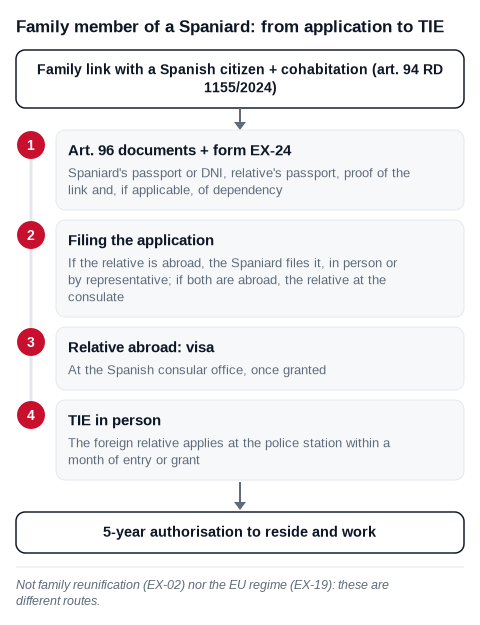
Steps
- Gather the art. 96 documents (passport/DNI, proof of the link, and proof of dependency if applicable) and fill in form EX-24 (general models).
- File the application. If the relative is abroad and the Spaniard in Spain, the Spaniard files it at the provincial Oficina de Extranjería, in person or through a representative (art. 97.2). If both are abroad, the relative at the consulate, with the visa (art. 97.3). If both are in Spain, exceptionally and only for the relatives in letters a) to h) of art. 94.1, either of them at the Oficina de Extranjería (art. 97.1 c and 97.4). Applications at the Oficina de Extranjería can also be filed via Mercurio, according to sheet 18.
- If granted and the relative is abroad, apply for the visa at the Spanish consular office within a month of the notification (art. 41.2).
- Within a month of the grant or of entry, the foreign relative applies in person for the TIE at the police station (art. 97.7).
Deadlines
- Decision: 2 months from the filing date; if that time passes with no answer, the application is treated as rejected (art. 97.6). If it was filed at the consulate (both outside Spain), the 2 months run from when the Oficina de Extranjería receives the consulate's communication.
- Incomplete documents: the office asks you to fix them within the period it sets, up to 15 days; if you do not, the file is closed (art. 97.6).
- Both in Spain (letters a to h): once the application is admitted, you may live and, if of working age, work provisionally until the decision, unless authorisations of the same type were already refused or inadmitted on the same facts. If it is granted, its effects go back to the filing date; if it is refused, the provisional work permission is lost (art. 97.5).
- Visa (relative abroad): apply within a month of the notification of the grant, and the consulate issues it within a maximum of 15 days (art. 41.2). The consulate checks the requirements of art. 38 (among others, a passport valid for at least one year, criminal records from the countries of residence in the last five years if you are of criminal age, and a medical certificate) and the original documents proving the family link.
- Refusal: the visa or the authorisation may be refused on grounds of public order, public security or public health, proportionately; if the ground is public order or public security, the refusal must be based only on personal conduct. Previous convictions are not by themselves an automatic ground for refusal, except for relatives in letters c), g), h) and i), who must prove they have no criminal record (art. 98.1). The Supreme Court annulled the parts of arts. 97.4 and 98.1 that impose automatic refusal for a criminal record without an individual assessment, in the cases covered by art. 20 of the Treaty on the Functioning of the EU (ruling of 8 July 2026); if you have a record, ask a professional.
Cost
- The procedures of art. 97 are free and handled as a priority (art. 97.8).
Visa at the consulate (the relative is outside Spain): this part is the procedure at the consulate, separate from filing at the Oficina de Extranjería. The residence visa for family members of Spaniards is in art. 41 of RD 1155/2024: the consulate issues it within a maximum of 15 days and the art. 38.h visa fee is not charged. Each consulate publishes its own document list and way to book an appointment. What follows is what the page of the Spanish Consulate General in Havana says, checked on 8 November 2026. At another consulate, confirm its list.
Documents
- One national visa form per applicant, signed (for a minor, a legal representative signs), and a recent colour photo on a light background. How many paper copies to bring to the appointment, confirm with your consulate.
- Original passport and a photocopy of the data page. It must be valid for at least one year and have two blank pages; passports issued more than 10 years ago are not accepted. Some Oficinas de Extranjería may ask for a copy of every page.
- From the Spaniard: a complete copy of a valid passport or DNI and, if the relative is a spouse or partner, a sworn statement that no other spouse or partner lives with them in Spain.
- From the relative: if the Spaniard already applied for the authorisation from Spain, the original and a copy of the granted authorisation. If both are outside Spain, the signed form EX-24, with an address in Spain and an email, and the documents proving the link (marriage certificate, birth certificate, etc.).
- If a child under 18 is the child of only one of the spouses or partners, Havana also asks for the other parent's notarised authorisation. It is not needed if the Spaniard, their spouse or their partner is shown to hold parental authority exclusively.
- Criminal records from the countries where you lived in the last five years, if you are of criminal age, and a medical certificate. In Havana, Cuban certificates must be less than 6 months old and legalised by the MINJUS.
- Proof of residence in the consulate's district.
- Foreign documents are filed legalised or apostilled and translated into Spanish. Each document goes in original and photocopy: the consulate checks it and keeps the photocopy, not the original.
- The visa is free. The page says a service fee is paid if you file through the external visa receiving centre. Since 19 October filing in Cuba goes through the Visa Application Centre (see below): confirm there whether that fee is charged.
Does the Spaniard have to go to the appointment? The visa application is filed in person by the relative, with exceptions (art. 26.1 of RD 1155/2024). The Havana page adds that only people on its appointment list may enter the consulate, but the Spaniard on whose presence the application is based may enter. It also accepts an accredited representative for justified reasons assessed by the consulate. Ask when you book the appointment whether the Spaniard must also attend.
Marriage not registered in the Spanish Registro Civil: according to Havana, in that case you file the Cuban marriage certificate. It must be legalised by the MINJUS and by the Consulate General. For other countries the general rule on foreign documents in sheet 61 (above) applies. To register the marriage in the Spanish civil registry, ask the consulate or the Registro Civil.
Children aged 21 or over and the EU regime: on the route for family of a Spaniard, children under 26 do not prove dependency; from 26 they do (above, art. 94.1.d). In Guayaquil, a child under 18 who does not travel with both parents provides documents on parental authority, custody and the consent of the parent who does not travel (descendants of EU citizens). The age limit of 21 belongs to the EU regime (RD 240/2007, art. 2). The Buenos Aires and Guayaquil consulate pages give it for family of EU citizens. The Guayaquil list adds that this decree may apply to family of Spaniards in the cases the rules provide for. Both consulates ask for proof that a child over 21 is dependent. Buenos Aires mentions money transfers or bank transfers in the last year. They must add up to at least 51 % of the GDP per capita of the applicant's country of residence. Which regime applies to your case, confirm with the consulate.
Passport with little validity left: art. 38.d of RD 1155/2024 requires a passport valid for at least one year for the visa, even if the residence authorisation has already been granted. The visa is applied for within a month of the notification of the grant (art. 41.2): if your passport has less than a year left, deal with it as soon as possible, ideally while the authorisation is being processed.
Change of filing place in Cuba: according to the Havana page, from 19 October 2026 visa applications for family of Spaniards and of EU citizens are filed at the Visa Application Centre for Spain in Cuba. The same page still shows the earlier procedure of booking by email. Confirm the current procedure in the Centre's frequently asked questions.
Official source: RD 1155/2024 — Immigration Regulation (Ch. VII, arts. 93-97) and form EX-24 / general models (inclusion.gob.es). Nationality: Civil Code, arts. 17 and 20 (BOE). Foreign documents: sheet 61, legalisation and translation (inclusion.gob.es).
Informational only; the exact documents and steps vary by case — check the official source and a professional for your specific case.
