
In short: long-term residence is obtained after 5 years of continuous legal residence in Spain; it allows residing and working indefinitely. It is a separate authorisation, not a mere renewal (RD 1155/2024, arts. 175-189).
In person or by representative? It depends on where you are (RD 1155/2024; information sheets 49 and 50). If you are in Spain, the application goes to the immigration office (oficina de extranjería) of the province where you live (arts. 177.1 and 184.1). You can file it in person or electronically on the Mercurio portal, or through a representative with a notarial power of attorney or an apud acta authorisation (sheet 60; art. 197.4). If you are outside Spain, you file it in person at the Spanish consulate for your place of residence, which forwards it to the immigration office of the province where you will live (arts. 177.1 and 184.1, second paragraph). Once it is granted, you apply for the TIE card in person within one month of the notification (arts. 177.7 and 184.7).
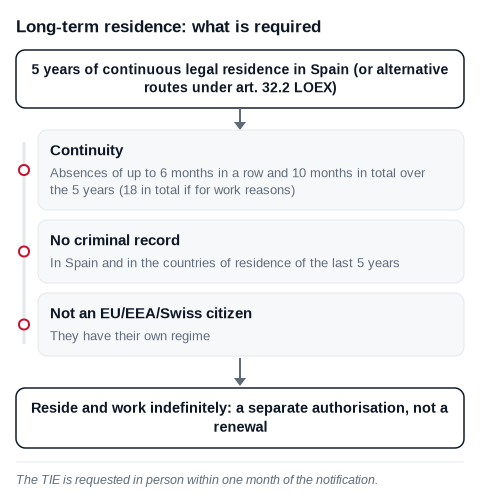
Main requirement: 5 years of continuous legal residence (or alternative routes under art. 32.2 LOEX: birth in Spain, prior Spanish nationality, subsidiary protection, among others).
Continuity (allowed absences): up to 6 months in a row and a maximum of 10 months in total over the 5 years; for work-related absences, up to 6 months in a row and 18 months in total over those 5 years (art. 183.2 of RD 1155/2024).
Other requirements: not being an EU/EEA/Swiss citizen (they have their own regime) and having no criminal record in Spain or in the countries of residence over the last 5 years.
National or EU: the regulation covers two authorisations. National long-term residence (arts. 182-185) and EU long-term residence (arts. 175-178), which is also governed by Directive 2003/109/EC. For the national one, the list of documents (art. 184.3) does not include financial means or health insurance. For EU long-term residence you must also prove stable and regular resources (at the family reunification amount) and health insurance (arts. 176.b, 176.c and 177.3).
If you come from another EU country: someone who holds EU long-term residence granted by another Member State can apply to live in Spain without a visa (art. 179 of RD 1155/2024). The application is filed before you enter or, at the latest, within three months after entry, at the immigration office of the province where you will live or at the Spanish consulate for your previous place of residence in the EU. The application comes with proof of EU long-term residence in the other State, a complete copy of a valid passport and proof of the fee. Depending on the reason, you add financial means and health insurance (if you will not work) or the work documents that apply, and the national employment situation is not taken into account (art. 179.3). It is decided within 2 months and, with no answer, it is deemed rejected. If the reason is to work, the authorisation takes effect on registration with Social Security, which must happen within three months of the notification of the grant. With a residence permit from another Schengen country you can stay in Spain up to 90 days in any 180-day period, without a visa (art. 4.1; see travelling in Schengen with residence); to stay longer you need a Spanish visa or authorisation, depending on the route that applies. Confirm which route fits you at the Oficina de Extranjería of the province where you will live.
Absences for force majeure (national long-term residence): besides the limits above, continuity is not broken by absences due to duly justified force majeure; the deciding body assesses each case individually (art. 183.2). The 6 and 10-month limits do not apply if the departures were made "irregularly" (art. 183.2). Before you apply, ask your immigration office which documents to provide to justify an absence.
Deadlines
- The 5-year condition is counted backwards from the day you file the application (art. 183.1).
- File in the 2 months before your current permit expires: this extends its validity until the decision. If you file within 3 months after it expires, it is also extended, but a sanction procedure may be opened (arts. 177.2 and 184.2). These deadline and extension rules do not apply if you already hold a valid residence permit and meet the requirements (arts. 177.2 and 184.2).
- The administration decides within 3 months of the application entering the register; if it does not reply in that time, the application is deemed approved (arts. 177.6 and 184.6).
- After approval, you apply for the TIE in person within 1 month (arts. 177.7 and 184.7).
Documents (national long-term residence, art. 184.3 and sheet 49)
- Application form EX-11 (how to fill it in).
- Complete copy of a valid passport, travel document or cédula de inscripción.
- Proof of the fee: form 790, code 052, heading 2.6; it is paid within 10 working days of the application being admitted (how to pay it).
- If the application is based on previous periods of residence: a report proving that the children in your care of compulsory school age are enrolled.
- Where applicable, a criminal record certificate from your country of origin and from the countries where you lived in the last 5 years. The office obtains your Spanish record itself (art. 184.4).
- Documents from other countries: sworn translation and apostille or legalisation (sheet 49).
- For EU long-term residence, also proof of resources and health insurance (art. 177.3.d and e).
How the years are checked: once the application arrives, the immigration office checks your previous periods of residence in Spain (art. 184.4). Registration at the town hall (padrón) is not on the document list in art. 184.3. Which proof of presence your office asks for, check with it before you apply.
Renewing the TIE (arts. 178 and 185): the first renewal is requested after 5 years; after that, every 5 years until the age of 30 and every 10 years from 30. The application goes in during the 2 months before the card expires and extends the old one until the decision; it is also extended if you file up to 3 months later. Not renewing on time does not end the authorisation, although the office checks that the conditions still hold (art. 185.3) and a sanction is possible. Documents (art. 185.4): a complete passport in force, travel document or cédula de inscripción; proof of the fee; one photograph. An expired passport does not meet that requirement: renew it at your consulate or ask the immigration office or the police station about the cédula de inscripción.
Children and family: with long-term residence you can start family reunification (reunification guide). You can bring children under 18, or adult children with a disability that requires support or who cannot support themselves because of their health (art. 66.1.c). If they are children of only one of the spouses or partners, you also need sole parental authority, or exclusive custody with authorisation for the move, or shared custody with the other holder's consent. You must prove income of 150% of IPREM for two people and 50% for each extra member, adequate housing with a social services report, and health insurance; if you have other children of compulsory school age already in Spain, they must be enrolled in school (art. 67). The application is filed in person at the immigration office, and your relative's authorisation is not granted before yours has been granted or renewed (art. 68).
Long-term residence and nationality: long-term residence allows you to live and work indefinitely on the same terms as Spaniards (art. 182), but it is not nationality. You remain a foreign national and renew the card. The authorisation ends, among other cases, after 12 consecutive months outside the EU (art. 201.1.c). Nationality is a separate application: as a general rule it requires 10 years of residence (art. 22 of the Civil Code), with shorter periods in some cases (nationality by residence).
Official source: Immigration Regulation (RD 1155/2024); detail at inclusion.gob.es.
Informational only; exact requirements and documents vary — check the official source and a professional for your case.
