
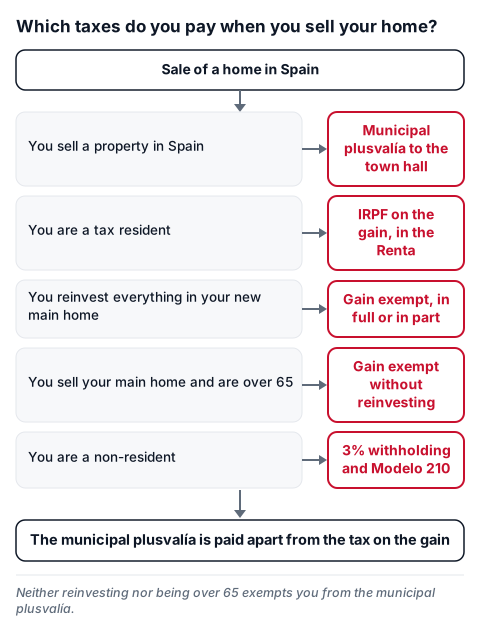
In short: selling property in Spain triggers the municipal plusvalía, which you pay to the town hall, and a tax on the gain: IRPF if you are a tax resident, IRNR if you are not. As a resident, the gain is taxed at 19% to 30% and can be exempt if you reinvest in your new main home or are over 65. As a non-resident, the buyer withholds 3% of the price and you file the Modelo 210 (19% on the gain).
In person or by representative? You do not have to go to the tax office in person. The sale deed is signed before a notary, in person or with a power of attorney (see buying a home as a foreigner). The plusvalía is declared at your town hall and its ordinance sets how (art. 110.1 of the local finance law, TRLRHL), so check its online office. The Renta is filed online with Cl@ve or a certificate (Renta guide). The Modelo 210 is filed online with a certificate, the electronic DNI or Cl@ve. A representative with powers or a social collaborator (a person or firm authorised to file for others) can also file it, under art. 12 of Orden EHA/3316/2010. On paper, a form with an amount to pay is filed and paid at a partner bank in Spain (art. 11.1). A form that ends in a refund is handed in at the AEAT or sent by registered mail (art. 11.2). Anyone living abroad can also pay by bank transfer, without a certificate (art. 14).
What is paid, and to whom
- Municipal plusvalía (IIVTNU). The town hall charges it. It taxes the rise in value of the land, not of the building. In a sale, the seller pays it (art. 106.1.b).
- IRPF, if you are a tax resident. It taxes the gain you make on the sale. You pay it to the Tax Agency (AEAT) in the Renta of the year of the sale. Who is a resident: tax residence and the 183 days.
- IRNR, if you are not a tax resident. It also taxes the gain, with other rules and an advance: the buyer withholds 3% of the price.
- The purchase (ITP, VAT, AJD) is a separate topic, for the buyer: taxes when buying a home.
1. Municipal plusvalía
- What it taxes. The rise in value of urban land over the years you have owned it, up to a maximum of 20 years (arts. 104.1 and 107.1).
- Who pays. The seller (art. 106.1.b). If the seller is an individual who is not resident in Spain, the buyer is the substitute taxpayer: they take the seller's place and pay the town hall (art. 106.2). The article does not say how the cost is split afterwards. Ask the notary or your adviser how it is reflected in the deed.
- How it is calculated. There are two methods. The objective one multiplies the cadastral value of the land by a coefficient that depends on the full years you held it (art. 107.2.a and 107.4). The maximums in force run from 0.09 to 0.40 depending on the years (0.15 for under 1 year, 0.40 for 20 years or more), and each town hall approves its own coefficients without going above them. The real method uses the difference between the value of the land when you sell and when you bought (arts. 104.5 and 107.5).
- If you gained little or lost. If there is no increase in value, the sale is not subject to the tax (art. 104.5). If there is one but it is lower than the objective method gives, the tax base becomes the real increase if you ask for it (art. 107.5). In both cases you declare the sale and attach the purchase and sale deeds. The comparison takes the higher of the value in the deed and the value checked by the administration, without counting costs or taxes. For a flat, the share that the land has in the cadastral value is applied to both values (art. 104.5).
- Rate. Each town hall sets it, with a maximum of 30% (art. 108.1).
- Deadline. 30 working days from the date of the transfer, which in an ordinary sale is the date of the deed (arts. 109.1.a and 110.2.a). The town hall may require a self-assessment, meaning you calculate and pay it yourself (art. 110.4). Each town hall has its own ordinance and form: look for the one in your municipality. The buyer must also report the sale (art. 110.6.b), and notaries send the town hall a list of deeds every quarter and warn the parties of the deadline (art. 110.7).
- Exemptions. The ones listed in art. 105 are different: easements, cultural heritage assets with works, handing over a mortgage debtor's main home in payment of the debt, and public or charitable bodies, among others. Neither reinvesting in another home nor being over 65 is among them. Nor is there an exception for owning the home for more than 20 years: the table in art. 107.4 has a band for 20 years or more.
2. IRPF, if you are a tax resident
- The gain. Transfer value minus acquisition value (art. 34.1.a of the personal income tax law, LIRPF).
- Acquisition value. What you paid, plus works and improvements, plus the costs and taxes of the purchase (notary, registry, the purchase tax), without counting mortgage interest (art. 35.1). If the home produced income, for example from a rental, the tax-deductible depreciation is subtracted, whether you deducted it or not (art. 35.1 and art. 40.1 of the personal income tax regulation, RIRPF). If you bought before 31 December 1994 there is a transitional regime (ninth transitional provision).
- Transfer value. The price actually received, unless it is lower than the market value, in which case the market value applies. From that you subtract the costs and taxes of the sale that you pay (art. 35.2). The article does not name the municipal plusvalía; the worked example in the AEAT's Renta 2025 practical manual (ch. 11) subtracts it from the transfer value. Confirm it with the AEAT.
- Rates. The gain goes into the savings base (arts. 46.b and 49), together with your interest and dividends. The state scale (art. 66) and the regional scale (art. 76) both apply, and each has bands of 9.5%, 10.5%, 11.5%, 13.5% and 15%. Added together: 19% up to €6,000; 21% from €6,000 to €50,000; 23% from €50,000 to €200,000; 27% from €200,000 to €300,000; and 30% above. Example: a gain of €40,000 and no other savings income gives €1,140 (19% of €6,000) plus €7,140 (21% of €34,000). That is €8,280, before the personal and family minimum, which reduces it (art. 66.1). The Basque Country and Navarre have their own regional tax rules, which this guide does not cover.
- When. The gain is assigned to the year of the sale (art. 14.1.c) and goes in the Renta of that year: income tax return.
IRPF exemptions
- Reinvestment (art. 38.1 of the LIRPF and art. 41 of the RIRPF). The gain can be excluded if you reinvest the whole amount obtained in a new main home. You have 2 years from the sale. A home bought in the 2 years before the sale also counts (art. 41.3). If you reinvest only part, the proportional part of the gain is excluded (arts. 38.1 and 41.4). If you bought the home with a loan, the amount to reinvest is the sale price minus the loan principal you still owed (art. 41.1). Renovating the home, in the cases defined in art. 41.1, counts as buying. If you do not reinvest in the same year, you state your intention in the Renta of the year of the sale. If you later fail to comply, you file a complementary return with late-payment interest (arts. 41.3 and 41.5).
- Over 65. The gain from selling your main home is exempt if you are over 65 or have severe dependency or major dependency (art. 33.4.b). You do not have to reinvest.
- What counts as a main home (art. 41 bis of the RIRPF). The one that has been your residence for at least 3 years in a row. There are exceptions, such as a wedding, a job transfer or a first job. You must have lived in it in practice within 12 months of buying it. For these exemptions it is enough that it was your main home when you sold or up to any day in the 2 years before (art. 41 bis.3).
- Another route from 65. If you sell any asset, not only the home, and put the whole amount within 6 months into a lifetime annuity insured in your favour, the gain can be excluded. The maximum is €240,000 (art. 38.3).
- Real Decreto-ley 26/2026 (repealed). It provided for two changes. One extended the main-home window (art. 41 bis.3 of the RIRPF) for people over 65 and dependent people who moved to a care home or to a relative's home. The other was an exemption for selling an empty home to a public body (65th additional provision of the LIRPF). Congress repealed it on 2 October 2026 (BOE-A-2026-20526); they do not apply. If you signed or applied for something relying on the decree between 1 and 2 October, talk to a professional.
3. IRNR, if you are not a tax resident
- The tax. The gain from selling a property in Spain is income obtained in Spain (art. 13.1.i.3.º of the non-resident income tax law, TRLIRNR). It is taxed at 19% (art. 25.1.f.3.º) and the base is calculated with the LIRPF rules on gains (art. 24.4).
- What the buyer does. The buyer withholds 3% of the agreed price and pays it with the Modelo 211 within 1 month of the sale (art. 25.2 of the TRLIRNR; arts. 8.3 and 8.5 of the Order). The buyer gives you a copy of the 211 as proof (art. 8.4). If the buyer does not pay it, the property stays liable for the lower of the withholding and the tax (art. 25.2).
- What you do. The 210 is filed by you, not by the buyer. You file it for the gain, even if tax was already withheld and whatever the result (arts. 4.3 and 5.a of the Order). The deadline is 3 months that start 1 month after the date of the sale, so up to about 4 months from the sale (art. 5.a). You file one 210 per sale. If both spouses are non-residents and co-owners, one form is enough (art. 2.1.a). The competent AEAT office is the one for the place where the property is (art. 6.1).
- The sum. You work out 19% of the real gain and subtract the 3% withheld, attaching the proof (art. 26.b of the TRLIRNR and art. 7.2 of the Order). If an amount is left to pay, you pay it. If the withholding is higher than the tax, or you sell at a loss, you claim the refund in that same 210 (arts. 4.4 and 2.1.a). As arithmetic: the withholding exceeds the tax when the gain is below 15.8% of the price (3 divided by 19).
- The 4-month myth. Some websites say that if you do not file the 210 within 4 months you lose the 3%. The Order does not say that: it sets the deadline for filing. For refunds of other income it speaks of 4 years from the end of the period for paying the withholding (art. 5.c.3.º). For property sales it refers to the IRNR regulation, which we have not reviewed. Filing late can bring surcharges or penalties (the general tax law is not reviewed here), so do not wait.
- Reinvestment for EU and EEA residents (seventh additional provision of the TRLIRNR). If you live in an EU state, or an EEA state with effective exchange of tax information, and sell what was your main home in Spain, the gain can be excluded. You must reinvest everything in a new main home, with the rules of art. 38 of the LIRPF. The 3% withholding and the return remain compulsory, but if you reinvest before the filing deadline, it counts when working out the debt. The text does not say where the new home must be: confirm with the AEAT.
- Over 65. Art. 24.4 refers to the LIRPF rules on gains, but no source we reviewed confirms that the exemption of art. 33.4.b applies to non-residents. Ask the AEAT before counting on it.
- Tax treaties. If you apply a treaty to avoid double taxation, you attach a tax residence certificate valid for 1 year (art. 7.1 of the Order): tax residence certificate. If you have no NIF, see the Modelo 030.
What the texts do not clarify
- Whether the AEAT accepts subtracting the municipal plusvalía in every case (its Renta 2025 worked example subtracts it from the transfer value).
- Whether a non-resident seller can use the over-65 exemption.
- The deadline to claim back the 3% on a property sale.
- Whether the new home in a non-resident's reinvestment must be in Spain.
- The amount of the surcharges for filing late.
For these points ask the AEAT or a tax adviser.
Documents
- Sale deed and purchase deed (for the plusvalía, art. 110.3, and to calculate the gain).
- Cadastral value of the land and of the whole home (IBI receipt or Cadastre).
- Invoices and proofs of works, improvements and purchase and sale costs (notary, registry, agency).
- If you bought with a loan and reinvest: certificate of the principal outstanding on the date of the sale.
- If you reinvest: deed of the new home.
- If you are a non-resident: the copy of the Modelo 211 the buyer gives you, and a NIF.
- If you claim a refund: proof of ownership of the bank account (art. 7.4 of the Order).
- If you apply a treaty: the tax residence certificate.
List based on the articles cited; it may not be exhaustive: check what your town hall and the AEAT ask for.
Steps:
- Gather the purchase and sale deeds, the invoices for works and costs, and the cadastral value of the land.
- Declare the plusvalía at your town hall within 30 working days of the date of the sale, with the form or self-assessment of its ordinance. If you made no gain, or less than the objective method gives, ask for the real method and attach both deeds.
- If you are a tax resident, calculate the gain (transfer value minus acquisition value) and check whether you qualify for the reinvestment exemption (2 years) or for being over 65.
- Declare the gain, or the exemption, in the Renta of the year of the sale. If you have not reinvested yet, state that you plan to.
- If you are a non-resident, check that the buyer withholds 3% and files the Modelo 211 within 1 month, and ask for your copy.
- File the Modelo 210 within the 3 months that start 1 month after the sale. Subtract the 3% withheld and, if the result is a refund, claim it in the same form.
Official source: TRLRHL, arts. 104 to 110, BOE, LIRPF, arts. 14, 33 to 38, 46, 49, 66 and 76, BOE, RIRPF, arts. 40 to 41 bis, BOE, TRLIRNR, arts. 13, 24 to 26 and the seventh additional provision, BOE and Orden EHA/3316/2010, BOE.
Informational only; check the official source and a professional for your specific case. Rules checked against official sources on 3 October 2026.
