
In short: the taxes when buying property in Spain depend on who sells it to you. If you buy from a private individual (second-hand), you pay the ITP, a transfer tax that each autonomous region sets. If you buy a new build from the developer, you pay IVA (VAT) and AJD (stamp duty). In the Comunitat Valenciana (Valencian Community) the general ITP rate is 9 %. It falls to 6 % for people under 35 and to 3 % for large families and people with a disability, if the home is worth up to €180,000 and the conditions are met. You file the Modelo 600 within 1 month. If the seller is not a Spanish tax resident, you also withhold 3 % of the price and pay it with the Modelo 211.
In person or by representative? Mixed. In the Comunitat Valenciana the Modelo 600 is calculated in the Sar@2 program of the ATV (Agència Tributària Valenciana), paid at a partner bank or with the Generalitat payment application, and filed online, with a digital certificate, or at an ATV office with a prior appointment. Without an appointment it is filed at the liquidating office that corresponds to you (ATV, Modelo 600 individual). If someone else files it, for example a gestoría (administrative agent), the ATV regulates representation in its section «Representación, certificados y requisitos para presentar». The deed is signed before a notary: if you want to sign with a power of attorney, ask the notary, because this guide does not cover that step. The Modelo 211 can be filed by a representative with powers or a social collaborator (art. 12 of Orden EHA/3316/2010).
Who pays what. ITP and AJD are two parts of the same tax, the tax on property transfers and documented legal acts, regulated by the TRLITPAJD. LIVA is the VAT law, TRLIRNR the non-resident income tax law and TRLRHL the local finance law, where the municipal plusvalía sits. The ITP and AJD rates in the table are those of the Comunitat Valenciana. VAT is national.
| Item | Who pays | Rate | Rule |
|---|---|---|---|
| ITP (second-hand) | The buyer, even if the contract says otherwise | 9 % general and 11 % if the property is worth more than €1,000,000 | Art. 8 of the TRLITPAJD and art. 13.Uno of Law 13/1997 |
| IVA (new build) | The buyer, to the developer, on the invoice | 10 % for a home and 4 % for protected housing of the special regime | Arts. 84, 88 and 91 of the LIVA |
| AJD (new build) | The buyer | 0.1 % if it is a main home and 1.4 % in all other cases | Art. 29 of the TRLITPAJD and art. 14 of Law 13/1997 |
| AJD on the mortgage | The bank | Not paid by you | Art. 29 of the TRLITPAJD |
| Municipal plusvalía | The seller; the buyer, if the seller is a non-resident individual | Paid to the town hall | Art. 106 of the TRLRHL |
| 3 % withholding | The buyer, if the seller is not a tax resident | 3 % of the agreed price | Art. 25.2 of the TRLIRNR |
Notary, Land Registry and gestoría costs are separate. This guide gives no figures for them: they depend on each operation and we have not verified them in the sources of this guide. Ask for a quote before you sign.
Second-hand: ITP. According to the ATV, a home is second-hand if it is transferred for the second time or more. The buyer pays the ITP (art. 8 of the TRLITPAJD) and each region sets its own rate (art. 11.1.a). For property, what counts is where the property is: if it is in the Comunitat Valenciana, the tax is filed here. Law 13/1997 sets the rates in the table for the Comunitat Valenciana (consolidated text, last amended on 10 August 2026).
| Situation | Rate | Art. of Law 13/1997 |
|---|---|---|
| Homes and other property, general rate | 9 % | 13.Uno |
| Property worth more than €1,000,000 | 11 % | 13.Uno |
| Under 35, first main home, up to €180,000 | 6 % | 13.Tres.1 |
| Under 35, first main home, more than €180,000 | 8 % | 13.Dos.2 |
| VPO of the general regime, first main home, up to €180,000 | 6 % | 13.Tres.2 |
| VPO of the general regime, first main home, more than €180,000 | 8 % | 13.Dos.1 |
| VPO of the special regime, first main home, up to €180,000 | 3 % | 13.Cinco.1 |
| VPO of the special regime, first main home, more than €180,000 | 4 % | 13.Cuatro.1.1 |
| Large or single-parent family, main home, up to €180,000 | 3 % | 13.Cinco.2 |
| Large or single-parent family, main home, more than €180,000 | 4 % | 13.Cuatro.1.2 |
| Person with a disability of 65 % or more (or an intellectual or mental disability of 33 % or more), main home, up to €180,000 | 3 % | 13.Cinco.3 |
| Person with a disability of 65 % or more (or an intellectual or mental disability of 33 % or more), main home, more than €180,000 | 4 % | 13.Cuatro.1.3 |
| Woman victim of gender violence, main home, up to €180,000 | 3 % | 13.Cinco.4 |
| Woman victim of gender violence, main home, more than €180,000 | 4 % | 13.Cuatro.1.4 |
- Main home. The law refers to the IRPF concept of main home (art. 13.Seis). In that rulebook, for certain exemptions, it is the home where you live continuously for at least 3 years and that you occupy within 12 months of buying it (art. 41 bis of the RIRPF). Check with the ATV how it applies to your purchase.
- Public deed. The reduced rates require the purchase to be in a public document, or to be formalised that way within the filing period (art. 13.Siete).
- Maximum income. For people under 35, victims of gender violence and large or single-parent families, the buyer's income counts. The general taxable base plus the savings base of the IRPF cannot exceed €30,000 in an individual return or €47,000 in a joint one (art. 4.Cuatro). For large families of the special category, the same section sets €35,000 and €58,000. The article does not say which IRPF year that base comes from: ask the ATV.
- Share you buy. The rates for young people, disability and victims of gender violence apply to the share bought by each person who meets the requirements.
- Garages and storage rooms. The ATV counts the garages and annexes you buy at the same time as part of the home.
- If you lose the benefit. If you later fail a requirement, you file another self-assessment within 1 month of the breach, with late-payment interest (art. 14 ter.2).
General rates in each region (2026)
Summary by the Ministry of Finance, «Tributación autonómica. Medidas 2026» (updated to 23 September 2026). These are the general rates. For the ITP, every region has reduced rates or relief for the main home of some groups (young people, large families, people with disabilities, low incomes), and most also for the AJD, with price and income limits: the details are in annexes V and VI of that document and at your region's tax office.
| Region | ITP, resale home | AJD, general rate on the deed of a new home |
|---|---|---|
| Andalucía | 7 % | 1.2 % |
| Aragón | 8 % to 10 %, by value | 1.5 % |
| Asturias | 8 % to 10 %, by value | 1.2 % |
| Illes Balears | 8 % to 13 %, by value | 1.5 % |
| Canarias | 6.5 % | 0.75 % |
| Cantabria | 9 %; 7 % up to €300,000 if it will be your main home (from 1.05.2026) | 1.5 % |
| Castilla-La Mancha | 9 % | 1.5 % |
| Castilla y León | 8 % up to a band of the value and 10 % on the rest | 1.5 % |
| Cataluña | 10 % to 13 %, by value | 1.5 % |
| Comunitat Valenciana | 9 %; 11 % if the value is over €1 million (from 1.06.2026) | 1.4 % (from 1.06.2026) |
| Extremadura | 8 % to 11 %, by value | 1.5 % |
| Galicia | 8 % | 1.5 % |
| Comunidad de Madrid | 6 % | 0.75 % |
| Región de Murcia | 7.75 % | 1.5 % |
| La Rioja | 7 % | 1 % |
| Ceuta and Melilla | 6 %, with a 50 % relief on the tax | 0.5 %, with a 50 % relief on the tax |
| Basque Country and Navarre | their own foral rules | their own foral rules |
- Ceuta and Melilla: the state rates apply (6 % and 0.5 %, arts. 11 and 31.2 of the tax law) with the 50 % relief of art. 57 bis.
- Cantabria: since 1 May 2026, under Cantabria Law 5/2026 (BOC extraordinary no. 12, 30 April 2026), buying a home that will be your main home pays 7 % up to €300,000 of value and 9 % on the part above that, with no age condition (art. 9.2 of Decreto Legislativo 62/2008, consolidated text). If you are under 40, a large or single-parent family, or in another case of art. 9.3, the rate is 4 %, and 3 % if you have a disability of 65 % or more (art. 9.6). These rates only apply up to €300,000; on the part above that you pay 9 % (art. 9.7). The reduced rates must be requested expressly in the deed (art. 9.9). On a new build, the AJD on the deed of your main home is 1 % (art. 13.3); 0.1 % if you are under 40, a large or single-parent family, or in another case of art. 13.4, and 0.05 % with a disability of 65 % or more (art. 13.6), also only up to €300,000 (art. 13.9). More in the Law 5/2026 guide.
- Basque Country and Navarre: the tax is regulated and collected by their foral tax offices. Ask your Diputación Foral (Álava, Bizkaia or Gipuzkoa) or the Hacienda Foral de Navarra.
- Canarias, Ceuta and Melilla: VAT (IVA) does not apply there (art. 3 of the VAT law). A new home is taxed by those territories' own indirect taxes: ask their tax office.
The base: price or reference value. The ITP is calculated on the reference value that the Catastro assigns to the property on the date of the act. If the agreed price or the declared value is higher, the higher one rules (art. 10.2 of the TRLITPAJD). The tax accrues on the day of the act (art. 49.1.a). For the ATV, the reference value is the minimum base. It is set every year from the prices of sales before a notary and cannot exceed the market value. If there is no reference value, the base is the highest of three figures: the declared value, the price or the market value.
You can look up the reference value of a property in the Catastro online office, with Cl@ve, a certificate or the electronic DNI. It is worth doing before you sign, to know the base you will pay on. If you disagree with the value, you can only challenge it by appealing the assessment or asking to correct your self-assessment. The tax office decides with a binding report from the Dirección General del Catastro (art. 10.3 and 10.4).
New build: IVA and AJD. A new build is the first delivery made by the developer of a finished building. Second and later deliveries are exempt from IVA and pay ITP (art. 20.Uno.22 of the LIVA and art. 7.5 of the TRLITPAJD). There are exceptions, for example a building that an owner or tenant already used for 2 years in a row or more, so ask which tax your operation carries before you sign.
- IVA. 10 % for homes, with up to 2 garage spaces and the annexes transferred at the same time (art. 91.Uno.1.7º). Business premises do not count as annexes. The rate is 4 % for VPO of the special regime or public promotion when the developer sells (art. 91.Dos.1.6º). Real Decreto-ley 26/2026 provided for extending that 4 % from 1 December 2026 to protected homes with permanent or indefinite qualification. Congress repealed it on 2 October 2026 (BOE-A-2026-20526); it does not apply. The developer charges the IVA on the invoice and you pay it to the developer (arts. 84 and 88).
- AJD. The deed of sale of a new build pays AJD and the buyer pays it (art. 29 of the TRLITPAJD; ATV). In the Comunitat Valenciana it is 0.1 % if it is your main home and 1.4 % in all other cases (art. 14.Uno.a and 14.Cuatro of Law 13/1997). The base cannot be lower than the reference value (art. 30.1). There is a third rate, 2 %, when the seller waives the IVA exemption (art. 14.Dos). The LIVA only allows that waiver if the buyer acts as a business or professional (art. 20.Dos), so it does not apply to someone buying a home to live in.
- Mortgage. The AJD on the mortgage loan deed is paid by the bank, not by you (art. 29 of the TRLITPAJD, second paragraph; ATV).
Modelo 600: when and how. The buyer files the Modelo 600 within 1 month of the day the act or contract is made (art. 14 ter.1 of Law 13/1997). The ITP accrues on the day of the act and the AJD on the day the deed is formalised (art. 49.1 of the TRLITPAJD). If you buy with a deed and no earlier private contract, that is the day you sign. If there was a private sale contract before, confirm with the ATV or your gestoría which day your month starts.
It is done in two steps (ATV, Modelo 600 individual). First you calculate the self-assessment in the Sar@2 program and pay it, at a partner bank or with the Generalitat payment application. Then you file it, online with a digital certificate or at an ATV office, with a prior appointment at the Delegación or without one at the liquidating office. The ATV allows you to defer or split the payment if you ask, under the general collection rules. On the Generalitat online office procedure page it appears as an electronic filing.
If you are late and the ATV has not asked you before, the surcharge is 1 % up to 1 month late and 1 % more for each full month, up to 12 %. After 12 months it is 15 % plus late-payment interest. The surcharge drops by 25 % if you pay everything on time (art. 27 of the LGT, according to the ATV). Filing is not optional: a document with acts subject to this tax has no effect in a public registry unless the payment, the exemption or at least the filing is shown (art. 54.1 of the TRLITPAJD).
If the ATV assesses you later, for example over a difference with the reference value, you can file an appeal for reconsideration or an economic-administrative claim. Both are filed within 1 month of the day after notification (ATV).
NIE or NIF. For operations with tax significance you need a tax identification number (art. 18.1 of RD 1065/2007). For a foreigner it is the NIE (art. 20.1): how to apply. If you do not have one yet, you can ask the AEAT for a NIF with the letter M using the Modelo 030 (art. 20.2). To file the Modelo 211 online you must also be identified in the AEAT census (art. 12 of Orden EHA/3316/2010). The notary and the bank may ask for other documents: ask them which ones.
If the seller is not a tax resident. When the seller is a non-resident person or company with no permanent establishment in Spain, you, as the buyer, withhold 3 % of the agreed price. You pay it to the Tax Agency as an advance payment of the seller's tax (art. 25.2 of the TRLIRNR). «Non-resident» refers to the seller's tax residence, not nationality: tax residence and the 183 days.
- Modelo 211. You file and pay it within 1 month of the date of the transfer, at the AEAT office for the area where the property is (art. 8 of Orden EHA/3316/2010). It can be filed online with a certificate or Cl@ve, through a representative with powers or a social collaborator, or on paper (arts. 10 and 12). Then you give a copy to the seller, who uses it to justify the advance payment in their own return, the Modelo 210. More on the AEAT Modelo 211 page.
- If you do not pay in the withholding, besides any penalties, the property stays liable for the lower of the withholding and the seller's tax (art. 25.2).
- Municipal plusvalía. It is the seller's (art. 106.1.b of the TRLRHL). If the seller is a non-resident individual, you are the substitute taxpayer and pay it to the town hall (art. 106.2). How it works from the seller's side: taxes when selling a home.
Is there a 100 % tax for buyers from outside the EU? In the consolidated BOE texts we checked for this guide on 2 October 2026 (TRLITPAJD, Law 13/1997 of the Comunitat Valenciana, LIVA and TRLIRNR) there is no 100 % tax and no surcharge for nationality. The general ITP rate of the Comunitat Valenciana, 9 %, does not depend on your nationality or on whether you are a resident. The reduced rates depend on age, family or disability. A political proposal is not law until it is published in the BOE and comes into force.
After buying. There are annual taxes (IBI and, if you are not a tax resident, IRNR): buying a home as a foreigner.
🏦 Looking for financing? h2b Hipotecas is a mortgage broker for buyers in Spain: it compares offers from several banks. 🤝 Our partner; do compare on your own too.
Documents
- Deed of sale (original and copy).
- The buyer's NIE or NIF. If you have not done any operation with tax significance in Spain before, the ATV asks for a copy of the NIF or NIE, or an authorisation to check your identity data.
- Cadastral documentation of the property: the ATV asks for it when you file; confirm which on the procedure page.
List based on the ATV Modelo 600 individual page, checked on 2 October 2026. It may not be exhaustive: check it there.
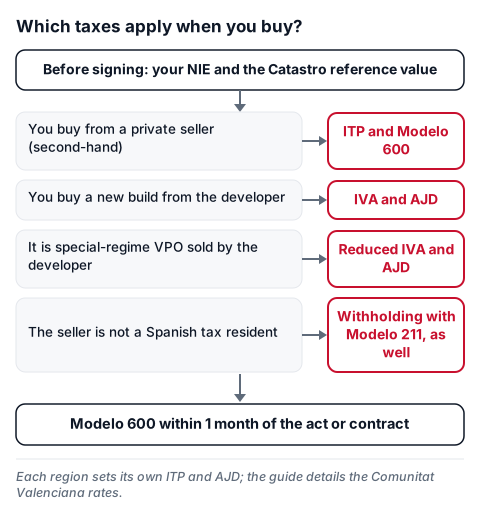
Steps:
- See in the diagram which taxes apply to you: ITP if you buy from a private individual, IVA and AJD if it is a new build, and withholding if the seller is not a tax resident.
- Have your NIE, or ask for a NIF with the letter M using the Modelo 030, before you operate.
- Check the reference value in the Catastro online office and compare it with the price: the base will not be lower than the reference value.
- Ask the notary or the gestoría which rate and which base they will apply and who will file the Modelo 600.
- If the seller is not a tax resident, withhold 3 % of the price and file the Modelo 211 within 1 month.
- File the Modelo 600 within 1 month: calculate in Sar@2, pay at a partner bank or with the Generalitat payment application, and file online or at the ATV.
- Keep the proofs of payment and filing: the Land Registry needs them.
Official source: Law 13/1997, arts. 4, 13, 14 and 14 ter, BOE, TRLITPAJD, BOE, LIVA, arts. 20, 84, 88, 90 and 91, BOE, TRLIRNR, art. 25, BOE, Orden EHA/3316/2010, BOE and ATV, Transmisiones Patrimoniales y Actos Jurídicos Documentados.
Informational only; check the official source and a professional for your specific case. Rules checked against official sources on 3 October 2026; the Cantabria rates on 5 October 2026.
