
In short: the Spain tax residency certificate (in Spanish, certificado de residencia fiscal) is the document with which the Spanish Tax Agency (AEAT) certifies that you are a tax resident in Spain. You request it yourself online, in the AEAT online office, with an electronic ID card (DNIe), an electronic certificate or Cl@ve PIN. The official sheet of procedure G305 gives 10 working days to decide and mentions no fee. It is issued if the data held by the AEAT show that you are resident; if it is not issued, you can submit documents and allegations.
In person or by representative? You do not have to go in person: the sheet allows filing online and at AEAT offices. The technical help adds that you can also request it at the Administración or Delegación of your tax address with the Modelo 01, booking an appointment first or by phone (you book an appointment and the AEAT calls you to make the request). If someone else applies in your name, they must prove their authority (art. 71 of RD 1065/2007). The online office has a Register of powers of attorney for tax procedures online; ask the AEAT whether it works for this procedure.
Who asks for it, and why. Whoever demands it, for example a broker, a bank or a payer abroad, or the tax authority of your home country, is the one who says what they need it for and in what form. The AEAT only certifies your tax residency in Spain; its effects are those stated in the certificate and those set by the rule that regulates its use (art. 75 of RD 1065/2007). The AEAT has two official models (Orden EHA/3316/2010, additional provision 2 and annexes IV and V): the general one, «Residencia fiscal en España», and the one «for the purposes of the treaty», «Residencia fiscal en España. Convenio», which says you are resident within the meaning of the treaty between Spain and the country named. If you are asked for one or the other, ask them in writing which text and which country they need. The public sheet does not list the fields of the request, which sits behind the login.
What the tax office checks
The official page only says the certificate is issued if the data held by the AEAT allow it to deduce that you are tax resident in Spain. It does not publish which data are enough. What the official sources do say:
- Tax residency is not a residence permit. The AEAT reminds that holding a residence permit in a country is not the same as being tax resident there. The criteria of art. 9 of the IRPF law count (more than 183 days, center of interests, family presumption), see tax residency and the 183 days.
- The census. The census of taxpayers records whether you are resident or non-resident and your tax address (art. 4 of RD 1065/2007). The sheet does not explain how that data is fed.
- Data that do not match. If what you declared does not match what the AEAT has verified, the certificate records what was verified (art. 72).
Time, cost and validity
- Time: whenever possible the certificate is issued immediately (AEAT technical help). If not, the maximum is 10 working days: the sheet and Orden EHA/3316/2010 (additional provision 2) say so, and that order is the specific rule for this certificate, instead of the 20 days of the general regulation (art. 73). If the AEAT does not issue it in time, it is not deemed issued as a positive one: silence does not replace the certificate.
- Cost: the sheet mentions no fee or payment, and we found none.
- Validity: the sheet does not state it. The general rule of the regulation (art. 75) is 12 months for periodic obligations and 3 months for non-periodic ones, unless the specific rule says otherwise and as long as the circumstances behind its content do not change. We could not confirm which one the AEAT applies to this certificate: ask whoever requests it how old a certificate they accept.
- Result: an electronic document with a secure verification code (CSV). The electronic version has the same effects as the paper one (art. 75), and whoever receives it can check on the AEAT website that it is genuine with the CSV (art. 73).
If it is not issued or has errors
- What it means. The official page makes the certificate depend on the data held by the AEAT. If the requirements are not met at that moment, the AEAT technical help says the online office lets you complete the request, generates a denial document and offers a way to continue without going to the office; Orden EHA/3316/2010 speaks of a «comunicación de que no procede acceder a la solicitud» (a notice that the request cannot be granted). The most likely reason is that the AEAT data do not allow it to deduce your tax residency in Spain, although the online office does not confirm it. It does not publish a list of reasons and we have not seen the exact message, which sits behind the login.
- Submit documents and allegations. The page offers the step «Presentar documentos y/o alegaciones» (link to the step; it also asks you to identify yourself). The query of issued and pending certificates explains that you can use it while the request is being processed, with the reference number of the receipt. The technical help says it serves to submit the documents that justify your tax residency in Spain and so reopen the file.
- What to submit. The AEAT does not publish a closed list. What matters is what shows your days in Spain and the center of your interests (art. 9 of the IRPF law). As examples of our own based on art. 9, not as an AEAT list, these can help: the padrón, your TIE card, a work or rental contract, your bank accounts and cards, your children's school enrolment and your tax return if you have already filed one. The AEAT does not say what it will accept.
- Certificate issued with wrong data. You can file a letter of disagreement addressed to the body that issued it, within 10 days from the day after you receive it, with the evidence that supports it. If the body finds it incorrect, it issues a new one within 10 days; if not, it tells you the reasons (art. 73).
- Appeal. There is no appeal against the certificate itself (art. 75); acts issued afterwards using that information can be appealed.
- Census data. If you think the problem is your tax address or your personal data, the Modelo 030 covers registration, change of address and changes to personal data. The certificate sheet does not mention it: confirm with the AEAT whether it applies to you.
Cases that often complicate it
- You have just arrived. There may not yet be data at the AEAT showing your residency; the online office offers the documents and allegations step, but does not publish which data are enough. What counts in your first year: tax residency and the 183 days.
- You are asked for an earlier year. The public sheet does not explain whether it can be requested for a past year. Ask the AEAT and whoever requests it which year they need.
- They want it in English or another language. The official models (annexes IV and V of Orden EHA/3316/2010) are bilingual: their sentences are in Spanish with the English below them, and the AEAT attaches an annex in Spanish and English explaining the CSV. We have not seen an issued certificate nor found versions in other languages; if you are asked for another language or a translation, ask whoever requests it. More in the 183-day card.
- Their tax authority has its own form (Portugal's 21RFI, France's 5000-ES and similar). According to the AEAT, the signature and stamp of an official on that paper form carry no more legal weight than the certificate of annexes IV and V, which you request online. The steps the AEAT gives for these forms are on its page «Tramitación de formularios de residencia fiscal».
- Your tax address is in Navarra or the Basque Country. The AEAT pages on this certificate do not mention the foral territories. If you live there, ask your foral tax authority and whoever requests it which certificate they accept. The Hacienda Foral de Navarra publishes its own electronic certificates, with the options «Residencia fiscal» and «Residencia fiscal (sin convenio)».
- You are also resident in another country. The AEAT certificate only speaks about Spain. How the conflict between two countries is settled is in the 183-day card, and to avoid paying twice see the international double taxation deduction. If an authority in Ukraine asks for it, the reference text is the Spain-USSR treaty of 1985, which according to the BOE note applies today to Ukraine; which document its administration accepts is for it to say.
Documents
- An electronic identification: electronic ID card (DNIe), electronic certificate or Cl@ve PIN (the ones the sheet lists). How to get one: Cl@ve and electronic certificate.
- The sheet lists the «Modelo 01» as required documentation. According to the AEAT technical help, it is the form for requesting it at the Administración or Delegación of your tax address; online you fill in the form of the online office, which sits behind the login and we could not see.
- If a representative acts: a document proving their authority (art. 71).
- For allegations: evidence of your residency (see «What to submit»).
The list may be incomplete: the sheet gives no more detail. Check it on the official sheet.
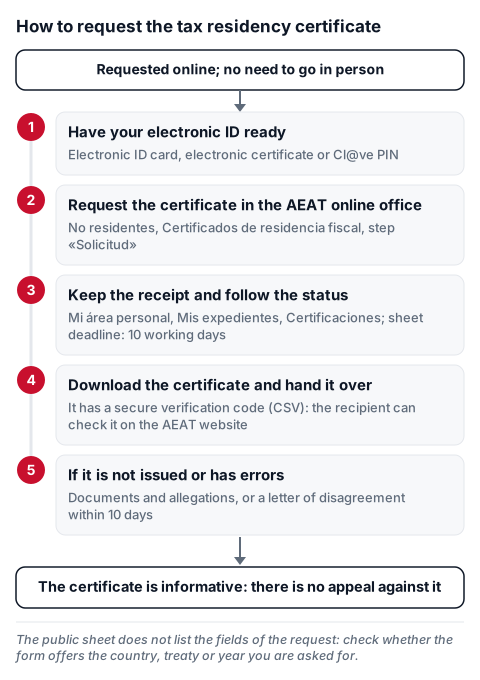
Steps:
- Have an electronic identification ready: electronic ID card (DNIe), electronic certificate or Cl@ve PIN. How to get one: Cl@ve and electronic certificate. The sheet names Cl@ve PIN; other screens of the online office mention Cl@ve Móvil, so check what each one accepts.
- Go to the AEAT online office, section No residentes, Certificados de residencia fiscal, and choose the step «Solicitud» (direct link to the request; it asks you to identify yourself, which is why we could not open it from outside). You can also get there from the procedure sheet G305.
- Fill in the request. If whoever asks for the certificate needs a specific country, treaty or year, check whether the form allows it; the public sheet does not list the fields.
- Keep the receipt: its reference number lets you follow the request and submit documents later. Whenever possible the certificate is issued immediately; if not, the maximum is 10 working days.
- Follow the status in Mi área personal, Mis expedientes, section Certificaciones (query of issued and pending certificates). The answer appears there.
- Download the certificate and hand it to whoever asked for it. It carries a secure verification code (CSV): the recipient can check on the AEAT website that it is genuine.
- If it is not issued or has errors: submit documents and allegations from the same step or, if you already hold a certificate with wrong data, a letter of disagreement within 10 days.
Official source: AEAT, procedure sheet G305 and RD 1065/2007, arts. 70 to 75, BOE.
Informational only; check the official source and a professional for your specific case.