
In short: healthcare in Spain without papers is requested with a declaration of responsibility (declaración responsable). If you live here without legal residence, you apply for the health card at the unit your autonomous region sets up, usually at your health centre. When you file, you get a provisional document that already lets you use public healthcare, and the decision is due within 3 months at most. The procedure has been in force since 13 March 2026 (Royal Decree 180/2026).
In person or by representative? RD 180/2026 says the procedure is started by the person themselves or by a third party they have expressly authorised (art. 3.1), so it is not a strictly personal task. In practice each region sets its own channel. According to its website, the Region of Murcia takes the application in person at primary care centres and publishes a representation form. The Comunitat Valenciana takes it at the counter of its health centres. The declaration is written in the first person, so if someone else goes for you, ask at your health centre first how the authorisation is proved.
Who can apply. Foreign nationals who are in Spain without legal residence (the decree says “without legal residence”; in everyday speech it is “without papers”). Care is paid from public funds if three conditions of Law 16/2003 (art. 3 ter) are met, which you declare yourself:
- you do not have to prove health coverage by another route (EU law, bilateral agreements);
- you cannot export coverage from your country of origin or provenance;
- no third party is obliged to pay for your care.
The rule itself is explained in our RD 180/2026 card.
What it covers. The law recognises the right to health protection and healthcare on the same terms as people with Spanish nationality (art. 3 ter.1): it is access to the National Health System, not only emergencies. You are assigned a personal health code (CIP-SNS), single for all health services in Spain. There are three limits. It gives no right to care outside Spain. To join the transplant waiting list you must prove 2 years of residence in Spain, with the padrón or another document from the list below. And co-payment (copago) on medicines: according to our pharmaceutical co-payment card, which covers Royal Decree-law 11/2026, foreigners not registered or authorised as residents (art. 3 ter of Law 16/2003) pay 40% of the price with a cap of €8.23 a month.
Deadlines and silence. When you file, you receive a provisional document that allows publicly funded care while the file is decided (art. 3.2). The decision must be notified within 3 months of your application entering the Administration's electronic register. If there is no answer and you or your representative filed it, it is deemed approved by positive silence. If the Administration started the procedure on its own initiative (when, because of the nature of the healthcare, the person cannot do it themselves), silence counts as a refusal (art. 3.5). With a favourable decision you receive the health card or a certifying document, with no expiry as long as you do not get coverage by another route (art. 3.6). If you are refused, you are not billed for earlier care provided you later show you met the requirements when you were treated; in other cases it is billed under your region's rules. If you stay temporarily in another region, that stay is treated like the temporary assignment of insured people: the right does not have to be processed again there, and care before the assignment is formalised is not billed (art. 3.4). If you move there for good, ask at your new health centre.
If the centre says no. The decree requires health and social services to inform and help you as far as possible, and to let you start the procedure at the centre itself from the first contact (art. 3.3). If they still do not allow it, ask your municipality's social services or a health-and-migration NGO for help, and you can file a free complaint with the Defensor del Pueblo (the ombudsman; open to foreigners too; Organic Law 3/1981, arts. 10.1 and 15.2). For appeals against a specific decision, consult a professional.
Pitfalls worth knowing:
- False data. If an essential piece of data in the declaration turns out to be inaccurate, false or omitted, the provisional document stops having effect and you may be asked to repay the cost of the care received, on top of other liabilities.
- Visa, EU or TIE. In the declaration you tick that you have no valid stay visa, are not registered as an EU citizen and have no valid TIE. If you are in any of those cases, this route is not yours: see the health card guide.
- Temporary stay. If you are in a situation of temporary stay under Organic Law 4/2000, the decree (second additional provision) also requires a prior favourable report from your region's social services. Ask your municipality's social services.
- Minimum time in Spain. The websites of the Comunitat Valenciana (people who have been in the Comunitat more than three months) and the Region of Murcia (minimum 90 days) mention a minimum time. The decree sets none for this application, only the 2 years for the transplant list, and its preamble speaks of a procedure without a minimum-seniority requirement. If your region asks for it, ask which rule it is based on.
Groups with their own rule (art. 4). Their care is recognised under their specific rules:
- minors under 18 and pregnant women (pregnancy, birth and postpartum);
- international-protection applicants (from the moment they apply), stateless-status applicants and temporary-protection applicants;
- victims of gender violence and their children, of human trafficking and of sexual violence;
- notifiable diseases and women requesting a voluntary termination of pregnancy.
More in the cards on foreign children, temporary protection and asylum and IVE. If you already have residence, see the health card guide.
Private health insurance. To request the card by this route the decree asks for no private insurance: the list is ID, residence and the declaration of responsibility. In that declaration you tick that you are not obliged to take out health insurance, so review the annex before signing. If you are obliged to have health insurance (for example, because your visa or permit requires it), you cannot tick that box and this route is not for you. Private insurance is only needed if another procedure demands it, such as some visas or permits, and it is optional as a complement: see the private health insurance card.
Documents (list from RD 180/2026, art. 2; your region may use its own form or ask for more: check yours):
- The declaration of responsibility from the decree's annex (model on the Ministry of Health website). It asks for your name, ID number, address and region of residence.
- If your country has a social-security agreement with Spain that includes health coverage: also a certificate from that country's health institution stating that the coverage cannot be exported.
- Identity: passport or official ID document issued by your country. If you have none, another document issued by your country's authorities with at least a photograph is valid. Minors without a passport: birth certificate, family book or guardianship papers (a public child-protection body or a legal guardian appointed by a judge).
- Habitual residence in Spain: a current padrón certificate or volante (how to register).
- If you cannot provide the volante, any of these 8 documents works. Education: an enrolment certificate at a public or concertado educational centre, or a school-attendance certificate for minors in your care at a public or concertado educational centre. Consular and police: a travel letter (carta de viaje) issued by the consulate, a consular registration document, or a registration card from the National Police or a Public Prosecutor's decision on age determination. Social and other: a certificate of social-services visits from a basic social service (local body, region or autonomous city) or from registered social workers of an NGO declared of public utility. Electricity, gas, water, phone or internet bills in your name showing an address. A certificate from a centre of the public migration network.
- If someone else files the application: express authorisation (art. 3.1).
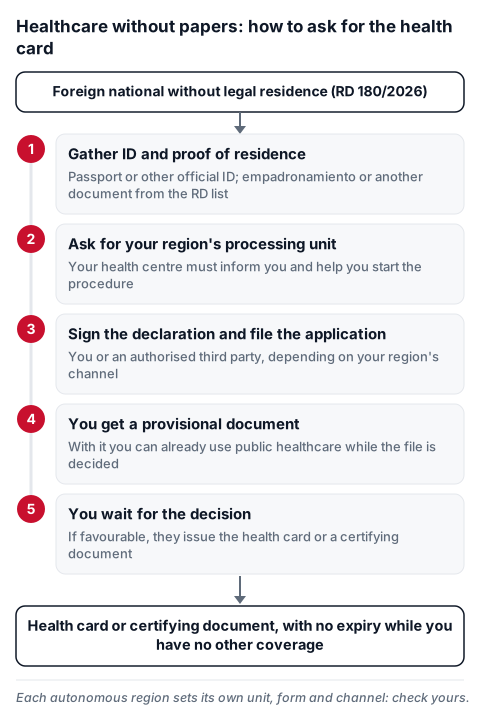
Steps:
- Gather your ID and proof that you live here. If you can, register at your town hall (empadronamiento); if not, use another document from the list.
- Ask for your region's unit. At your health centre they must inform you and help you, as far as possible, to start the procedure there (art. 3.3). Official example pages: Comunitat Valenciana, Region of Murcia and Andalucía. For the others, see the directory of regional health services. In Ceuta and Melilla it is handled by INGESA (the National Institute of Health Management).
- Fill in and sign the declaration of responsibility and file the application with your documents.
- Keep the provisional document they hand you: with it you can receive public care while the file is decided.
- Wait for the decision (3 months at most). If it is favourable, they issue the health card or a certifying document.
- If you stay temporarily in another region, you do not have to start again: it is treated like a temporary assignment (art. 3.4).
Official sources: RD 180/2026 (BOE), Law 16/2003, art. 3 ter, Ministry of Health: universal access to the SNS.
Informational only; check the official source and a professional for your specific case.