
In short: yes, you can be an autónomo without a gestor in Spain: no law requires one, and you can file the forms yourself or act through a representative (General Tax Law, art. 46). What does not change is that the obligations are yours: registration with the tax agency (modelo 036) and with RETA, invoices and record books, modelos 303 and 130 every quarter, modelo 390 in January and the Renta. This card gathers what you file, when and with which free tools; how much IRPF, VAT and contribution you pay is in the card on taxes for foreign autónomos.
In person or by representative? Everything is done online on the AEAT website with Cl@ve, an electronic certificate or an electronic DNI. Modelos 303, 390, 349 and 347 can only be filed online; modelo 130 also allows a printed PDF that you take to the AEAT office or the bank, and modelo 036 a paper form at the office. If you prefer, a representative with your authorisation can file them for you.
Who it is for. Autónomos who are tax residents in Spain, foreigners included, under the general VAT regime and simplified direct estimation for IRPF. Your residence permit has to allow self-employment (residence and work as self-employed). If you are under módulos or the equivalence surcharge, in the Basque Country or Navarre, or you have staff or rented premises (modelos 111 and 115), other forms apply that this card does not cover.
Deadlines
| What | When | Where |
|---|---|---|
| Modelo 036 (tax census registration) | Before you start the activity. The tax agency treats the first sale, collection or payment as the start (RD 1065/2007, art. 9.4) | AEAT, modelo 036 |
| RETA registration | Before you start, at most 60 days before (RD 84/1996, art. 32.3) | Social Security (Import@ss) |
| Invoices | With each transaction; to businesses and professionals, before the 16th of the following month (Invoicing regulation, art. 11) | Your software or the free AEAT application |
| Record books for income, expenses and investment goods | All year round | Spreadsheet or software |
| Modelo 303 (VAT) and modelo 130 (IRPF) | 1 to 20 April, July and October; the 4th quarter, 1 to 30 January | Modelo 303, modelo 130 deadlines |
| Modelo 349 (EU transactions) | Only if you have intra-Community transactions: sales of goods and services to businesses in another EU country, and purchases of goods and services from EU businesses where you pay the VAT yourself (VAT Regulation, art. 79). Quarterly: by 20 April, July and October and 30 January | Modelo 349 |
| Modelo 390 (annual VAT summary) | 1 to 30 January | AEAT website |
| Modelo 347 (transactions with third parties) | In February, only if you went over €3,005.06 with one person or business in the year (RD 1065/2007, art. 33) | Modelo 347 |
| Renta (modelo 100) | April to June | Renta WEB (how to file the Renta) |
If the last day is not a working day, the deadline moves to the next working day. In 2026 modelo 347 was filed by 2 March, because 28 February was a Saturday, and the Renta for 2025 from 8 April to 30 June (AEAT, taxpayer calendar 2026). The exact 2027 dates appear in the AEAT 2027 calendar. Modelo 349 becomes monthly if your sales of goods and services to the EU go over €50,000 in the quarter or in any of the four previous quarters (VAT Regulation, art. 81).
What people forget most.
- A zero modelo 130 is still filed. If nothing comes out to pay in a quarter, you file a nil return (AEAT, modelo 130 deadlines). You do not file it if you are a professional and in the previous year at least 70% of your income had withholding (details in the tax card).
- 20% reduction when you start. In the Renta, someone starting an activity under direct estimation reduces by 20% the positive net income of the first year in which it is positive and of the following year. The reduction is calculated on at most €100,000 of net income a year (IRPF law, art. 32.3). It only counts as a start if you had no economic activity in the year before the start date. It does not apply in a year when more than half of your income comes from a company or person that paid you a salary in the year before you started. You do not choose the year or carry it to another one (DGT, ruling V2660-24).
- Simplified invoices. A receipt or simplified invoice is allowed up to €400 including VAT, or up to €3,000 in certain sectors such as retail or hospitality (Invoicing regulation, art. 4). It is not allowed for services to businesses in other EU countries where the client declares the VAT, or for transactions outside the EU: there you issue a full invoice, with the client's name and address.
- ROI to work with the EU. You need it if you provide services to businesses in another EU country or buy services from them on which you declare the VAT. You must be in the Register of Intra-Community Operators (RD 1065/2007, art. 3.3). You request it in modelo 036, box 582, with the expected date of the first transaction in box 584. If the AEAT does not reply within 3 months, the request may be treated as refused (AEAT, identification for EU transactions).
- Working from home. You can subtract 30% of the utilities of your main home in proportion to the square metres you use for work (IRPF law, art. 30.2.5). The calculation with an example is in the tax card.
Cost
Doing it yourself costs nothing at the AEAT. There are free and paid programs for invoices and books; this card does not recommend any.
- AEAT invoicing application. Free, with no invoice limit; you log in with Cl@ve Móvil, a certificate or an electronic DNI. Every invoice has a recipient, so it does not do receipts or simplified invoices; it allows one recipient per invoice and does not export the records to other software (AEAT, free VERI*FACTU application).
- VERI*FACTU. Under the BOE, autónomos who invoice with software must use a compliant program before 1 July 2027 (Royal Decree 1007/2023, fourth final provision). On 05.10.2026 the Ministry of Finance announced a postponement to October 2028 (Ministry note), but until it is published in the BOE, the date in force is still July 2027. Handwritten invoices are outside VERI*FACTU. Which program to choose: free Verifactu invoicing software.
- E-invoicing between businesses. That is a different tool and a different rule: the free AEAT e-invoice (Order HAC/1028/2026).
If you are late or make a mistake. The cost depends on whether the tax agency asked first. A formal request (requerimiento) is any action of the tax agency, notified to you, to review or collect that debt (General Tax Law, art. 27).
- You file late on your own and there is tax to pay: surcharge of 1% plus another 1% for each full month of delay, with no penalty. After 12 months, the surcharge is 15% plus late-payment interest. The surcharge drops by 25% if you pay the tax when filing and the surcharge within the period you are notified (art. 27).
- You file late and there is nothing to pay (303, 130, 390): fixed fine of €200, reduced to €100 if you file without a formal request. For modelo 036 it is €400 and €200. For modelo 347 it is €20 for each person or business you had to include, with a minimum of €300, also halved without a formal request (art. 198).
- You file on time with incomplete or wrong data, with no tax lost (303, 130, 390): fine of €150; modelos 036 and 347 have different fines (art. 199).
- The tax agency finds an unpaid amount before you do: on top of the tax, a penalty from 50% of the unpaid amount (art. 191).
- Fix it yourself before a formal request. If you correct on your own a return filed with mistakes, there is no penalty for the original mistake (art. 179.3). But the new return is late. If there is tax to pay, you pay the surcharge; if there is nothing to pay, the reduced fixed fine of €100 instead of the €150 (art. 198.2). There is no penalty either if the mistake comes from a technical fault in the AEAT help programs (art. 179.2.e).
Where
- Calendar. AEAT taxpayer calendar, with every date of the year.
- Help with modelo 303. The AEAT offers the Pre303 help service from the modelo 303 page.
- Do your services to another country carry VAT? The AEAT locator for services shows where a service is taxed, who declares the VAT and whether the invoice carries VAT. For digital products, see also VAT on ebooks, guides and online courses.
- A specific question, in writing. The binding ruling request to the Directorate-General for Taxation is filed before the deadline of the return it affects (art. 88.2). The tax agency has 6 months to reply and silence does not mean it accepts your view (art. 88.6). The answer binds the administration in your case, and the request does not stop deadlines (art. 89.1 and 89.3). If you follow the answer given to someone else in a substantially equal situation, and that view has not changed, there is no penalty either (art. 179.2.d); the tax is still owed.
When a professional is worth it. If you were paid before registering, sell to clients in several countries, have staff or premises, change regime or receive a formal request from the tax agency, ask a tax adviser. To choose your IAE heading, see the card on IAE headings for content creators and consultants.
Steps
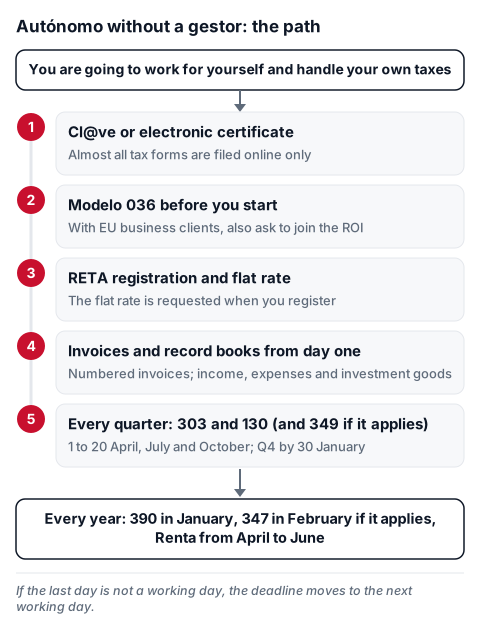
- Get Cl@ve or an electronic certificate (Cl@ve and certificate).
- File modelo 036 before you start. If you will work with EU businesses, tick box 582 (ROI) and enter the date of the first transaction in box 584.
- Register with RETA before you start and request the flat rate at that moment. How registration works: registering as an autónomo for foreigners.
- Issue numbered invoices and enter income, expenses and investment goods in the record books.
- Every quarter file modelos 303 and 130, and 349 if it applies, from the 1st to the 20th of the month after the quarter; the 4th quarter by 30 January.
- In January file modelo 390; in February, modelo 347 if it applies; from April to June, the Renta.
Official source: AEAT, taxpayer calendar 2026, General Tax Law, Invoicing regulation and Royal Decree 1065/2007.
Informational only; check the official source and a professional for your specific case.