
In short: a binding tax ruling in Spain is called a consulta vinculante: a written question to the Directorate-General for Taxation (DGT), part of the Ministry of Finance, about how your specific case is taxed. If you file it before the tax deadline, the answer obliges the bodies that apply taxes, such as the AEAT, to treat you under that criterion. The DGT has 6 months to answer, and in the meantime your deadlines keep running.
In person or by representative? You do not need to go in person. It is filed through the Tributos electronic office (with electronic DNI, electronic certificate or Clave PIN, according to the office) or at any public registry under art. 16 of Law 39/2015. A representative can file it, with the document that proves the representation (Tax management and inspection regulation, RD 1065/2007, art. 66.1). Anyone obliged to deal with the tax authority electronically can only file it that way (art. 66.5).
What it is for. As an autónomo, landlord or employee, it is sometimes unclear which VAT rate applies, which activity code (epígrafe) to register under or whether you are entitled to a reduction. You can ask a gestor or the Administration itself. The law allows any taxpayer to ask which tax regime, classification or characterisation applies to them (General Tax Law, art. 88.1). Many people search for it as "consulta vinculante AEAT" or "consulta vinculante Hacienda". But the answer comes from the DGT, the competent body for State taxes, such as IRPF and VAT (RD 1065/2007, art. 65). For taxes that are not State taxes, the answer comes from the body in charge of interpreting them (General Tax Law, art. 88.5). Overview of autónomo taxes: foreign autónomo, IRPF and VAT.
Before asking, search. The DGT publishes its answers in a public search tool, with tabs for general and binding rulings; you can search by ruling number or by text. Examples of specific cases already answered:
- V0332-26, of 18.02.2026: instructions in PDF sold from a website carry the 4% VAT rate insofar as they are a book; otherwise 21%. Details in the card on VAT on ebooks, PDF guides, courses and consultations.
- V2660-24, of 27.12.2024: the 20% reduction of net income for people starting an activity (art. 32.3 of the IRPF law) applies in the first year with positive net income and the year after. It cannot be postponed.
- V0068-25, of 03.02.2025: psychotherapy sessions by video call are not an electronically supplied service for VAT purposes, because the internet is only the channel.
If you find an answer with facts identical to yours, the Administration must apply the same criterion to you (General Tax Law, art. 89.1). If the facts are substantially the same and the criterion has not changed, following it at least keeps you free of a penalty (art. 179.2.d).
Requirements
- Who. Any taxpayer, person or company (art. 88.1). Professional associations, official chambers, employers' organisations, trade unions and consumer associations can also ask. The same goes for associations or foundations of people with disabilities, business associations and professional organisations. In all these cases, the question has to affect their members in general (art. 88.3).
- When. Before the deadline for filing the return or self-assessment, or for meeting the obligation in question, ends (art. 88.2). If you file it later, it is not admitted (RD 1065/2007, art. 66.7).
- About what. A question of tax regime, classification or characterisation. If you already have an open procedure, appeal or claim on that issue, the answer does not bind the Administration (art. 89.2).
Documents
The letter to the DGT contains at least (RD 1065/2007, art. 66.1):
- Full name or company name and NIF; if a representative acts, their details too and the document that proves the representation. The DGT offers an optional representation form on its written tax rulings page.
- An express statement of whether you have an ongoing procedure, appeal or economic-administrative claim on the same issue.
- The subject of the request: the specific question.
- The background and circumstances of the case, set out clearly and in as much detail as needed.
- Place, date and signature, or proof of your will by any legally valid means.
- If the request is about a cross-border transaction or the existence of a permanent establishment, say so expressly. Add the details of art. 66.2: the group you belong to, if any, and a description of the activity or transactions. Also state the States and the residents of other States that may be affected, and any other details required by the mutual assistance rules.
You can add an address for notifications and documents that help explain the case (art. 66.3).
Deadlines
- To file: before the deadline of the tax form or obligation concerned (art. 88.2).
- To fix defects: if something is missing, the DGT asks you and you have 10 days. If you do not reply, the request is treated as withdrawn and closed (RD 1065/2007, art. 66.6; General Tax Law, art. 88.4).
- To answer: 6 months from filing. If the DGT does not answer in that time, that does not mean it accepts your view (art. 88.6).
- Your obligations do not wait: the request does not interrupt the deadlines to file and pay (art. 89.3). File your forms on time even if you are still waiting.
What the answer gives you and what it does not
- It binds the Administration towards you. The bodies that apply taxes apply the criterion of the answer to you if you filed in time. That criterion holds as long as the law, the case law and the facts you described do not change (General Tax Law, art. 89.1).
- It also helps others. The Administration must apply that criterion to any taxpayer with identical facts and circumstances (art. 89.1).
- Someone else's ruling protects you from a penalty. If you follow the criterion of an answer given to another taxpayer, there is no penalty. This applies when your circumstances are substantially the same and the criterion has not changed (General Tax Law, art. 179.2.d). No penalty does not mean nothing to pay: that article only removes the penalty, and the tax and the late-payment interest (General Tax Law, art. 26) can still be claimed from you.
- It cannot be appealed. The answer is informative and cannot be appealed. You can appeal the acts the tax authority issues later applying that criterion, for example an assessment (art. 89.4).
- If the DGT changes its criterion, it has to give reasons for the change (RD 1065/2007, art. 68.1).
When it is worth it. When the question changes how much you pay and there is no published answer with facts like yours. For example, the VAT rate of a digital product, the IAE activity code for a new activity or how income from a platform is taxed. Describe your real case in detail: the answer only covers the facts you write down. If you handle your taxes without a gestor, see also what an autónomo without a gestoría files and when.
Where
- DGT procedure page "Consultas tributarias escritas": Tributos office. It lists the channels (registries under art. 16 of Law 39/2015 and online filing), identification (electronic DNI, electronic certificate, Clave PIN) and the 6-month period.
- Online filing and representation form: DGT written tax rulings.
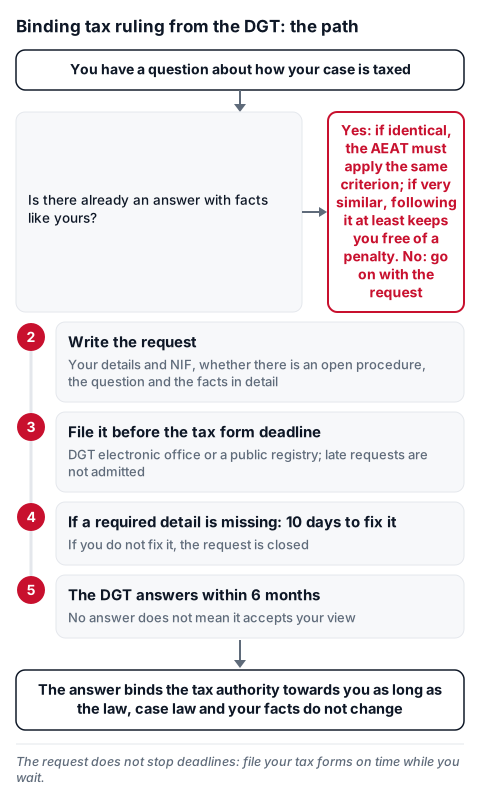
Steps
- Search the DGT search tool for an answer with facts like yours.
- Write the request with the details of art. 66.1: your details and NIF, whether there is an open procedure, the specific question and the facts in detail.
- File it before the deadline of the tax form concerned, through DGT online filing or at a public registry.
- If the DGT asks you to fix a defect in the request, do it within 10 days; if it asks for more documents, reply within the period it sets.
- While you wait, file your tax forms on time. When the answer arrives, keep it with your records.
Official source: DGT, written tax rulings, BOE, General Tax Law, arts. 26, 88, 89 and 179 and RD 1065/2007, arts. 65 to 68.
Informational only; check the official source and a professional for your specific case.