
In short: To register a foreign marriage in Spain means entering in the Spanish Registro Civil (civil register) a marriage celebrated under another country's law when one spouse is Spanish, for example after obtaining nationality under the Democratic Memory Law. You apply at the Spanish consulate of the district where you married or at any General Office of the Registro Civil in Spain (art. 10.1 of Law 20/2011). Before registering, under the 2006 DGRN Instruction, the officer hears each spouse separately. At the end you get the literal marriage certificate; the libro de familia (family book) is no longer issued.
In person or by representative? Mixed. The DGRN Instruction of 31 January 2006 requires a personal, private and separate hearing of each spouse, so that part is in person. The channel depends on the consulate: Havana requires both spouses at the appointment (only one, if the other is outside Cuba and proves it); Miami first asks for the data sheet by email and then contacts you by email or phone to set an appointment. If you want a representative to file the documents, ask your consulate before booking.
Requirements
- One spouse is Spanish: the Registro Civil records events affecting Spaniards, and events that took place outside Spain are registered when Spanish law requires that registration (art. 9 of Law 20/2011).
- Either spouse can apply, whatever their nationality (consulates in Havana and Miami).
- A marriage celebrated before a foreign authority enters the register through the registration of the local certificate, provided it is effective under Law 20/2011 (art. 59.2). A certificate from a foreign register is valid if it was issued by the competent foreign authority, if that register offers guarantees similar to those Spanish law requires, if the marriage is valid under the legal system designated by Spanish private international law rules and if registering it is not manifestly incompatible with Spanish public policy (art. 98).
- The officer registers it if there are no doubts about the reality of the marriage and its legality under Spanish law (art. 256 of the 1958 Registro Civil Regulation, which the Havana consulate lists among its basic rules). Otherwise, registration requires a file procedure (art. 257).
Documents
Common list in Havana and Miami (each consulate adds requirements and can ask for more):
- Data declaration sheet for the marriage registration (hoja declaratoria de datos), signed by the declarant.
- Marriage certificate issued by the local civil register.
- Literal birth certificate of the Spanish spouse, issued by the Spanish Registro Civil in the last 6 months (not needed if the birth is registered at that consulate).
- Birth certificate of the foreign spouse, from their country.
- Identity document or passport of both spouses.
- If there was a previous marriage: the certificate of that marriage with the divorce note, or the divorce judgment or certificate; if either spouse was widowed, the certificate of widowhood (Havana) or the death certificate of the previous spouse (Miami).
- Birth certificates of children in common, if any.
Requirements specific to each consulate (examples):
- Havana: certificate of marital status at the time of marriage (or a note under Observaciones on the marriage certificate); a certificate from Cuban Immigration listing trips outside Cuba if either spouse has left the island; all Cuban certificates legalised by MINJUS.
- Miami: a sworn statement from each spouse and a document proving the current address. According to Miami, US marriage certificates need neither an apostille nor a translation.
Foreign documents are filed legalised or apostilled (art. 95.2 of Law 20/2011) and translated into Spanish if in another language. When an apostille is enough: apostille, when you need it; for Cuban documents: apostille and legalisation of Cuban documents.
Steps
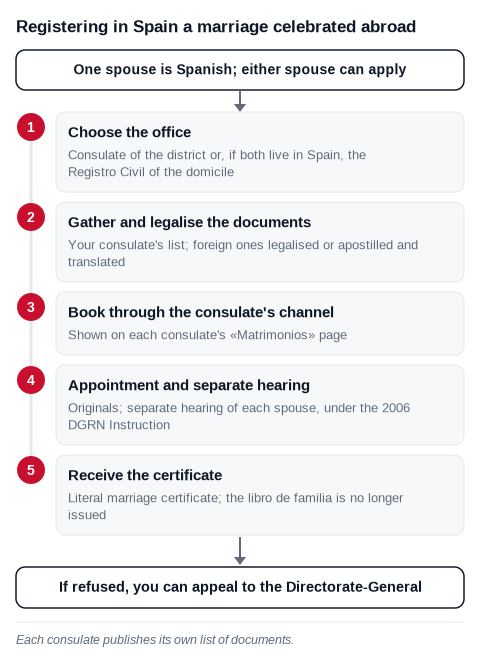
- Choose the office: the Spanish consulate of the district where you married or, if you both live in Spain, the Registro Civil of your domicile. Find your consulate in the directory of embassies and consulates.
- Gather the documents on your consulate's list and legalise or apostille the foreign ones. Check the dates: the Spanish birth certificate must be from the last 6 months.
- Book the appointment through the channel on your consulate's «Matrimonios» page. In Havana you first register by email and then book online; in Miami you send the data sheet by email and the consulate contacts you with an appointment.
- Attend the appointment with the originals and the separate hearing. In Havana, if the file is not accepted that day, a new application is needed.
- Receive the certificate of the entry. For later copies, on the Ministry of Justice portal marriages celebrated abroad are requested through the general procedure «Solicitud de certificado de Matrimonio», which has a longer form; the quick request does not cover them. The form may ask for the registry details (from the Registro Civil Central or the consulate) shown on your certificate.
- Use the certificate in your procedures: for example, residence as a family member of a Spanish citizen.
Deadlines
- Spanish literal birth certificate: issued in the last 6 months (Havana and Miami).
- If registration is refused: 1 month to appeal to the Directorate-General (art. 85 of Law 20/2011). The Directorate-General decides within 6 months; without an answer, the appeal is deemed rejected (art. 86).
- How long your file takes, ask your consulate. Havana has a file information page that covers marriage transcription.
Cost
- Havana and Miami: «La inscripción del matrimonio es gratuita» (registration is free). Legalisations, apostilles and translations have their own cost in each country; check where you request them.
Where
- Spanish consulate of your district: the consulate's «Matrimonios» page on its exteriores.gob.es website (directory).
- In Spain: any General Office of the Registro Civil (art. 10.1 of Law 20/2011). The Central Office registers foreign documents and certificates, except those that fall to the Consular Offices (art. 21).
- Later certificates: Ministry of Justice portal, marriage certificate.
What you get and what it is for
- After registration, the officer makes the certificate of the marriage entry available to each spouse (art. 59.4). The entry is proof of the marriage, its date and its place (art. 59.5).
- Libro de familia: since Law 20/2011 came into force (30 April 2021; for consular offices, 1 October 2020), no libros de familia are issued (third transitional provision). The Havana consulate says it «no expide Libros de Familia» and issues literal birth and marriage certificates. If a body asks you for the book, ask which certificate it accepts.
- Visa or residence as a relative of a Spaniard: for the family visa for relatives of Spaniards, Havana asks for the Cuban marriage certificate legalised by MINJUS and by the Consulate, unless the marriage is already registered in the Spanish Registro Civil. Which proof of the link your consulate or your Oficina de Extranjería accepts, ask there. The residence itself: residence as a family member of a Spanish citizen.
If you have not married yet: certificate of marriage capacity
If you plan to marry abroad under local law and that law asks for a certificado de capacidad matrimonial (certificate of capacity to marry), it is issued by the court registrar (letrado de la Administración de Justicia), a notary, the Registro Civil officer or the consular officer of the domicile of either of you, after a file or deed proving capacity (art. 58.11 of Law 20/2011). Under art. 252 of the 1958 Regulation, it is valid for 6 months from its date. The Buenos Aires consulate, for example, issues it to Spaniards registered as residents at that office, with a prior file, an appointment and personal appearance. If you prefer to marry in Spain: marrying a foreigner in Spain, the marriage file.
Official source: Law 20/2011 on the Registro Civil, consolidated text, DGRN Instruction of 31 January 2006 and the «Matrimonios» pages of the Havana and Miami consulates.
Informational only; check the official source and a professional for your specific case.