In short: the EX-15 form («Solicitud de Número de Identidad de Extranjero (NIE) y Certificados») is the official application for the NIE or for a resident or non-resident certificate. There is no official EX-15 form in English: the PDF on inclusion.gob.es is free and Spanish only. Fill in 4 sections in capitals, black ink or typed, and submit an original and a copy.
In person or by representative? It depends on where you file. In Spain, art. 205.4 of RD 1155/2024 says the NIE is requested «personalmente» (in person) from the Police, directly or through an Oficina de Extranjería or Comisaría; the EX-15 has a section for the representative who files the application, so confirm with the office first whether they accept one. From abroad you file at the Spanish consulate of your place of residence, which according to the Bogotá, Lima and Kyiv pages accepts a representative with a sufficient power of attorney; the physical presence of the applicant or the representative is required. Filling it in on a computer is not filing it: you print it, sign it and hand it in with its copy.
What the NIE is, the two routes and the time limit: how to apply for the NIE. This page covers the form only.
1) DATOS DE LA PERSONA EXTRANJERA
- PASAPORTE, N.I.E.: passport number; the N.I.E. has three boxes (letter, seven digits, letter) and you fill it in only if you already have one, for example to ask for a certificate. If you are applying for your first NIE, leave it empty.
- 1er Apellido, 2º Apellido, Nombre: surnames and given name, as in your passport. The second surname only if your passport shows one.
- Sexo(1): H man, M woman, X undefined (only if it is recognised for you in your country of origin).
- Fecha de nacimiento(2): dd/mm/aaaa. Lugar and País are in the same row: city and country of birth. Nacionalidad: the one in your passport; you can write it in Spanish, e.g. UCRANIA or REINO UNIDO.
- Estado civil(3): S single, C married, V widowed, D divorced, Sp separated.
- Nombre del padre, Nombre de la madre: your father's and mother's names.
- Domicilio de residencia, Nº, Piso, Localidad, C.P., Provincia, Teléfono móvil, E-mail: where you live now and your contact details. If you live outside Spain and apply at the consulate, give your address in your country of residence.
- Representante legal, en su caso, DNI/NIE/PAS, Título(4): only if you have one. "Título" takes the basis of the representation, such as parent of the minor or guardian.
2) DATOS DEL REPRESENTANTE A EFECTOS DE PRESENTACIÓN DE LA SOLICITUD(5)
This is the section for the person who files the application in place of the applicant. Per note (5), fill it in only if that person is not the applicant: if you file yourself, leave it blank. If you fill it in, the fields are Nombre/Razón Social, DNI/NIE/PAS, Domicilio de residencia, Nº, Piso, Localidad, C.P., Provincia, Teléfono móvil, E-mail and Representante legal (DNI/NIE/PAS, Título(4)). A consulate accepts a representative with a sufficient power of attorney; in Spain, confirm with the office first.
3) DOMICILIO A EFECTOS DE NOTIFICACIONES
- Nombre/Razón Social, DNI/NIE/PAS, domicilio, Teléfono móvil, E-mail: who receives notices and where. If empty, the applicant is notified (note 6). The phone and e-mail allow a purely informational alert when a notice is pending.
- CONSIENTO (Dehú): you accept notices in the Dirección electrónica habilitada Única; needs a valid electronic certificate or Cl@ve. Outside the obligated groups (legal persons and others), you get notices this way only if you tick the box. If you do not have a certificate or Cl@ve yet, leave it unticked.
4) DATOS RELATIVOS A LA SOLICITUD(7): tick the option that applies in each section.
- 4.1 TIPO DE DOCUMENTO (art. 206): one option only, NÚMERO DE IDENTIDAD DE EXTRANJERO (NIE) or CERTIFICADO, and then De residente (resident) or De no residente (non-resident).
- 4.2 MOTIVOS: four boxes, Por intereses económicos, Por intereses profesionales, Por intereses sociales (economic, professional, social interests) and Por otros motivos (other reasons), with a line to specify. For the NIE you must state the reasons (art. 205.3); buying a home in Spain is an economic interest. Detail for that case: NIE to buy property in Spain.
- 4.3 LUGAR DE PRESENTACIÓN: Oficina de Extranjería, Comisaría de Policía (police station) or Oficina Consular (consulate), depending on where you will hand it in.
- 4.4 SITUACIÓN EN ESPAÑA(8): ESTANCIA (stay) or RESIDENCIA (residence). The form carries no instructions for this section (note (8) is not among the printed notes): ask at the office where you file what to tick.
Bottom: place, date and FIRMA DEL SOLICITANTE (yours or, where applicable, your legal representative's). DIRIGIDA A, Código DIR3 and PROVINCIA: addressee and its code; the instructions do not explain them, so ask at the office or consulate. «Espacios para sellos de registro», top right: leave it empty.
Cost
The form is free. What you pay is the fee modelo 790, code 012, separately: under Orden PJC/617/2025, 9.84 € for assigning the NIE (item 5.12) and 7.31 € for each certificate issued at the person's request (item 5.13). Check the amount in the fee form before paying: fee 790 012, how to pay it. At a consulate, each office says how to pay.
Steps
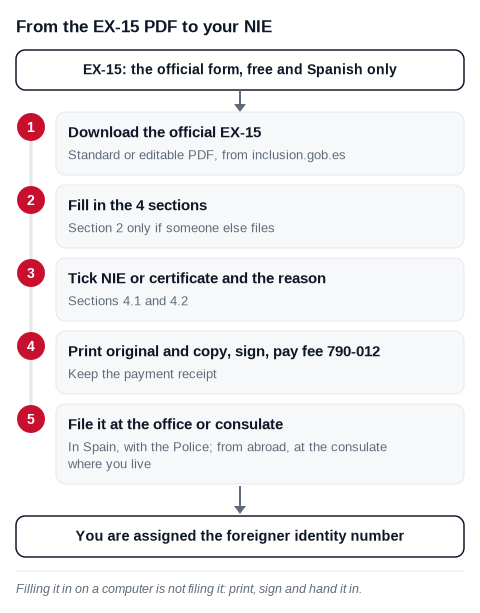
- Download the official EX-15 (or the editable version), or prepare it with the online EX-15 filler, free and without sending your data anywhere. The form bans selling it: do not pay for it. The other EX forms are in Spain EX immigration forms.
- Fill in sections 1 to 4 in capitals, in black ink and block letters or typed; dates as dd/mm/aaaa. Leave section 2 blank if you file yourself.
- Before signing, check the typical mistakes: do not tick Dehú without an electronic certificate or Cl@ve, tick only one option in 4.1 and make sure the reason in 4.2 is described.
- Print the original and a copy, and sign.
- Pay the fee 790 code 012 and keep the receipt. What else each office or consulate asks for varies; the list and the two routes are in how to apply for the NIE.
- File it: in Spain, usually with a prior appointment at the Oficina de Extranjería or the police station; if you live abroad, at the Spanish consulate of your place of residence, with your passport.
- Receive the NIE: the rule sets a maximum of five days and consulates say about two weeks.
Official source: EX-15 form (PDF, inclusion.gob.es) · general immigration forms · art. 205, RD 1155/2024. Informational only; check the official source and a professional for your specific case.