
In short: to withdraw your asylum claim in the Spanish regularisation (AP 20), you do it after the favourable decision, not before applying. You file the withdrawal through a registry office, addressed to the Asylum and Refugee Office (OAR), and keep the proof of filing. You bring that proof when you apply for the TIE, during the month immediately after the grant (AP 20, paragraph 7). Regularisation applications could be filed until 30 June 2026 (AP 20, paragraph 6): this guide is for people who already applied.
In person or by representative? The OAR explains that the withdrawal of the claim is filed in writing, «a título propio o a través de representante» (in your own name or through a representative) (processing of the claim). If a representative files it, their accreditation must be attached (OAR frequently asked questions). The TIE is requested in person (art. 209.1 of the regulation): see appointment for fingerprints and TIE.
What the rule requires. AP 20 (Additional Provision 20) of RD 1155/2024 was added by RD 316/2026. It allowed an arraigo residence permit for people who had filed or formalised an international protection claim in Spain before 1 January 2026 (paragraph 1). Paragraph 4 adds that, if the procedure is resolved favourably, the person «deberá desistir» (must withdraw) the international protection claim or the appeal they filed that is still pending. Paragraph 7 asks you to prove that withdrawal with its receipt when you apply for the TIE. The general guide to claiming asylum is in how to apply for international protection.
You did not withdraw before applying for the regularisation. The Ministry of Inclusion, in its 100 technical questions, answers «No» to two questions: withdrawing a pending claim (question 57) and withdrawing an appeal against the refusal (question 58). The withdrawal is made when the final decision arrives. Forms: applicants, former applicants, refused applicants and those who already withdrew filed the EX-31 (questions 22, 23, 55 and 56). If you arrived in Spain before 1 January 2026 but claimed protection afterwards, you filed the EX-32. You also withdraw if the decision is favourable, when you apply for the TIE (questions 24 and 60). More on forms in EX forms.
Deadlines
The 1-month period set by AP 20 is the one for applying for the TIE, and the receipt of the withdrawal is handed in at that step. Paragraph 7 says that during «el mes inmediatamente posterior a la concesión de la autorización» (the month immediately after the grant) you apply for the card, handing in the receipt of the withdrawal request. The Ministry, in question 47, writes «en el plazo de un mes desde la fecha de resolución» (within one month from the date of the decision). The permit «otorgará plenos derechos desde su concesión» (gives full rights from its grant), also before you have the card (paragraph 7). Details of the appointment and the TIE in appointment for fingerprints and TIE.
Documents
For the withdrawal:
- The OAR withdrawal or renunciation form (PI) (Word), in capital letters and preferably in electronic format.
- Mandatory fields (marked *): NIE, international protection file number, surnames, first name and signature. Optional: nationality, phone and email.
- If a representative acts: their details in the legal representation section and their accreditation.
- One form for each adult file.
To apply for the TIE: the receipt (justificante) of the withdrawal and the rest of the list in the card on appointment for fingerprints and TIE.
Where
- Form and instructions: OAR, withdrawal or renunciation. The OAR says the form is used «únicamente si no ha presentado un recurso administrativo» (only if you have not filed an administrative appeal) against the decision on the claim.
- Addressee: Subdirección General de Instrucción de Protección Internacional y Apatridia, code EA0054388.
- How to file (OAR FAQ): «a través del registro electrónico o cualquier oficina de registro administrativo» (through the electronic registry or any administrative registry office). The OAR guide «Información sobre la presentación de escritos y documentación» (information on filing documents) sets out the options. On paper, at a registry assistance office: they return the original and a receipt with date and time, they have opening hours and sometimes an appointment is needed (office finder). At Correos: open envelope so it is stamped, addressed to the Registro General del Ministerio del Interior, calle Amador de los Ríos 7, 28010 Madrid. If you are abroad, at consulates. Electronically: in the Electronic Registry, for people with a digital certificate. The user manual of the General Electronic Registry (REG, version 1.3) also allows access with Cl@ve PIN, Cl@ve permanente or foreign eIDAS identifiers. The «Firmar» button signs without a personal electronic certificate, and the receipt is downloaded from «Detalle del registro». Law 39/2015 (art. 14.1) lets individuals choose between electronic and non-electronic means.
- Electronic registry fields (OAR): name and surnames as in the claim; NIE without hyphens (initial letter, digits and final letter); subject «DESISTIMIENTO» and the file number, for example «DESISTIMIENTO 202811080010».
- OAR phone line on the international protection procedure: 910 006 910, in Spanish, Arabic, English and French. From 16 September to 15 June: Monday to Thursday 8:00 to 15:00 and Friday 8:00 to 14:00. From 16 June to 15 September: Monday to Friday 8:00 to 14:00.
- File status: a written request with the subject «estado del expediente» and your file number, addressed to unit EA0019195 (Subdirección General de Relaciones Institucionales e Información de Protección Internacional). The OAR adds that if your documentation is valid and you have received no notification, your file is still in progress.
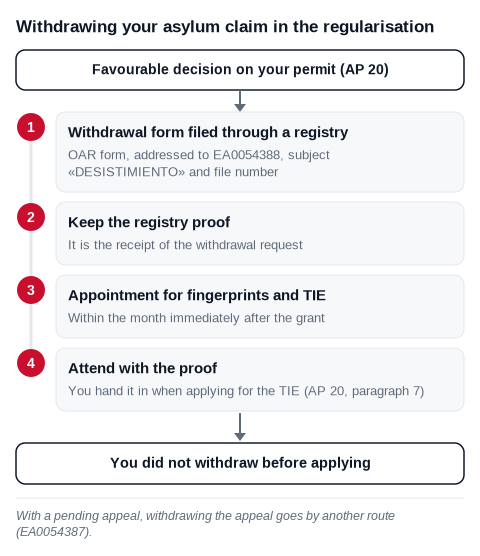
Steps
- Wait for the favourable decision on your permit (AP 20, paragraph 4; Ministry, questions 57 and 58). You do not withdraw before.
- Download the OAR withdrawal or renunciation form (PI) and fill it in in capitals: NIE without hyphens, file number, surnames and first name as in your claim, and your signature.
- Tick at least one box. The form offers three: withdraw the claim; renounce the refugee status or subsidiary protection granted; or withdraw the claim and, if already resolved favourably, renounce that status. AP 20 (paragraph 4) speaks of withdrawing the international protection claim.
- File it through a registry (electronic, registry assistance office or Correos) addressed to EA0054388, with the subject «DESISTIMIENTO» and your file number.
- Keep the registry proof or receipt. It is what you bring as the receipt of the withdrawal request. AP 20 (paragraph 7) asks for it when you apply for the TIE. The Ministry speaks of presenting the withdrawal «ante la Comisaría cuando se vaya a solicitar la TIE» (at the police station when the TIE is requested) (question 57).
- Book the fingerprint and TIE appointment on the immigration cita previa and attend with the proof, the decision and the rest of the documents, within the month immediately after the grant.
If you have a pending appeal. AP 20 (paragraph 4) speaks of withdrawing the appeal «que, en su caso, hubiere interpuesto y se encontrase pendiente de resolución» (that you may have filed and that is pending). Paragraph 7 asks for the receipt of the withdrawal request «o, en su caso, del recurso» (or, where applicable, of the appeal). The Ministry (question 58) says that withdrawal also goes with the final decision on the permit, when you apply for the TIE.
- Appeal of reconsideration (recurso de reposición): the OAR has its own page, withdrawal of the appeal. It is filed in writing and the Administration issues the corresponding decision. Route 1: the Interior Ministry e-office, which the OAR recommends. Route 2: the means in art. 16.4 of Law 39/2015 (electronic registry, Correos, consulates, registry assistance offices). Details: name and surnames as in the claim, NIE without hyphens, subject «DESISTIMIENTO DE RECURSO» and the file number. It is addressed to EA0054387 (Subdirección General de Asuntos Generales y Jurídicos de Protección Internacional).
- Judicial appeal (contencioso-administrativo, before a court): Law 29/1998, art. 74, allows withdrawing «en cualquier momento anterior a la sentencia» (at any time before the judgment). If a representative withdraws, the appellant must ratify it or have authorised it. The court clerk (letrado de la Administración de Justicia) gives the other parties 5 days. If they agree or do not object, it issues a decree ending the procedure and archiving the case. Withdrawal does not necessarily mean costs.
Minor children. According to the OAR:
- If you are the main applicant and extended the claim to minor children (family extension), you are the one who withdraws or renounces for them. Without an express indication, they are taken to withdraw on the same terms as you.
- To continue the minors' claim, say so in «Observaciones» and attach at that moment the submissions or supporting documents. Without them, the withdrawal is processed for the minors too.
- If the minor has their own file, or you only want to withdraw for one of the minors in a family extension, the father, the mother or the legal representative signs.
- The form lets you list the minors' file numbers and the option that applies.
- For each family member's regularisation application, the Ministry indicates one EX-31 form per person (question 26).
The red card while you wait. The OAR says the appointment to renew the documentation is requested through the icpplus application when it expires. The documents expire 9 months after the formalisation receipt is issued and one year after the red card is issued (renewal of documentation). It can be renewed at any authorised police station in the country, not only in your province (in Madrid, the Oficina de Asilo y Refugio, calle Pradillo 40). If the website causes problems, the OAR refers you to the Brigada Provincial de Extranjería y Fronteras of your province or the authorised police stations. Law 12/2009, art. 27, says withdrawal may be presumed when, within 30 days, the applicant «no compareciera para la renovación de la documentación» (did not attend to renew the documentation). It does not apply if they show it was for reasons beyond their will. AP 20 (paragraph 3) gives provisional authorisation to reside and work from the notice of start until the decision.
What happens next.
- Closure: according to the OAR, an explicit withdrawal of a claim leads to its closure (archivo) and ends the procedure. Law 39/2015 (art. 94.4) says the Administration «aceptará de plano el desistimiento» (will accept the withdrawal outright) and declare the procedure concluded. The OAR adds, on its processing page (PEMA section), that no appeal lies against the closure decision after an explicit withdrawal (Regulation (EU) 2024/1348, art. 67.1). That regulation applies from 12 June 2026 to claims within its scope (Interior instructions BOE-A-2026-12855 and 12856).
- Reception: art. 32.2.a) of RD 220/2022 lists the «desistimiento de la solicitud de protección internacional» (withdrawal of the international protection claim) among the grounds for withdrawing reception conditions.
- Permit: the AP 20 permit lasts 1 year (paragraph 10); what happens at expiry is in renewing the extraordinary regularisation.
Official source: OAR, withdrawal or renunciation request · RD 1155/2024 consolidated, AP 20 (BOE) · Ministry of Inclusion, 100 technical questions.
Informational only; check the official source and a professional for your specific case.
