
In short: Spanish nationality by option for children is the route for anyone who is or has been under the parental authority (patria potestad) of a Spaniard: you become Spanish with a declaration at the Registro Civil, without the years of residence that nationality by residence requires (art. 20.1.a of the Civil Code). The option lapses at age 20. For a child under 14 the legal representative makes it, from 14 to 17 the minor makes it with their representative, and from 18 the person makes it alone. If one of your parents was already Spanish when you were born, you do not need the option: you are Spanish by origin.
In person or by representative? It depends on age (art. 20.2 of the Civil Code). For a child under 14 the legal representative makes the declaration; if the parents disagree, a voluntary-jurisdiction procedure is opened. From 14 to 17 the minor declares, assisted by the representative. From 18 (or if emancipated) the person declares alone. The Registries that publish their lists (Córdoba, Canarias) ask for both parents to attend, or for one to bring a notarial power of attorney from the other; minors aged 14 to 17 go to the appointment with their parents. The law also allows the declaration before a notary (art. 68.3 of Law 20/2011).
Requirements
- Child of a Spaniard (art. 20.1.a): being or having been under the parental authority of a Spaniard. This is the route when a parent became Spanish later, for example by residence.
- Child of a parent who was originally Spanish and born in Spain (art. 20.1.b): no age limit (art. 20.3).
- Filiation, birth or adoption established after age 18 (art. 20.1.c, with arts. 17.2 and 19.2): there are 2 years from the date the filiation was established or the adoption was constituted.
- No legal residence for the child: art. 20 does not ask for it, unlike nationality by residence. Registries ask for the passport or residence card (the card only if the child has one) and empadronamiento.
- No mandatory lawyer: the declaration is made by the person concerned or their legal representative.
- Oath and renunciation: from age 14 you swear or promise loyalty to the King and obedience to the Constitution, and renounce your previous nationality, except for natives of Ibero-American countries, Andorra, the Philippines, Equatorial Guinea or Portugal and for Sephardim originating from Spain (arts. 23.b and 24.1). The acquisition only counts once it is registered at the Registro Civil (art. 23.c).
Deadlines
- Until age 20: the option lapses at age 20 (art. 20.2.c). If you turn 18 without being emancipated under your personal law, the period is extended until 2 years after emancipation. A person with a disability declares with the support they need (art. 20.2.d) and has 2 years from the end of the support measures that prevented it (art. 20.2.e).
- Close to the age limit: nationality is acquired by registration, which is constitutive (art. 23.c of the Civil Code and art. 68.1 of Law 20/2011). The parent has to have become Spanish while the child is still under their parental authority, that is, before the child turns 18 or is emancipated under their personal law (art. 20.1.a). If a parent takes the oath or is registered close to the child's 18th birthday (or emancipation under their personal law), ask your Registro Civil which date counts and book the appointment as soon as possible. The child's option lapses at age 20 (art. 20.2.c).
- If the period has passed: anyone who did not exercise the option in time can use nationality by residence with 1 year of legal, continuous residence immediately before the application (arts. 22.2.b and 22.3). Details in Spanish nationality by residence.
- Parents who became Spanish by residence: at the oath they must be expressly informed that children under their parental authority have the right to opt (DGSJFP Instruction of 22.12.2021, section IV). The oath itself is covered in Citizenship oath appointment.
Documents Each Registry publishes its own list. This is what the birth registration and option form of the Registro Civil Central and the Registries of Canarias and Córdoba ask for. Your office may ask for more: confirm the list before the appointment.
- Full (literal) birth certificate of the child (or of the person concerned), legalised or apostilled and translated if foreign. Validity periods vary: Canarias accepts 1 year for the foreign certificate, Córdoba asks for under 6 months.
- Full birth certificate of the Spanish parent (Canarias and Córdoba: under 6 months).
- Parents' marriage certificate, if any (Registro Civil Central).
- DNI of the Spanish parent and NIE or passport of the other parent.
- The child's passport with all pages and, if the child has one, the residence card.
- Joint empadronamiento certificate (Canarias and Córdoba: under 3 months).
- Córdoba also asks for the consulate certificate showing the child is registered with their nationality.
- Data sheet or declaration sheet of the Registry itself.
- Notarial power of attorney, if both parents cannot attend (in Canarias, under 1 year old).
Where
- Registro Civil of the home address of the person concerned or their representative, according to the Ministry of Justice.
- Appointment: the general Registro Civil appointment is booked on the Ministry of Justice electronic office (you need NIE, DNI or passport; SMS and email confirmations are sent). The Comunidad de Madrid uses its appointment system: for example, the Fuenlabrada office offers «Apertura de expedientes de nacionalidad» there. Which appointment type applies to the option at your Registry, confirm with them.
- Notary: art. 68.3 of Law 20/2011 allows option declarations before the head of the Registro Civil, a notary or a diplomatic or consular official. The DGSJFP Instruction of 22.12.2021 for notaries deals with nationality by residence; for the option, ask the notary's office beforehand which documents and deadlines they work with.
Cost A notary charges according to an official fee scale (arancel); ask for the amount beforehand. At the Registro Civil, confirm which fees or certificates they ask for. Birth certificates, their apostille or legalisation and the translation are at your expense.
Frequent cases
- My child and I are Spanish (the child's TIE): if one of the parents was already Spanish when the child was born, the child is Spanish by origin (art. 17.1.a) and does not need the option. What is needed is to register the birth at the Registro Civil (in Spain or at the consulate) and then apply for the DNI. If the child was born before the parent became Spanish, the child does need the option (art. 20.1.a). For what to do with the foreigner card in the meantime, ask at the Oficina de Extranjería or at the police station that issued the card.
- The child turns 18 soon: from 18 the child declares alone, and has until age 20, if the parent was already Spanish before the child turned 18. Keep the empadronamiento up to date and book the appointment now.
- Adult child: submits their own documents (their own full birth certificate showing the filiation and that of the Spanish parent).
- A different route: for descendants of Spaniards under the Democratic Memory Law there is another card (deadline closed in October 2025; files submitted in time continue to be processed): Spanish nationality and the Democratic Memory Law.
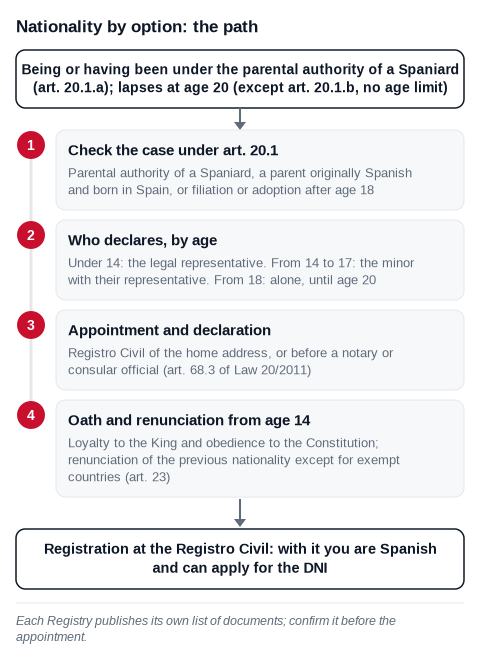
Steps
- Check which case of art. 20.1 the child fits and how old the child is (limit: 20).
- Gather the documents: full birth certificates (legalised or apostilled and translated), the Spanish parent's DNI, passports, empadronamiento and, if your Registry asks, the consulate certificate.
- Book an appointment at the Registro Civil of your home address through the Ministry's electronic office or your community's channel, or ask a notary's office.
- Attend with the documents. If the child is 14 to 17, the child comes with you; under 14, you declare as representative.
- The declaration is taken: from age 14, oath or promise and, where it applies, renunciation of the previous nationality.
- The nationality is registered at the Registro Civil; once registered you can apply for the Spanish DNI and passport.
Official source: Civil Code, arts. 17 to 23 · Law 20/2011 on the Civil Registry · Nationality by option, Ministry of Justice.
Informational only; check the official source and a professional for your specific case.
